
The usual advice, gate valves for slow flow and ball valves for quick shut-off, misses the decision that matters: will the valve provide safe, dependable isolation when your team needs it? A full-bore passage isn't the same as a reliable isolator. For UK OEMs and maintenance teams, the gate vs ball valve choice starts with operating duty, fluid compatibility, access and proof of shut-off, not the pipe size.
Gate vs Ball Valve at a Glance
Choose a gate valve for infrequent, full-line isolation, particularly buried waterworks duty. Choose a suitably rated ball valve for repeated operation where compact installation and visible position matter. Neither is an automatic substitute for the other.
A gate valve lifts its closure element out of the flow path through a multi-turn stem. A ball valve rotates a bored sphere through a quarter-turn. Those mechanisms affect operating effort, installation clearance and how confidently an operator can identify the valve's position.
Gate valve and ball valve compared
| Criterion | Gate valve | Ball valve |
|---|---|---|
| Operation | Multi-turn stem lifts a wedge or disc | Quarter-turn, 90 degrees, lever or gearbox |
| Fully open flow | Straight passage, low permanent loss | Full bore offers low loss close to pipe flow; reduced bore restricts |
| Throttling | Avoid; high velocity erodes seat and wedge | Standard ball is an isolator, not a control valve |
| Position | Often unclear, especially with a non-rising stem | Lever alignment normally shows open or closed |
| Close speed | Slow; can limit hammer on gravity lines | Fast; check hammer on long liquid lines |
| Best duty | Infrequent or buried isolation | Frequent cycling and compact installed plant |
| Indicative UK standards | BS 5163-1 and BS EN 1074 waterworks; BS EN 1171 cast iron; BS 5154 copper alloy | BS EN 13828 potable DN6–DN100; ISO 7121 steel; BS EN ISO 17292 industrial |
Match the duty before the connection
The table doesn't establish material compatibility, drinking-water approval or the pressure-temperature envelope of a particular product. Match the duty row first, then investigate the actual valve specification.
Don't confuse slower operation with suitability for low flow. A gate isn't a flow regulator, and a standard ball shouldn't be left partly open to balance a process. Equally, rapid operation isn't always desirable: slamming a ball valve shut on a long liquid line can generate damaging surge.
On a low-pressure gravity feed, a gate's gradual closure can be useful. On mains-pressure services, an idle gate can become the component that seizes or seeps when called upon.
Imported availability doesn't establish equivalence
The UK has a substantial international supply base: the IndexBox UK valve-market page records historical market context identifying the country as Europe's third-largest valve market and second-largest valve importer in 2016. That breadth of supply makes specification discipline more important, not less.
For a broader distinction between isolation and regulation, Yasu Trading Co. LLC's guide helps readers compare gate, ball, and globe valves. The purchasing rule remains straightforward: matching bore and PN markings doesn't prove technical or legal interchangeability.
How the Two Valves Are Built
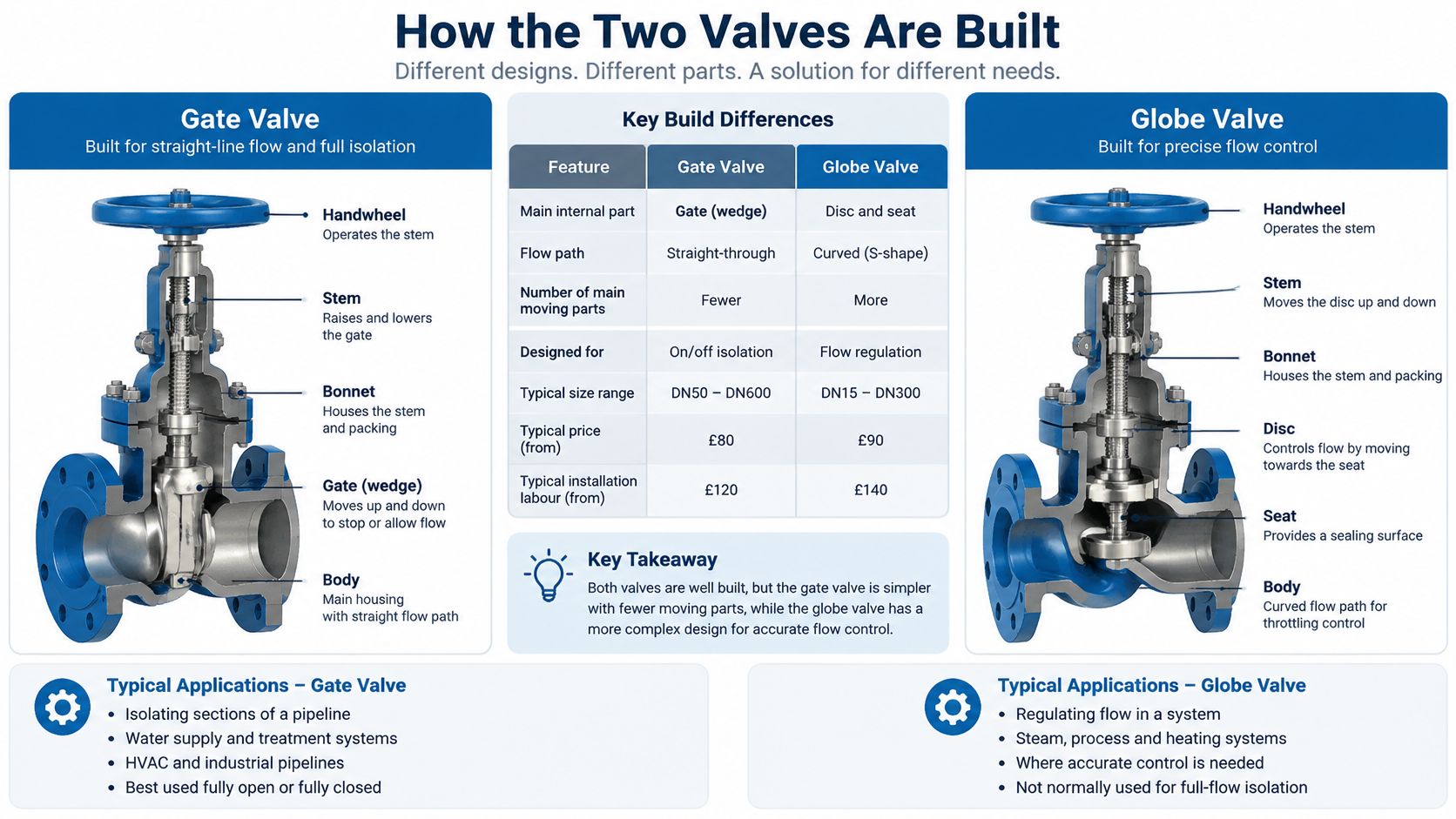
A gate valve's threaded stem drives a wedge or disc between guides in the body. Wedges may be solid, flexible or split; parallel-disc designs use a different seating arrangement. The stem, guides, packing and seating surfaces all influence whether the mechanism moves freely and closes properly.
The construction comparison provides a useful visual companion to the component descriptions.
Stem travel and ball support
A rising stem provides a visible indication of travel but needs clearance above the bonnet. A non-rising stem keeps the operating thread within the valve envelope, which suits chambers and low covers, but makes closure-element position harder to judge externally.
A floating ball is supported by its seats, with differential pressure helping press it against the downstream seat. A trunnion-mounted design supports the ball mechanically through its stem and lower trunnion, reducing the load carried directly by the seats. Trunnion designs become relevant as bore and pressure duty increase, although the manufacturer's design remains decisive.
- Full bore: Check the actual passage diameter against the connected pipe's internal diameter.
- Reduced bore: A smaller passage can reduce material and cost, but creates a restriction that matters on suction lines and with viscous fluids.
- Operator clearance: Include the lever's complete swing, gearbox access and gloved-hand clearance in the installation drawing.
The embedded video offers another view of valve operation.
Connections and replacement length
Small service valves may use BSP threaded, compression or solder connections. Larger process installations commonly use flanged connections, where flange drilling, facing and gasket selection must also match.
Nominal size doesn't establish replacement length. BS ISO 5752:2021 standardises face-to-face and centre-to-face dimensions for metal valves in flanged pipe systems, providing dimensional series rather than guaranteeing that every gate and ball valve is interchangeable.
Measure between the existing mating faces before ordering. Record stem type, bore, connection and operator envelope too, because a valve that fits between flanges can still be impossible to operate beneath a guard.
Flow Behaviour and Pressure Ratings
Compare valves in their intended operating positions, fully open or fully closed. Comparing a fully open ball with a partly open gate tells you little about a sensible installation.
A fully open gate and a correctly selected full-bore ball both provide relatively unobstructed passages. Neither has zero pressure loss, and the actual result requires the manufacturer's flow coefficient and the application's flow conditions. A reduced-bore ball introduces a smaller flow area, so it shouldn't be treated as hydraulically identical.
Open-flow performance isn't regulating performance
A partly open gate forces liquid through a narrow opening around the closure element. Local velocity and turbulence increase, exposing the gate and seats to erosion while giving the operator poor, unpredictable regulation.
A standard ball has a similar application boundary. Its partly exposed seat edges aren't a substitute for the characterised trim of a control valve. If the process needs a controlled flow rate, specify a suitable regulating device rather than relying on lever angle.
Our explanation of full-bore valve selection helps separate passage size from valve type. For engineering calculations, request the actual bore and flow coefficient instead of accepting full bore as a complete performance specification.
Practical rule: Select the flow passage for acceptable running loss, then select the seats and operating arrangement for dependable isolation.
Pressure ratings belong to a service envelope
For building potable-water service, BS EN 13828:2025 covers manually operated copper-alloy and stainless-steel ball valves from DN6 to DN100, rated PN10 or PN16, with a maximum distribution temperature of 65°C and excursions to 90°C for up to one hour. It addresses mechanical, hydraulic and acoustic performance, testing and marking.
Those limits aren't permission to use a building-water valve on a hotter heating circuit. If the operating conditions exceed that scope, obtain a valve explicitly specified for the actual duty.
Copper-alloy gate valves have a different specification route: BS 5154:1991 defines design, materials, ends, testing and marking, with two series having different maximum temperature ratings; BSI also identifies ISO 7121:2016 for general-purpose industrial steel ball valves. Their test regimes and service categories aren't interchangeable.
A PN stamp alone doesn't qualify a waterworks gate for hot oil or an industrial ball for drinking water. Body strength is only part of the selection; seats, packing and fluid compatibility can establish more restrictive limits.
Before accepting a substitution, check:
- Medium: Identify the fluid and any contamination or cleaning chemicals.
- Temperature: Include normal operation and credible excursions.
- PN or Class: Verify the manufacturer's pressure-temperature rating.
- Bore: Confirm the actual passage, not just the connection size.
- Standard: Obtain the applicable designation on the body, datasheet or certificate.
Match Each Valve to Its UK Duty
Buried water-main isolation favours the waterworks gate. BSI's BS 5163-1 guidance covers predominantly key-operated, flanged cast-iron gate valves complying with BS EN 1074-1 and BS EN 1074-2, primarily for underground waterworks and water intended for human consumption. Specify that established pattern for the duty, not an accessible plant-room valve placed in a chamber.
Which valve to specify by duty
| Duty | Specify | Why |
|---|---|---|
| Buried water-main isolation | Key-operated cast-iron gate to BS 5163-1 | Infrequent, full-line, flanged waterworks pattern |
| Frequent or emergency shut-off with visible position | Full-bore ball | Quarter-turn and obvious lever state, with closure speed assessed |
| Low-pressure gravity feed where hammer matters | Gate, closed slowly | Multi-turn travel helps limit surge |
| Mains-pressure building stop or servicing valve | Ball to BS EN 13828 if approved | Less prone to seize than an idle gate; check the standard’s temperature limit |
| Throttling a flow rate | Neither standard gate nor ball | Use a control or flow valve |
| Hydraulic oil on mobile or industrial plant | Inline circuit or CETOP manifold valve | Plumbing isolators aren’t oil-circuit components |
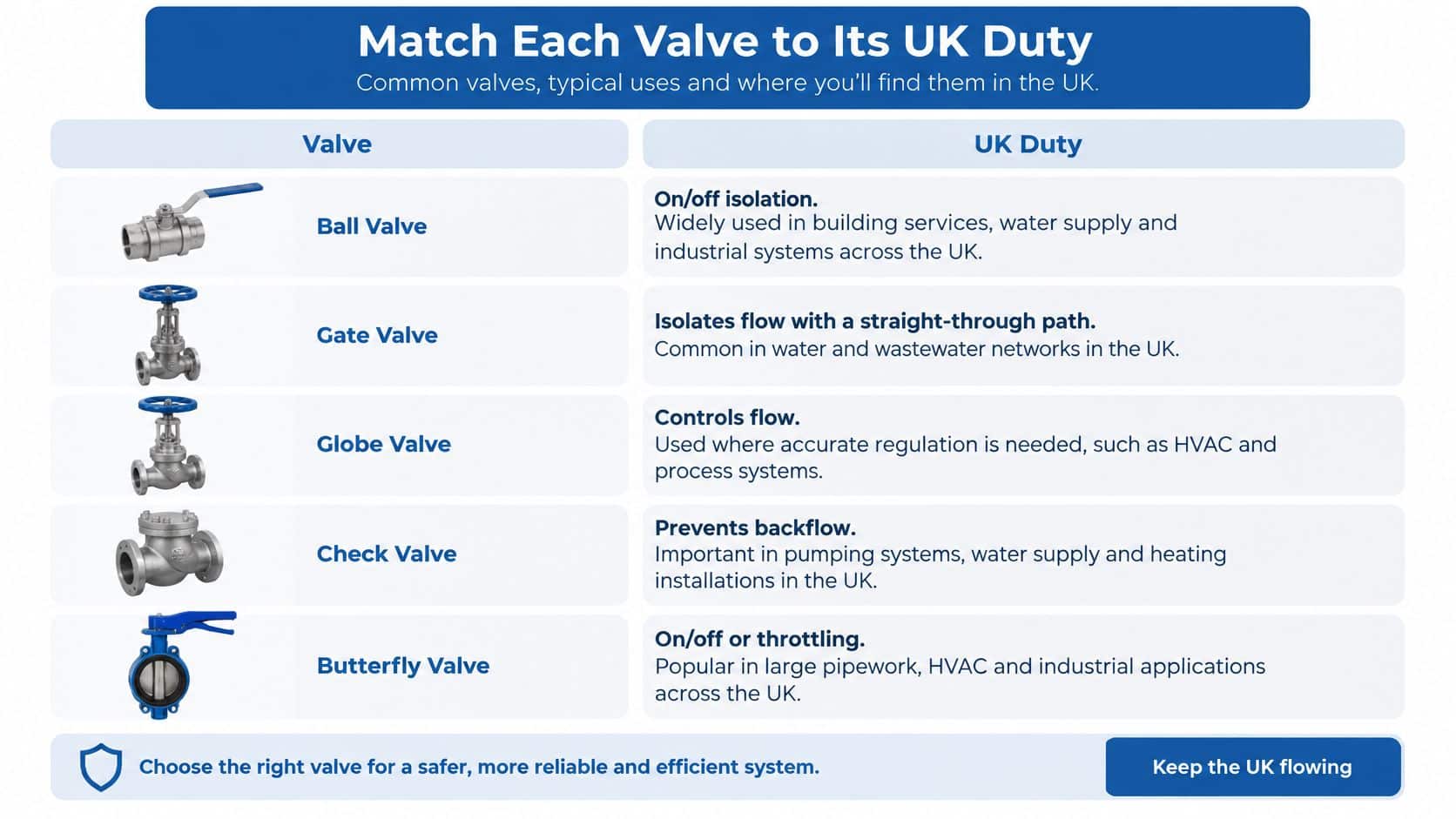
The wider range of valve duties is summarised visually below.
Buildings, factory services and mobile plant
Building servicing valves need suitable body and seal materials, accessible operation and evidence of drinking-water suitability. Actuation's valve-selection guidance identifies the Water Supply (Water Fittings) Regulations 1999 as governing domestic plumbing in England and Wales, and WRAS approval as commonly used evidence of suitability for wholesome water; it also distinguishes BS EN 1171:2015 cast-iron gates from BS EN ISO 17292 industrial balls.
For the practical replacement sequence, Erica's Plumbing, Air Conditioning & Restoration discusses replacing a main water shutoff valve. Use it as procedural context, not as a substitute for UK approval requirements.
On factory skids, favour a full-bore ball where operators cycle an isolator regularly and need an obvious operating position. Retaining a suitable gate can make sense on a large, rarely isolated service where the pipework already accommodates its installation length.
Mobile plant needs another check: the lever must clear guards, hoses and cab structures. For agricultural fluids, verify compatibility with slurry or fertiliser and assess frost exposure rather than assuming a water-service valve is suitable.
Keep hydraulic circuits in their own category
Our high-pressure ball-valve guidance addresses selection for demanding isolation duties, but a ball isolator doesn't replace a directional, load-holding or pressure-control valve.
We stock the full OMT Group inline circuit valve range, Hoyea CETOP directional and proportional solenoid valves, CETOP modular valves and a range of Orta valves. Our lines include Hoyea CETOP 3, 5, 7 and 8, Hoyea Modular Valves, Oleoweb Hydraulic Valves and Components, Taicin Valves, and ORTA Manual and Diverter Valves.
OMT Group options include cross relief, flow divider/combiner, overcentre, pilot operated check, pressure reducing, priority flow control, pump unloader, relief, sequence and solenoid valves. Choose the circuit function first, then the pressure, flow, ports and mounting.
What UK Catalogues Charge in 2026
Small brass and steel service valves are retail components. Flanged waterworks gates, process balls and hydraulic-circuit valves are specified purchases, so a domestic fitting's shelf price isn't a useful quotation benchmark for industrial plant.
The UK catalogue figures below are in GBP including VAT, for the products as listed on pages updated in 2026. They aren't installed prices or conversions from dollar examples.
UK catalogue prices in GBP including VAT, 2026
| Listed product | Price (GBP inc. VAT) | What it represents |
|---|---|---|
| Gate valve, The Hosemaster | From £10.68 | Small service valve, 2026 catalogue; the same catalogue lists the red steel ball below |
| Red steel ball valve, The Hosemaster | From £8.71 | Small service ball, 2026 catalogue |
| 28 mm brass gate valve, Travis Perkins | £10.26 | Domestic-size brass gate, 2026 catalogue |
| Ball valves, Compel Group | £85.99 to £158.99 | Equipment-catalogue range of 12 products, page updated 2026 |
Compare specifications, not valve labels
That spread doesn't establish that a gate costs more or less than a ball. The listed products aren't a controlled like-for-like comparison, and the operating principle alone doesn't determine the price.
A useful enquiry specifies:
- Size and rating: DN, PN or Class, and the required operating envelope.
- Wetted materials: Body, ball or gate, seats, packing and elastomers.
- Flow passage and ends: Full or reduced bore, threads, compression fittings or flange details.
- Documentation and operation: Required approvals, traceability, lockable operator and actuation.
For oil-circuit purchasing, our hydraulic-valve price guide gives a more relevant starting point than a plumbing shelf tag. Request a quotation against the actual circuit function rather than searching by connection size alone.
Include the replacement work
A low purchase price won't recover the labour spent draining a service, altering pipework around a length mismatch or correcting an unsuitable potable-water installation. Add access, isolation arrangements, commissioning and documentation to the comparison.
Maintenance costs differ too. A gate may need planned exercising and attention to packing, while a frequently cycled ball may need seat servicing or replacement after operator damage.
Separate a small, like-for-like service replacement from a specified line valve. The former may be a catalogue purchase; the latter needs a documented specification and a quotation that identifies exactly what's included.
Failures Maintenance Teams Actually See
A seized gate isn't a low-loss valve in any useful operational sense. If the stem won't move the wedge fully clear, or the seats won't meet, the nominally straight passage tells the maintenance team very little.
After prolonged inactivity, deposits can obstruct threads and guides, packing can resist movement, and contamination can prevent even seating. BuildWiz's stop-valve guidance describes mains-pressure gate valves as prone to seizing and seepage, while explaining the requirement for sectional stop valves and servicing valves that permit maintenance without draining the whole system.
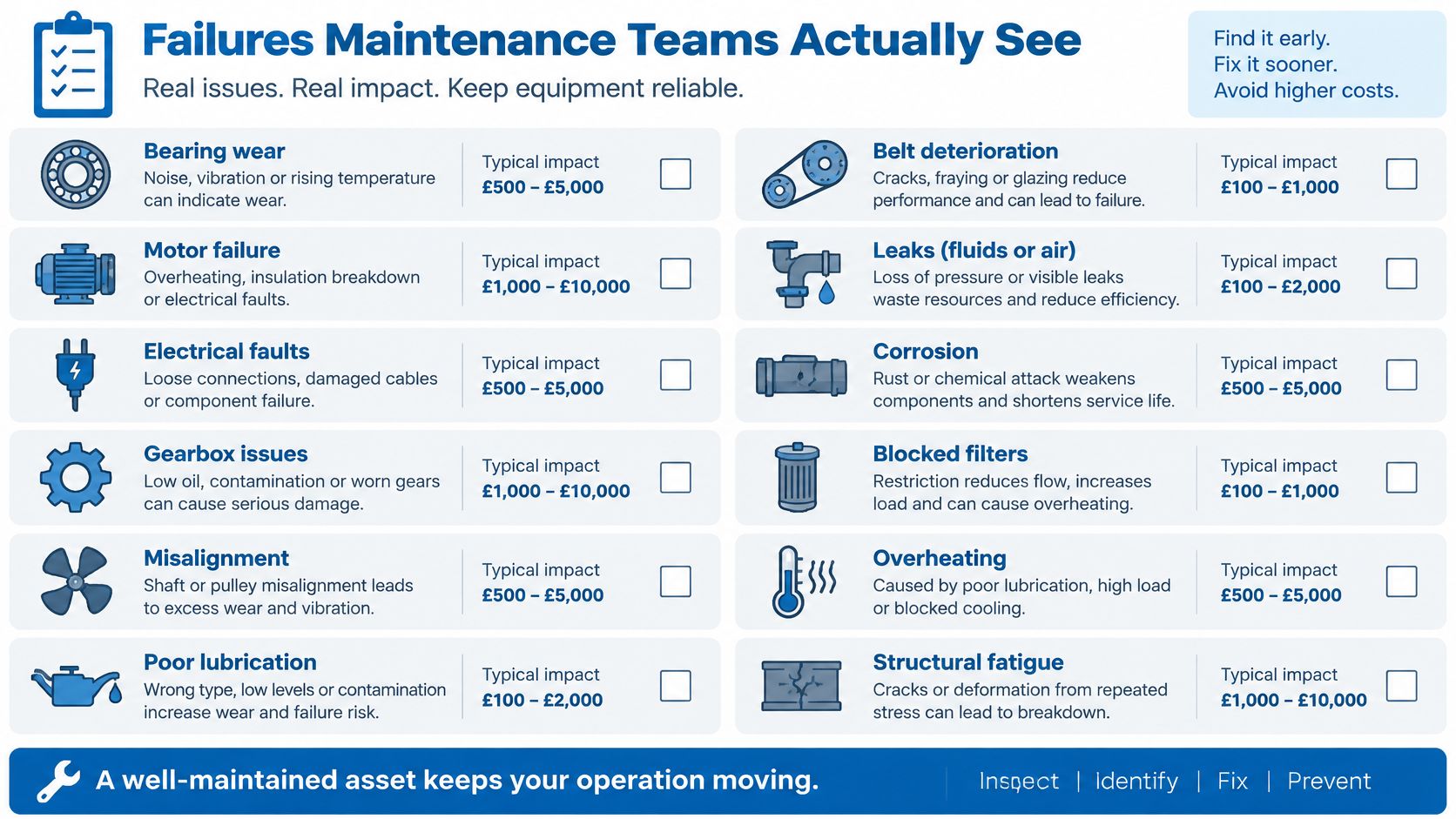
The maintenance checklist highlights the need to assess more than opening speed.
Visible position isn't proved isolation
A ball valve fails differently. Damaged seats can pass fluid despite a closed handle, while a damaged stem or loose handle connection can undermine the apparent position indication. Paint, impact damage and operators using levers as footholds create avoidable problems.
A reduced-bore valve can also be mistaken for a pipe blockage when the actual issue is an unsuitable replacement specification. Leaving a standard ball partly open to trim flow adds seat wear without providing dependable regulation.
A closed handle is an instruction to verify isolation, not evidence that the pipe is safe to open.
Build the maintenance routine around consequence
- Classify the duty. Identify emergency isolators, seldom-operated service valves and valves cycled during normal production. Give critical isolators a documented inspection and proving requirement.
- Exercise idle gates under controlled conditions. Plan full travel when the service can tolerate interruption. Don't discover an immovable stem during an incident, or force it with an improvised extension.
- Prove shut-off before breaking containment. Follow the site's isolation procedure, release stored pressure safely and verify the isolated section. Account for accumulators, gravity head and trapped liquid.
- Lock and tag the operating device. Use a suitable lockable lever, handwheel arrangement or actuator isolation so another trade can't restore the supply inadvertently.
- Replace a valve that won't seal. For routine service replacements, don't rely on improvised seat lapping. Record DN, ends and face-to-face dimensions before removal, then retain the replacement's identification.
Accessibility deserves the same attention as the mechanism. Modern Bathrooms' bathroom fitting considerations for Dublin renovations provide a building-layout perspective, but the plant-room lesson is specific: don't conceal servicing valves behind fixed finishes or equipment.
A buried key-operated gate can be correctly accessible for its duty. A compact ball trapped behind a guard without room to turn its lever isn't.
Confirm the Specification and Order
Start with the duty, then assemble a specification that lets procurement compare genuine equivalents. A photograph helps identification, but it doesn't replace operating data. An unreadable nameplate shouldn't become permission to guess.
For a pipework valve, record:
- Nominal bore and connections: DN, PN or Class, end connection and flange details.
- Operating conditions: Fluid, working temperature, maximum working pressure and credible surge conditions.
- Compliance evidence: The applicable valve standard and any required potable-water approval, supported by documentation.
- Operation and access: Cycle frequency, position indication, lock-off requirements and available lever or gearbox clearance.
- Replacement dimensions: Face-to-face length, centreline position and stem headroom, measured before removal.
Send circuit data for hydraulic valves
For hydraulic equipment, include pressure, flow, port size and mounting pattern, plus the function the valve must perform. Identify whether you're isolating a line, directing an actuator, holding a load or controlling pressure. Those are different requirements, even when the components have similar-looking ports.
We offer Orta manual spool and diverter valves, Hoyea modular check, flow control, reducing and relief valves, and Luen cartridge valves. That gives the enquiry a functional starting point rather than treating a plumbing gate or ball as a substitute for an oil-circuit component.
Don't approve a replacement solely because it screws into the pipe. Confirm the medium, rating, documentation and physical fit, then retain the final specification with the maintenance record.
MA Hydraulics Ltd offers hydraulic valve ranges and component-selection support for mobile and industrial applications, helping you distinguish pipe isolation from the circuit function you need. Visit MA Hydraulics Ltd, phone 01724 279508 today, or send us a message with the DN or port size, fluid, operating pressure and a photograph of the nameplate.
