
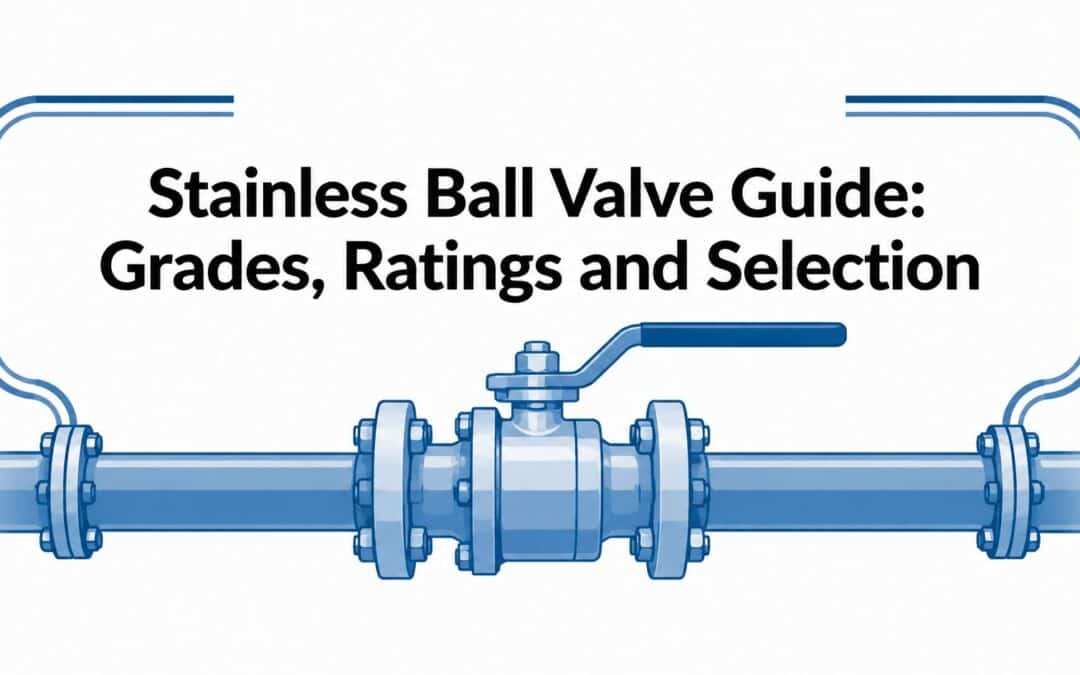
You're replacing a weeping isolation valve on a washdown line, the stores list just says stainless, and three suppliers are quoting three different grades at three different prices. That word on the label tells you almost nothing useful. A stainless ball valve that lasts for years in clean ambient water can pit through its seats in months on brackish water, and a valve rated for high pressure at room temperature can be wrong for a hot line once surge is added.
I would treat stainless as the starting point, not the answer. Check grade, chloride level, temperature, pressure class, crevice risk and conformity documents together, in that order, before you raise the purchase order.
Grade Choice by Fluid and Chloride Level
Grade decides whether the valve survives the fluid, so start here rather than with size or price. The table below gives you the working split used for most UK water, washdown and process duties.
| Grade | Chloride guidance | Typical duty |
|---|---|---|
| 304 (1.4301) | Generally suitable below about 200 mg/L chloride, crevice corrosion rare below about 200 ppm | Potable and general ambient water |
| 316 (1.4401) | Crevice corrosion rare below about 1,000 ppm chloride | Washdown, brackish or saline exposure |
| 316L (1.4404) | Same chloride guidance as 316, low carbon for welding | Welded bodies and process pipework |
| Duplex 2205 (1.4462) | Higher chloride resistance than 316, confirm limit with supplier | Higher-stress, higher-chloride duty |
When 304 Is Enough
For flowing, ambient-temperature water, 304 is the sensible default and usually the lowest-cost stainless option in GBP terms. The British Stainless Steel Association guidance on stainless steels in water supply and waste water treatment states that 304 stainless steel is generally suitable for most flowing, ambient-temperature water systems when chlorides are below 200 mg/L, and that crevice corrosion is rare below approximately 200 ppm chloride for 304 and 1,000 ppm for 316. Don't stretch that guidance to stagnant lines, hot water or chemical dosing points. It describes flowing water at ambient temperature, and that's the envelope you should hold it to.
If the same circuit also needs non-return protection, match grades across components rather than mixing blindly, for example when you specify a stainless check valve alongside the isolation valve. A 316 ball valve upstream of a lower-grade fitting doesn't protect the weaker part. It just moves the failure point.
When to Step Up to 316, 316L or Duplex
Choose 316 or 316L where you have washdown chemicals, brackish water, coastal air, road-salt splash on mobile plant, or water chemistry nobody can confirm. Uncertainty is a reason to step up, not a reason to guess low. 316L is the low-carbon version of 316, and it's the right call for welded bodies and process pipework because the weld zone keeps its corrosion resistance better after welding.
Duplex 2205 suits higher-chloride or higher-stress duty where 316 is being pushed, but don't assume a generic limit. Get the supplier's chloride and temperature limit for that specific valve in writing, because seat material and body casting quality matter as much as the alloy name.
Practical rule: Specify the grade from the worst-case chloride and temperature the valve will see, not the nominal figure on a tidy datasheet.
Why Grade Alone Doesn't Save a Bad Installation
These grades rarely fail by uniform wall thinning. They fail by localised crevice attack, usually where liquid sits trapped and oxygen can't replenish the passive layer. Trapped liquid behind the seat, a damaged seat face, contaminated threads, or a poorly drained dead leg can start that attack even when a bulk water sample looks benign.
That's why a ball valve is a higher-risk shape than straight pipe. It has cavities, seat pockets and a stem gland by design. Minimise stagnant cavities, keep surfaces clean, drain lines that sit idle, and don't leave chloride-bearing cleaning chemical sitting in a closed valve over a weekend.
Run three checks before you order:
- Get the actual chloride figure: Ask for a water analysis in mg/L or ppm, don't accept descriptions like clean or hard.
- Record the operating temperature: Note normal and worst-case temperature at the valve, because warm chloride water is far more aggressive than cold.
- Note the flow regime: State whether the line flows daily, sits stagnant, or gets drained between uses.
If you can't answer those three points, I would default to 316L and a design you can drain and inspect. The price gap is small against one unplanned shutdown to cut out a pitted valve.
Pressure and Temperature Ratings to Check
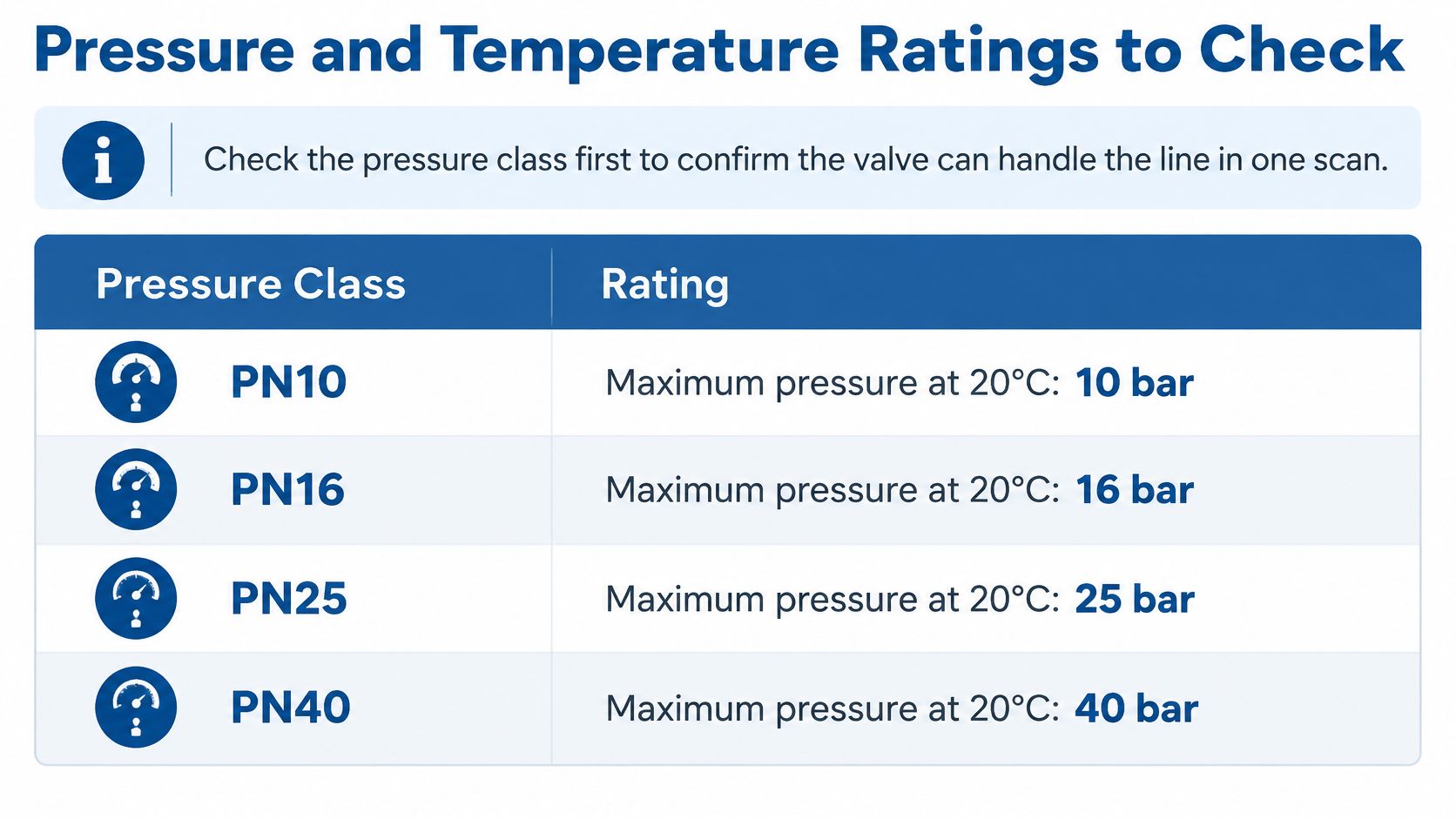
Check the pressure class first to confirm the valve can handle the line in one scan, then check what temperature does to that figure. The infographic and table below use the reference condition most buyers quote, 20°C.
| Pressure class | Maximum pressure | Typical duty |
|---|---|---|
| PN10 | 10 bar at 20°C | Low-pressure building and utility services |
| PN16 | 16 bar at 20°C | General industrial and building services |
| PN25 | 25 bar at 20°C | Process and hydraulic lines with derating at temperature |
| PN40 | 40 bar at 20°C | Higher-pressure industrial circuits |
For pipework drawn to North American specifications you'll also see ASME Class 150 at 19.6 bar at 38°C. Don't treat that as interchangeable with PN16 or PN25 just because the numbers look close. Flange drilling, facing and the rating basis differ, and mixing systems creates ordering errors that only show up on site.
The 20°C Figure Is Only the Starting Point
Ratings fall as temperature rises, and seat materials often limit the valve before the stainless body does. A PTFE-seated valve on a hot process line can lose its usable pressure rating well before the body casting is stressed. Always read the pressure and temperature curve for the exact seat and seal combination, not the headline PN class stamped in a catalogue summary.
Say a line runs at 90°C with regular thermal cycling. A valve sold as PN40 may still be the wrong choice if its derated limit at that temperature, with those seats, leaves no margin for surge. Ask for the curve and mark your operating point on it.
Surge, Ductility and Brittle Failure
Pressure integrity isn't only about steady running pressure. The Pressure Equipment (Safety) Regulations 2016 state that a pressure surge is generally required to remain within 10% of the maximum allowable pressure unless another justified value applies, and set a ductility benchmark for steel in relevant pressure equipment of at least 14% elongation after rupture in a standard tensile test and at least 27 J impact energy using an ISO V test piece at the specified test temperature.
In plain terms, the body, end connections and pressure-retaining parts must absorb surge and cold conditions without cracking. A valve that opens and closes smoothly on the bench can still be a poor pressure boundary if the material is brittle at winter temperatures or the end connection is the weak link.
Confirm three things on every enquiry:
- Design pressure plus surge: State both figures, not just normal working pressure.
- Temperature at the operating point: Give normal, maximum and minimum temperatures in °C.
- End connection rating: Check the flange, thread or fitting rating matches the valve body rating.
A stainless ball valve rated at 40 bar at 20°C isn't automatically suitable for 40 bar in service. Temperature, seats and surge decide that.
Body Styles and Bore Choice
Body style decides how you'll maintain the valve in three years' time, so choose it before you fix the connection. Bore decides pressure drop. Both choices are cheap to get right now and expensive to reverse once pipework is welded in.
- One-piece body: The simplest and lowest-cost build. You can't service the internals in line, so the valve must be cut out for seat or ball work, which suits lines that rarely need attention.
- Two-piece body: The most common build, with a main body and an end cap. Removing the cap gives access to the ball and seats while the body stays in the pipe, giving a good balance of cost and serviceability.
- Three-piece body: The centre section lifts out while both ends stay in line. I would choose this for frequent maintenance, hygienic cleaning, or any welded line where you'll need the valve out later without cutting pipe.
Full Bore or Reduced Bore
Full bore gives a flow passage close to the pipe inside diameter. It keeps pressure drop low, suits long runs and pumped lines, and allows pigging where that's part of the cleaning regime. The trade-offs are higher cost, a larger body and higher operating torque, and those points are worth reviewing against the options listed under full bore valve duties before you standardise on one pattern.
Reduced bore is typically one pipe size smaller through the ball. It's more compact and cheaper, but it adds pressure drop and restricts pigging. Use it on short branches, drains and isolation duty where flow is low and pressure drop doesn't penalise the pump.
One link matters between body and connection. Butt-welded lines usually need a three-piece body, because that's what lets you remove the centre section for welding and later service without disturbing the welded ends.
End Connections and Actuators to Specify
Choose the connection by size, duty and how often the valve must come out. A connection that's perfect on a small instrument line becomes a liability on a large line you strip every shutdown.
| Connection | Typical size | Best for | Check before fitting |
|---|---|---|---|
| Threaded BSP | DN6 to DN50 | Small-bore utility and instrument lines | Galling on stainless threads, sealant compatibility |
| Flanged to EN 1092-1 | DN15 to DN200 | Large bore and frequent removal | Gasket material, bolt tightening |
| Butt-weld | DN15 to DN150 | Permanent, high-integrity process pipework | Weld preparation, heat tint control |
| Compression or tube fitting | 6 to 25 mm tube | Instrument and sampling lines | Square tube cut, re-tightening after thermal cycles |
Stainless threads need care. They gall readily, especially stainless into stainless assembled dry and fast, so use a compatible anti-galling compound or sealant approved for the fluid, and don't use a sealant that contaminates potable water or process product. On flanged joints, specify the gasket material for the actual fluid and temperature, then tighten bolts evenly in a cross pattern so the flange faces pull up square.
For butt-weld ends, plan weld preparation and purge arrangements before the valve arrives, and control heat tint afterwards because heavy tint marks a weakened passive layer. Compression fittings need square-cut, deburred tube and a re-check after the first thermal cycles, since small movements show up early on sampling lines.
Actuator Choice by Duty
- Manual lever: Simple isolation with quick visual status from the handle position. Best where the valve is accessible and operated occasionally.
- Gear operator: Use where lever effort gets too high, typically larger bores and higher pressures. It slows operation, which also reduces surge from slamming a large valve shut.
- Pneumatic actuator: Remote or repeated cycling, with spring return where you need fail-safe positioning on air loss. Check available air pressure against the torque requirement at worst-case differential pressure.
- Electric actuator: Use where compressed air isn't available. Confirm power supply, duty cycle and running time, because an electric unit cycling too often will overheat or trip.
If you're automating, compare torque, mounting interface and fail position against a purpose-built actuator ball valve rather than bolting an actuator onto a manual valve and hoping the stem and bracket suit. Undersized actuators stall part-open, oversized ones damage seats and stems.
Choose the connection first, then the actuator that matches torque and cycle count, and confirm both on the datasheet before ordering.
Where Stainless Ball Valves Are Used
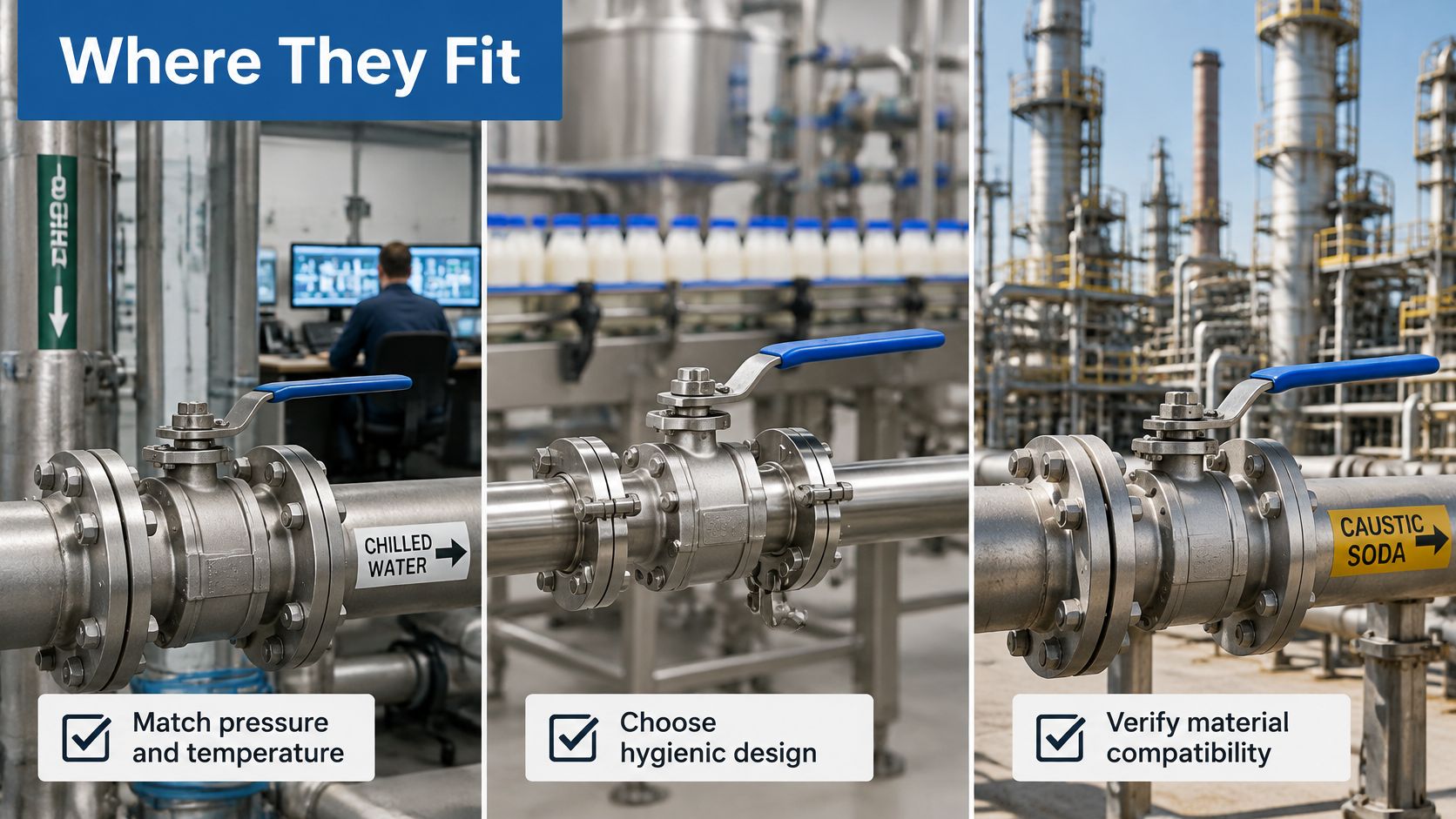
Installed examples show how the same basic valve ends up specified very differently once the duty is pinned down.
Building Water Circuits
The deciding check is potable-water suitability, not a generic pressure or temperature claim. The BSI product page for BS EN 13828:2025 states that the standard covers manually operated stainless-steel ball valves from DN6 to DN100 for PN10 or PN16 systems, with a maximum distribution temperature of 65°C and short excursions to 90°C permitted for no more than one hour. Confirm the distribution temperature at the valve and any excursions, and use threaded or compression ends where building pipework sizes suit them.
A related point crops up on drinks and dispensing lines, where handle position and shut-off clarity matter to operators, and the tap handle advice from Carbon 6 Brewing is a useful reminder that the handle is part of safe, repeatable operation, not decoration. If staff can't see at a glance whether a valve is open, you'll get operating errors.
The short video below is useful for showing operators what correct quarter-turn operation and handle alignment look like before they work on a live building circuit.
Agricultural and Washdown Duty
Dairy, livestock and wash bays expose valves to chloride-rich cleaning chemicals and repeated hosing, inside and out. 316 with clean, drained cavities is the usual step up here, and flanged or three-piece threaded bodies make seat changes realistic during short shutdowns. The deciding check is the chloride level in both the process fluid and the cleaning regime, including how often the line is drained.
Mobile and Process Plant
Sample points, drains and isolation valves on mobile and process plant must hold under vibration with limited access. Compression or threaded connections suit small sampling lines, provided tube is supported so vibration doesn't work the fitting loose. The deciding check is vibration level and access for maintenance, because a correctly rated valve nobody can reach or operate won't get maintained.
UK Standards Behind a Valve Specification
A stainless ball valve on a pressurised UK line isn't just a mechanical component you pick from a shelf. The UK government guidance on the Pressure Equipment (Safety) Regulations 2016 for Great Britain states that the regulations apply to pressure equipment and assemblies with a maximum allowable pressure above 0.5 bar, covering pressure accessories such as industrial valves used in pressurised piping systems, and identifies EN 1983:2013 for industrial steel ball valves and EN 12266-1:2012 for testing metallic valves including mandatory pressure-test procedures and acceptance criteria.
That 0.5 bar threshold catches most industrial, process and mobile-equipment installations. Once you're above it, documented pressure integrity and traceable testing are part of the purchase, not paperwork you chase after delivery.
| Standard | Scope | Why it matters |
|---|---|---|
| Pressure Equipment (Safety) Regulations 2016 | Pressure equipment and assemblies above 0.5 bar maximum allowable pressure | Sets conformity and marking duties in Great Britain |
| EN 1983:2013 | Industrial steel ball valves | Designated standard for pressure equipment placed on the GB market |
| EN 12266-1:2012 | Testing of metallic valves | Pressure-test procedures and acceptance criteria |
| BS EN 13828:2025 | Manually operated stainless-steel ball valves, DN6 to DN100, for potable water in buildings | Material, test and marking requirements for building water services |
The Practical Baseline for Buyers
Check pressure rating, intended fluid, temperature range, materials and conformity documentation together. A pressure-test certificate without material traceability leaves a gap, and a material certificate without test evidence leaves a different one. Ask which standard the valve was designed to, which standard it was tested to, and what documents arrive with it.
Equipment below the applicable regulatory limits isn't exempt from safe design either. It must still be designed and manufactured according to sound engineering practice and supplied with adequate instructions. Your file should let a competent person reviewing the installation later see what was fitted, why it was suitable, and how it was tested.
Ordering rule: For a pressurised line above 0.5 bar, request the test and conformity documents before the purchase order is raised, not after the valve lands in goods-in.
Note also that a standalone valve can become part of a larger assembly, such as a hydraulic power pack or manifold build. When that happens, the assembly documentation needs to cover the valve as fitted, with its rating and fluid compatibility assessed at system level. A technically suitable valve can still make the complete installation non-compliant if instructions, testing or examination arrangements were overlooked.
Maintenance That Keeps Seals and Stems Working
Most stainless ball valve failures I would expect in service are seal, seat and stem problems, not body failures. The infographic below summarises the service sequence, and the numbered routine after it gives you the detail to run on site.
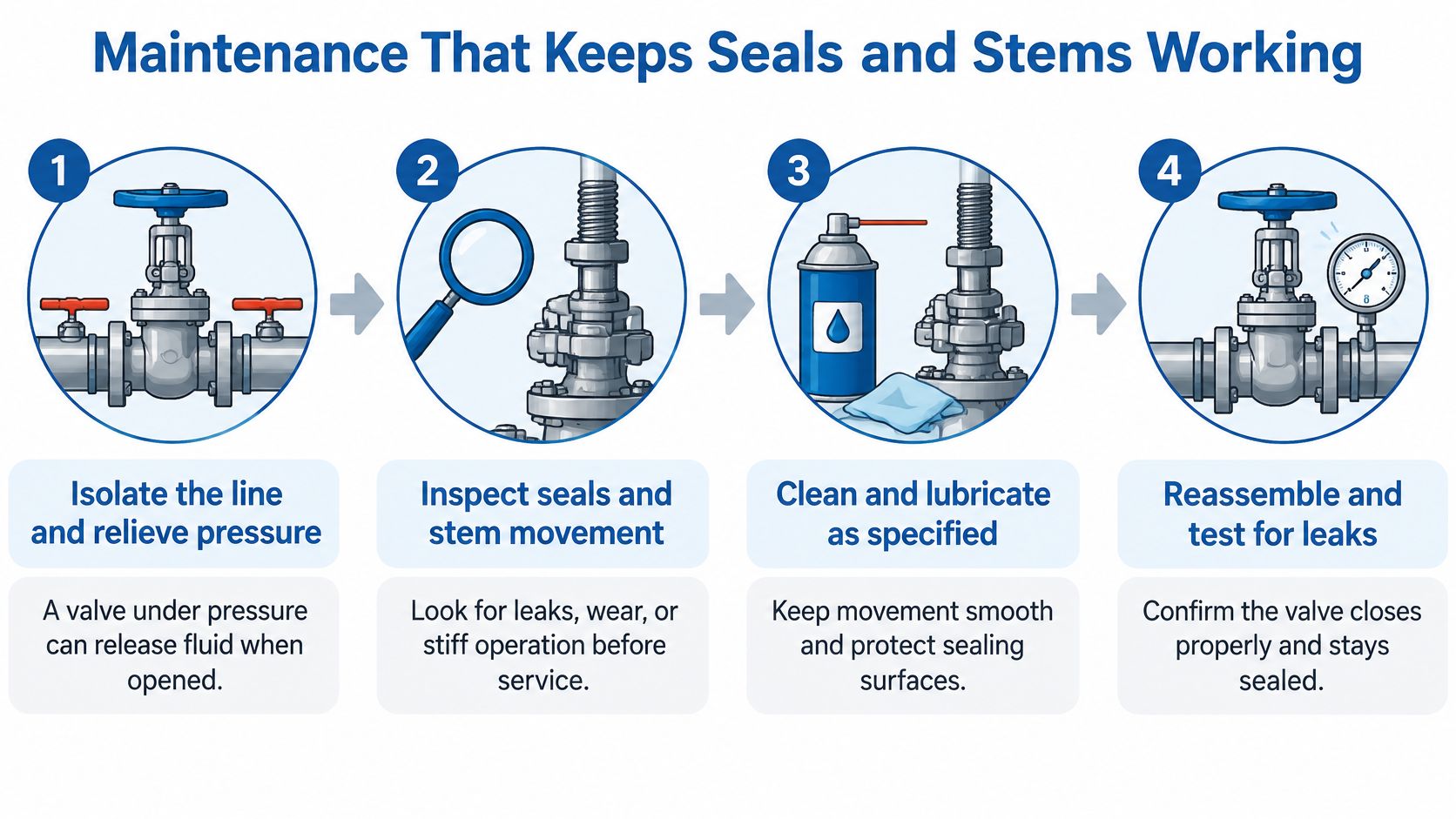
- Isolate the line and relieve pressure: Close the nearest upstream and downstream isolation, then vent safely. A valve under pressure can release fluid suddenly when the gland is loosened.
- Confirm the line is drained, including the cavity: Crack the valve part-open as the manufacturer's instructions allow so trapped liquid escapes. Trapped fluid drives crevice attack in service and can freeze and split a body in winter.
- Inspect the stem gland for weeping: Tighten the gland nut only as far as the leak stops, in small increments, cycling the valve between adjustments. Over-tightening wears the stem, raises operating torque and can stall an actuator.
- Check handle or actuator travel: Confirm free movement through the full 90-degree travel with positive stops at open and closed. Stiffness, grating or a spongy stop suggests debris, seat swelling or seat wear.
- Examine the ball and seats: On a serviceable body, look for scoring, deposits or chemical attack on the ball surface and seat faces. Replace the seats rather than the whole valve when the leak is at the seat and the ball is undamaged.
- Clean threads and flange faces: Remove old sealant and contamination, then refit with a compatible sealant or a new gasket of the specified material. Contaminated threads are a common cause of leaks blamed wrongly on the valve.
- Record tag, date and findings: Log what you found and what you changed against the valve tag. Repeat faults then show a pattern, such as one line eating seats because of abrasive particles or chemical attack.
Signs of a Healthy Valve
A healthy valve operates smoothly with consistent torque, shows no weeping at the gland or body joints, shuts off cleanly, and drains clean after washdown. Exercise valves that sit open for months, because a stainless ball valve that's never moved is the one that won't move during an emergency isolation.
Set a clear replacement trigger so fitters aren't guessing. Mine is simple: any leak that returns after one correct reseal means strip and inspect properly, and replace the valve if the ball or body sealing surfaces are damaged.
Enquiry Brief and Next Step
A supplier can quote the right valve first time if your enquiry contains five things in one message. Missing any one of them usually means a round of questions while your line stays down.
- Fluid and worst-case chloride level: Name the fluid, give the chloride figure where water-based, and state the operating temperature range in °C.
- Design pressure with surge margin: Give normal and design pressure in bar, plus the pressure class you're specifying.
- Size, bore and connection: State nominal size, full or reduced bore, body style, and the end connection including the mating flange standard or fitting type.
- Actuator requirement: State manual, gear, pneumatic or electric, with torque or differential pressure, expected cycle count, fail position and power or air supply where relevant.
- Application: Say whether it's potable water, washdown, process or mobile plant, so the correct conformity and test documents can be supplied with the valve.
Valve lines available through us include Hoyea Cetop 3, 5, 7 and 8 valves, Hoyea Modular Valves, OMT Group Valves, Oleoweb Hydraulic Valves and Components, Taicin Valves and ORTA Manual and Diverter Valves, and we offer products from manufacturers including Borelli, Coolbit, Hoyea, Hydronit, Kinde, MAXMA, OMT Group, ORTA, Oleoweb, Taicin, Vivoil and Parker. Stainless ball valve availability and cross-references change with stock, so confirm the exact pattern, grade and documents directly with the team before ordering.
Phone 01724 279508 today to talk through your specification, or send your five-point brief through our contact page and we'll respond with suitable options. Include a photograph of the existing valve plate or markings if you're replacing a failed unit, since that often settles grade and connection questions immediately.
If you're specifying a stainless ball valve for a hydraulic, process or mobile application, MA Hydraulics Ltd can help you match grade, pressure class, bore, connections and actuation to the complete assembly, backed by component selection and cross-reference support. Send the five-point brief above or phone the team, and you'll get options you can fit with confidence rather than a generic stainless substitute.
