
A telehandler arrives at a Scunthorpe workshop with a familiar complaint. It has been pushed to 12,000 hours, the power unit has already been booked in for the third time in 18 months, and the operator is tired of explaining downtime. The maintenance accountant wants to know why a £3,800 pump keeps failing, while the fitter is looking at another replacement that may not address the original fault.
That situation is rarely solved by fitting a more expensive sensor. Hydraulic service life extension starts with evidence, clean oil, correct operating conditions and a decision about the individual component in front of you. Sometimes the right answer is a rebuild. Sometimes it's a change to filtration or cooling. Sometimes replacement is the only sensible route.
Why Hydraulic Service Life Extension Matters on UK Fleets
Reactive replacement looks simple on a purchase order, but the cost sits elsewhere. A failed hydraulic pump can stop a construction machine on site, leave a factory press idle, or force a maintenance team to rearrange labour around an unexpected repair. Modern axial piston pumps may also bring longer procurement lead times than older gear-pump designs, many of which remain practical to inspect and rebuild.
The UK's ageing infrastructure makes this approach commercially important beyond individual machines. The Royal Academy of Engineering's ageing infrastructure report says proactive maintenance can save about £5 to £10 for every £1 spent. It also records that around 60% of mains infrastructure in England and Wales was built before 1981, while the replacement rate for sewers and potable water mains is only 0.1%, implying asset lives of up to 1,000 years where replacement continues to be deferred. These figures concern public infrastructure, but the maintenance principle transfers directly to hydraulic fleets. Planned intervention is usually cheaper than waiting for a failure that damages connected parts.
The cost is not only the pump
A pump failure can contaminate a reservoir, damage valve spools, score cylinder surfaces and fill hoses with debris. The invoice then includes flushing, filtration, labour, transport and lost production, not just the failed casting.
Extending component life also reduces the need for replacement castings and the associated embodied carbon. That matters when larger UK MRO contracts include environmental reporting alongside price, delivery and technical compliance. The same lifecycle thinking appears in other sectors. The UK government's publication on lifetime extension and material recovery for wind assets focuses on continued operation, reuse and recovery rather than automatic decommissioning.
Workshop rule: Don't ask only whether a component is old. Ask whether its condition, duty cycle and failure evidence justify removing it.
Treat the machine as separate decisions
A power pack isn't one uniform asset. A gear pump, manifold, relief valve, electric motor, reservoir and breather can all have different remaining lives. Ofgem's GB transmission economic-life analysis found technical asset lives ranging from 5 to 120 years, with a weighted Great Britain average of 55 years. The practical lesson is clear. A long-lived assembly can still be limited by a short-life auxiliary component.
This guide therefore focuses on component-level decisions, inspection records and cleanliness control. Sensors have a place, but they shouldn't disguise missing maintenance history or poor oil handling.
Root-Cause Failure Analysis for Hydraulic Components
A hydraulic component rarely fails without leaving clues. The fitter's job is to connect the clue to the mechanism before ordering parts. Replacing a pump without identifying the cause often sends the same failure back into service.
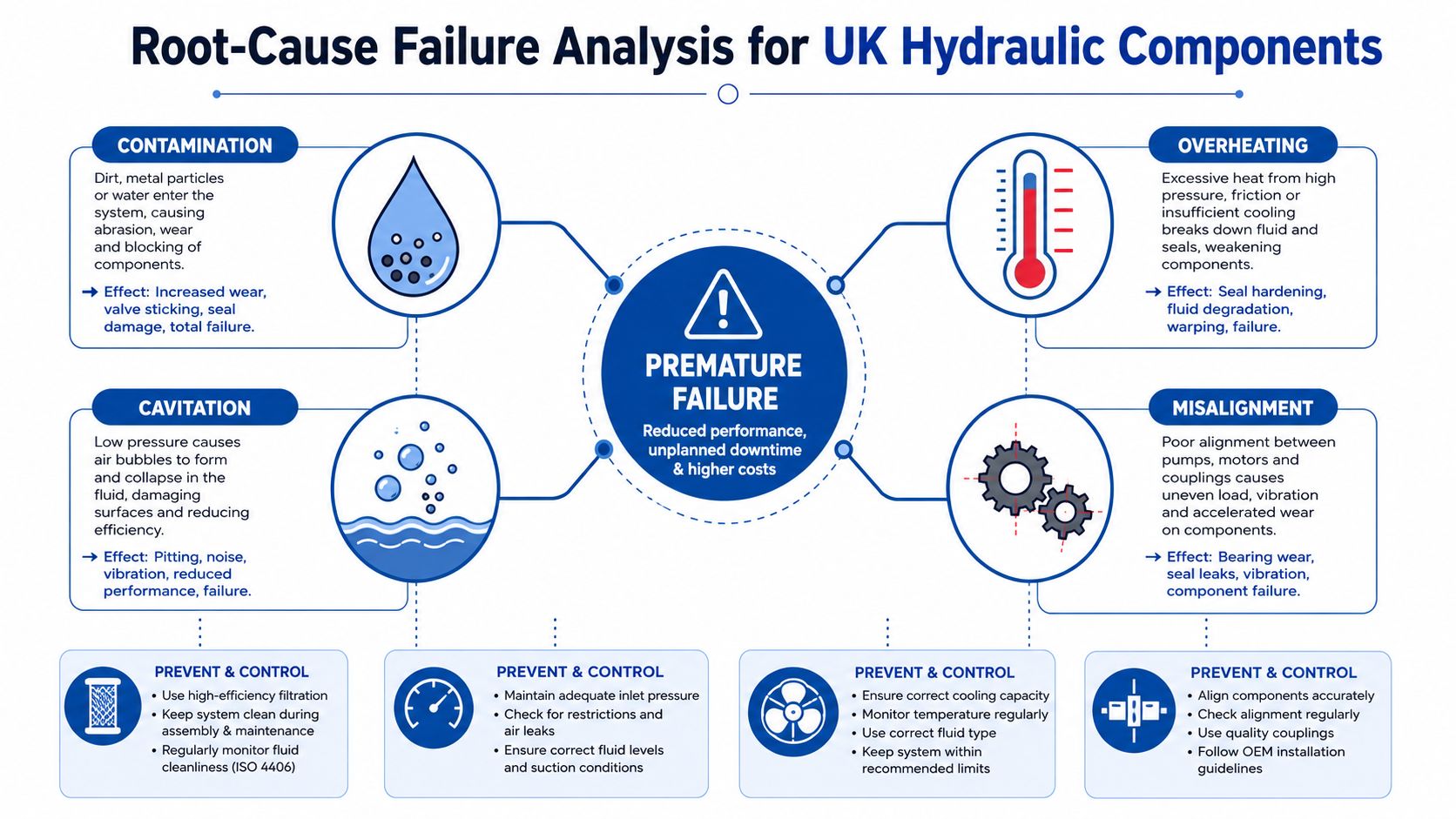
Contamination and abrasive wear
Silica, rust, paint flakes and worn metal circulate through clearances designed for controlled lubrication. A failed breather can let abrasive dust into a mobile machine, while an unsealed transfer container can add dirt before oil ever reaches the reservoir. In an external gear pump, that contamination can score flank plates and gear surfaces, producing falling efficiency, heat and metallic swarf on the magnetic plug.
Check the breather, reservoir interior, filter element and sample results together. A clean replacement pump will not last if the source of the particles remains in place.
Overheating and seal damage
Excess heat changes oil viscosity and accelerates seal deterioration. A relief valve set too high can force unnecessary power across the valve, particularly where the machine spends time at pressure without useful flow. The fitter may find hardened or cracked nitrile seals, darkened oil and a smell of oxidation.
Measure actual pressure and temperature under the machine's normal duty. Don't rely on the setting written on an old inspection sheet. Correcting the relief setting, cooler performance or unloading arrangement may protect the rebuilt component better than changing its seal material alone.
Cavitation and air ingestion
A pump that whines during a cold lift, especially on a mobile boom, may be starving on the suction side. Restricted suction hoses, blocked strainers, low oil level and oil that's too viscous at start-up can create local pressure loss. The resulting bubbles collapse inside the pump and damage surfaces.
Look for frothy oil, pitted surfaces and a noise that changes with inlet conditions. Inspect hose collapse, clamps, tank breathers and suction fittings before condemning the pump.
Fluid degradation
A power pack running continuously can oxidise its oil, form varnish and develop increasing acidity. Sticky valve spools, sluggish response and dark deposits around hot areas point towards degraded fluid rather than a simple electrical or directional-valve fault. Oil analysis should be connected to the operating temperature, duty and service history, not filed as an isolated laboratory report.
The UK offshore ageing and life-extension guidance takes the same evidence-led position. Historical performance, inspection and maintenance data should precede targeted physical assessment and a documented continue, repair or replace decision.
Preventive Maintenance Schedules That Hold in Practice
A schedule pinned to a workshop wall means little if the fitter cannot carry it to the machine. On a mobile excavator working a winter shift in Yorkshire, record both operating hours and calendar time. Condensation, exposed breathers, ageing hoses and deteriorating oil do not wait for the hour meter.
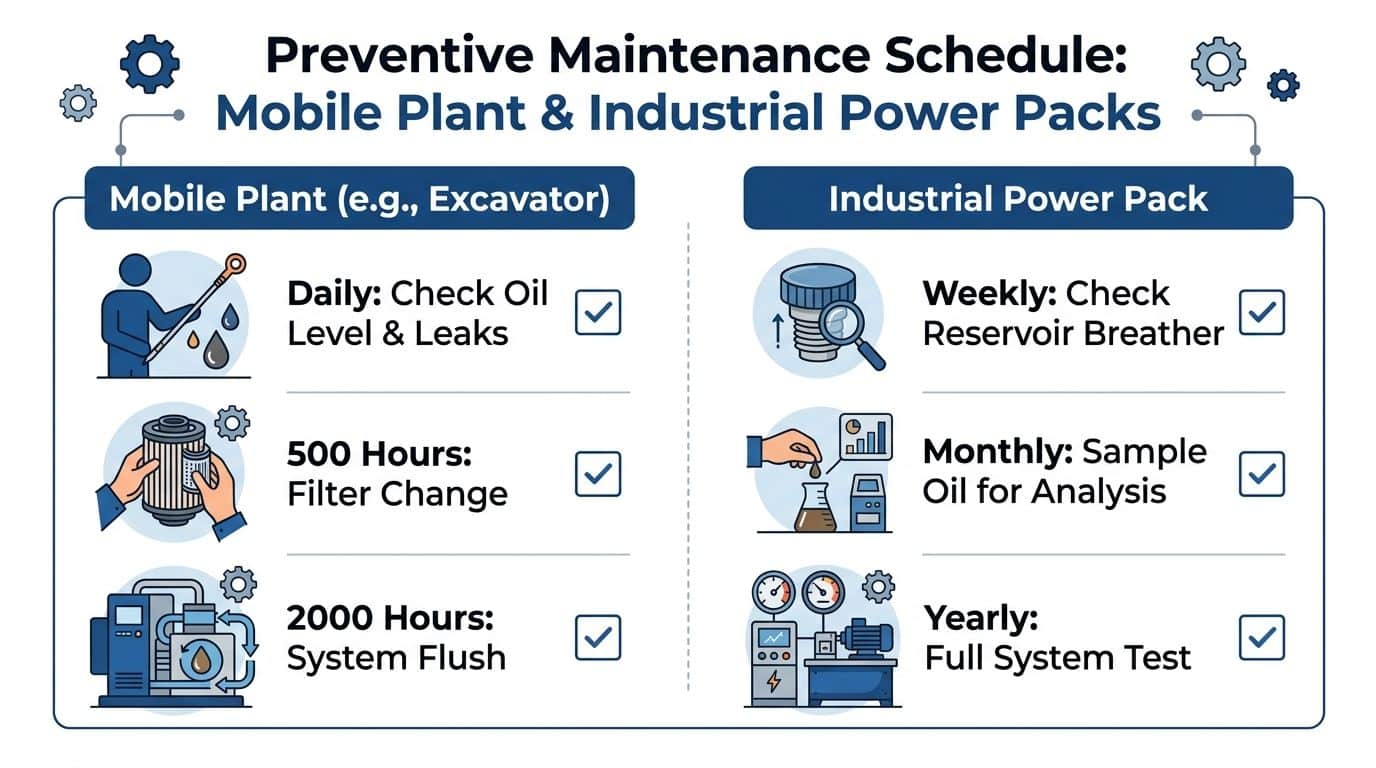
A workable mobile-plant routine
Use this as a starting point, then match it to the manufacturer's instructions, duty and required cleanliness level:
- Daily checks: Confirm oil level, inspect for leaks and look for fresh damage around hoses, fittings and cylinder rods.
- Every 250 hours: Take a representative oil sample for laboratory analysis, including ICP spectroscopy where appropriate. Record the result against the machine, oil type and previous sample.
- Every 500 hours or six months: Change hydraulic filters unless condition data and the manufacturer's instructions support a different interval.
- Every 2,000 hours: Inspect hoses for chafe, especially near bulkhead fittings, clamps and bend transitions. Check pump mountings and manifold bolts for looseness or fretting.
- Annually: Replace the reservoir breather, inspect the filler cap, and clean the reservoir drain plug and magnetic element.
Where a task has both hour and calendar limits, use whichever arrives first. A low-hour machine can still suffer from a blocked breather, moisture ingress or neglected hose inspection.
Industrial power packs need records, not just rounds
For a fixed power pack, make reservoir level, visible leakage, noise and temperature part of the operator's routine checks. Take oil samples at a consistent interval, inspect filter restriction indicators and verify cooler performance under normal production load. After intervention, include torque checks for pump mountings, manifold fasteners and pipe supports.
The missed tasks are usually simple. A fitter fails to log the sample, leaves an old breather in service or ignores debris on the reservoir drain plug. That removes evidence of contamination and wear before they become pump damage.
Use the hydraulic preventive maintenance checklist to structure these checks as planned work orders. It should identify the asset, operating hours, technician, findings, corrective action and follow-up date.
Maintenance habit that pays back: A sample without an asset number, oil identification and previous result is not a trend. It is just a bottle of oil sent to a laboratory.
Filtration and Fluid Cleanliness for Longer Hydraulic Life
Oil can look clear and still contain enough particles to damage a pump, motor or proportional valve. ISO 4406 expresses solid contamination through a three-part particle-count code. A result such as 18/16/13 records counts across three particle-size bands, giving the maintenance team a repeatable cleanliness measure rather than a visual opinion. The ISO 4406 standard defines this coding approach for hydraulic fluid power systems.
MA Hydraulics identifies 19/17/14 as a typical target for gear pumps and general lower-sensitivity components. Cleaner proportional-valve systems can require 16/14/11, with an extended-life target of 15/13/10. The most sensitive component in the circuit should set the system target.
| Component | Target ISO 4406 Code | Recommended Filter Beta Rating | Typical Application |
|---|---|---|---|
| Gear pump and general low-sensitivity circuit | 19/17/14 | Select a suitable high-efficiency return or pressure filter | Mobile plant and basic hydraulic circuits |
| Fixed-displacement pump with tighter wear control | 18/16/13 | Use an efficient pressure or return filter matched to flow | Industrial and mobile power units |
| Proportional valve circuit | 16/14/11 | Specify high-efficiency pressure and return filtration | High-pressure controlled motion |
| Extended-life proportional system | 15/13/10 | Use filtration selected for the complete circuit and duty | Clean, closely controlled applications |
The guide also warns that new oil delivered from bulk or drums in the UK and Europe typically contains 2 to 20 times more particles than acceptable levels for many hydraulic systems. Transfer new oil through a suitable filter, keep containers sealed and store drums away from standing water and dirt. Choosing the oil itself also matters, so engineers comparing viscosity, additive systems and operating conditions may find selecting the right industrial lubricant useful alongside the machine manufacturer's specification.
Put filtration where it protects the circuit
Suction strainers protect against large debris but can starve a pump if undersized or blocked. Pressure filters protect sensitive downstream components, while return filters clean oil before it reaches the reservoir. Mobile machines often need heavy-duty breathers and protection against dusty working environments. Industrial units can benefit from a kidney-loop filter that cleans the reservoir independently while production continues.
Sampling must be consistent. MGR Fluid Engineering's contamination-control guidance recommends sampling from a suitable point, not downstream of a filter, and suggests a reservoir sample after the system has run for at least 15 minutes as a starting point. Fitters should trend samples from the same point, maintain filters when restriction indicators show blockage and add indicators where none exist. Breathers need scheduled replacement, not attention only after a pump fails. The ISO cleanliness code guide provides a practical reference for interpreting and applying the code.
Refurbish, Upgrade or Replace a Decision Framework
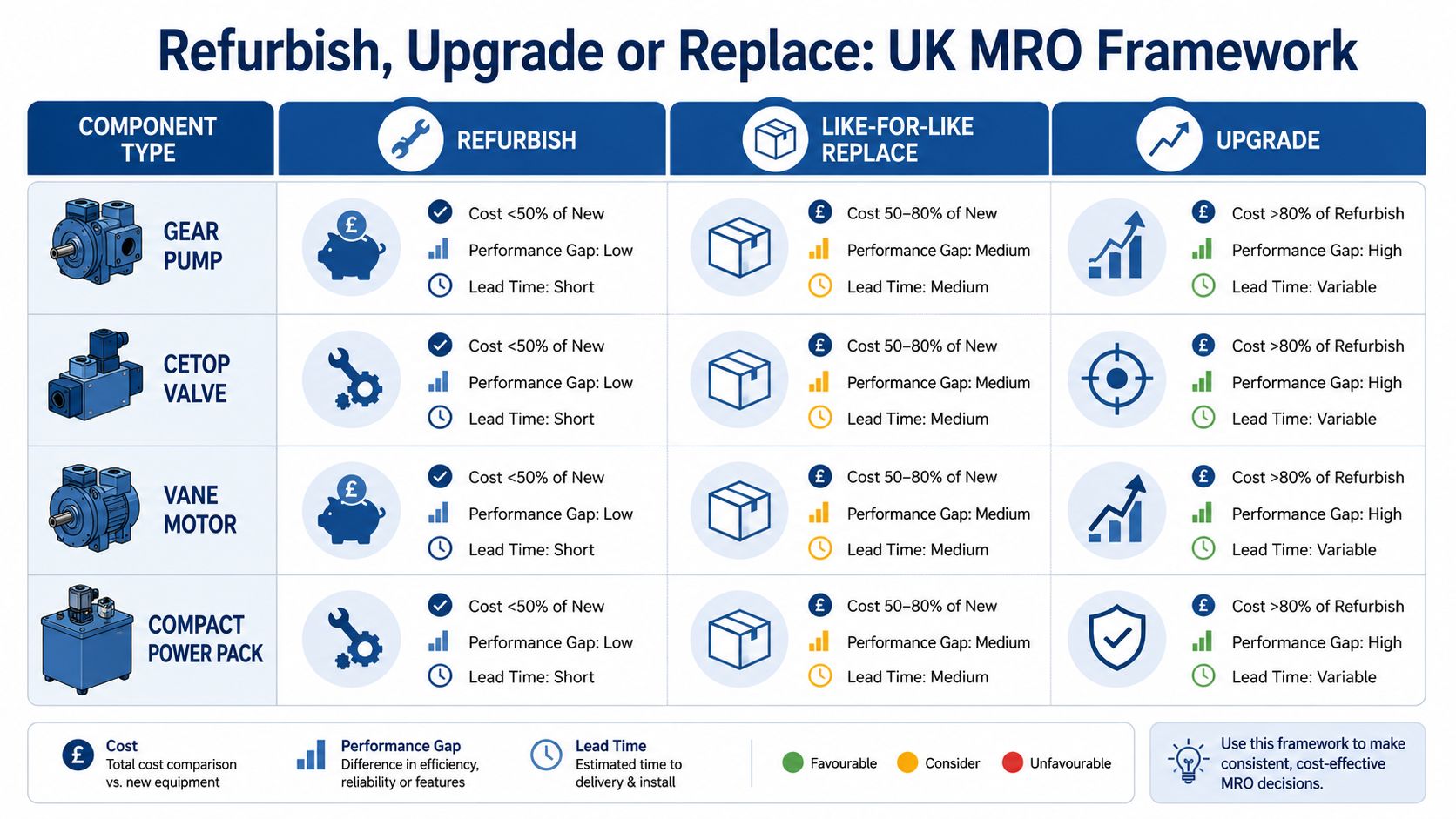
The cheapest component isn't always the cheapest repair. A refurbished gear pump may be right for a standard mobile circuit with sound housing, shaft and bearings. A replacement may be more sensible where the original unit has suffered contamination damage across several parts. An upgrade earns its cost when the existing design is causing an identifiable performance or reliability problem.
Start with condition and duty
For a gear pump, inspect housing bores, gear flanks, side plates, shaft seal lands and bearing races. A CETOP directional valve may only need seals and cleaning, but spool chrome damage or a distorted body changes the decision. A vane motor requires close attention to port plates, rotor, vanes and cam ring condition. Compact power packs should be assessed as assemblies, including motor, pump, valve block, reservoir, wiring and cooling.
The UK life-extension guidance recommends a gap analysis of known and unknown condition, followed by targeted inspection and a documented economic decision. Use that process rather than assuming that age alone condemns the unit.
| Route | Usually suits | Main risk | Upgrade opportunity |
|---|---|---|---|
| Refurbish | Sound housing and shaft, recoverable wear surfaces, predictable duty | Hidden damage or repeat failure | Improve seals, filtration or setup during rebuild |
| Like-for-like replace | Broad internal damage, urgent return to service, supported specification | Repeating the original failure mode | Limited unless the replacement specification changes |
| Upgrade | Known efficiency, control, heat or availability problem | Paying for capability the machine won’t use | Higher-efficiency pump, improved valve control or better filtration |
Know when refurbishment stops paying
Refurbishment often loses its advantage when the measured repair scope reaches roughly 60% to 70% of new cost, especially if the housing, shaft and bearings all show measurable wear. That threshold is a commercial guide, not a substitute for inspection. A unit that has already been rebuilt once deserves extra scrutiny, because repeated seal replacement without correcting alignment, contamination or pressure settings is maintenance theatre.
During a rebuild, an upgrade can be rational. A cast-iron gear pump might be replaced with an aluminium-bodied, higher-efficiency unit where weight and efficiency matter. A basic valve block may justify a load-sensing arrangement if the duty spends substantial time throttling flow and creating heat. Don't add complexity merely because it's available.
The arithmetic should be based on cost per hour of reliable extended service, not purchase price. For a 32 cc/rev telehandler pump, compare rebuild cost, installation time and expected operating hours against the replacement option. For a steel-works power pack, include production interruption, contamination flushing and the value of a planned outage. If the evidence is weak, spend money on inspection before committing to a detailed upgrade.
Step-by-Step Rebuild Workflow for Pumps and Power Packs
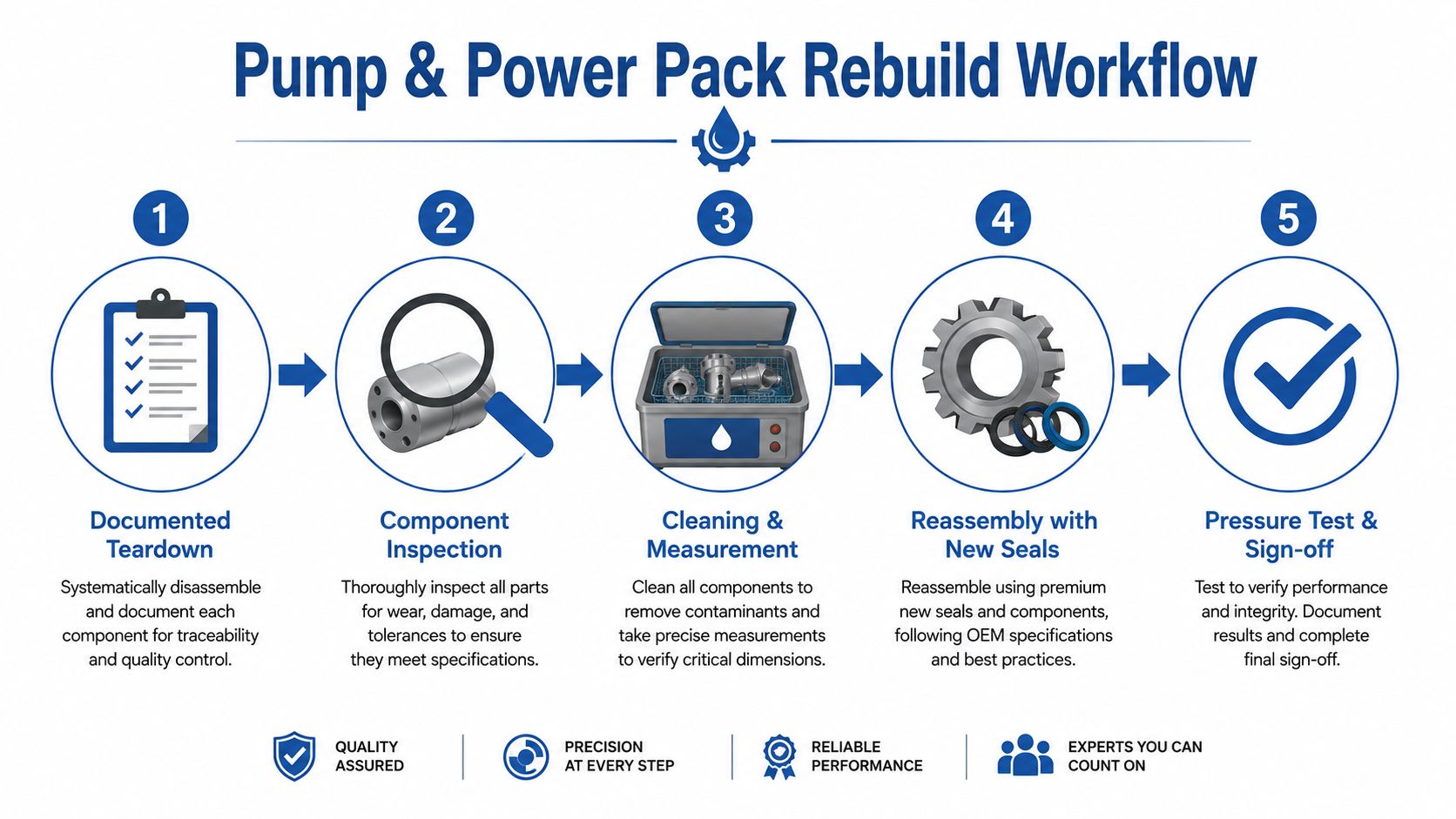
A good rebuild starts before the first bolt is removed. Photograph pipe connections, mark orientation, record the original settings and capture the failure symptom. A documented teardown protects against lost evidence and makes the final report useful when the same machine returns.
Strip down without destroying the evidence
Drain and cap the unit, then clean the exterior before opening it. Keep parts in order and separate clean components from contaminated ones. Use a controlled cleaning process suitable for hydraulic components, with cleanliness expectations aligned to the equipment and the applicable cleaning standard, rather than washing parts in an open container beside the machine.
Inspect the parts that determine whether a rebuild is viable:
- Gear pumps: Check gear flank contact, side-plate scoring, housing wear, bearing races and shaft seal lands.
- Vane units: Examine the port plate, vanes, rotor slots and cam ring for scoring, pitting and uneven contact.
- Valves: Inspect spool chrome, lands, body bores, springs and contamination trapped around the control edges.
- Power packs: Check pump alignment, motor coupling, manifold faces, relief-valve condition, reservoir debris and electrical terminations.
Measure against the manufacturer's tolerances. Don't invent a clearance from memory or accept a visibly worn part because a seal kit is already on the bench.
Rebuild with a controlled parts kit
A sensible kit normally includes bearings, seals, circlips and dowels, with gaskets and wear plates where the design uses them. Replace damaged fasteners and contaminated hoses where cleaning cannot guarantee removal of embedded debris. Confirm shaft rotation, port orientation, seal material, displacement and pressure rating before assembly.
Use calibrated torque tools and the manufacturer's torque, clearance and alignment figures. A pump mounted slightly out of line can load the shaft and coupling, then return a premature seal or bearing failure that looks like a poor rebuild.
A pressure test to 1.5 times working pressure is part of the requested verification approach, provided the component and test arrangement are rated for that procedure and the test is controlled safely. Check case-drain flow where applicable, record no-load noise and confirm that the unit holds pressure without abnormal heating or leakage.
Sign-off standard: A rebuilt pump isn't ready because it turns by hand. It's ready when the inspection record, measurements, test result and commissioning checks support its return to duty.
Before commissioning, prime the filters, flush the oil circuit, confirm the correct rotation and verify suction conditions. Record an initial oil sample after the machine has stabilised in service, with the planned 50-hour sample forming part of the commissioning record. For specialist support, see the hydraulic pump repair service.
A short visual demonstration can help technicians check the sequence, but embedded videos should be reviewed on the page to ensure the frame renders at the intended aspect ratio:
Condition Monitoring, KPIs and When Predictive Pays Back
Condition monitoring works when it answers a maintenance decision. A dashboard full of readings isn't useful if nobody knows which value triggers sampling, inspection, derating or replacement. Start with the failure modes already found in the machine's history, then monitor the variables that can expose those modes early.
| KPI | Measurement Method | Target / Threshold | Sample Interval | Predictive Payback |
|---|---|---|---|---|
| Oil cleanliness | ISO 4406 particle count | Circuit-specific code set by the most sensitive component | Consistent laboratory sampling | High where contamination causes repeated pump or valve wear |
| Filter restriction | Visual indicator or differential-pressure measurement | Act on the manufacturer’s restriction setting | Operator checks and planned inspections | High when blocked filters risk starvation or bypass |
| Temperature | Reservoir and pressure-line temperature measurement | Stay within oil and component limits | During representative duty | Useful where heat causes seal, viscosity or varnish problems |
| Vibration and noise | Technician observation, vibration route or sensor | Investigate change from the established baseline | Route-based or continuous where justified | Valuable on critical rotating equipment with accessible baselines |
| MTBF | CMMS failure and operating-hour records | Track direction rather than chasing an artificial number | At each failure and review period | Useful for comparing repair strategies and repeat faults |
Use sensors where the consequence justifies them
Predictive monitoring earns its keep on equipment where failure causes major production loss, access is difficult or the failure develops in a measurable way. A continuously operating steel-works power pack may justify temperature, vibration and oil monitoring if the readings are linked to planned outage decisions. A lightly used mobile auxiliary circuit may get better value from inspection, filter restriction checks and disciplined sampling.
The UK offshore guidance requires service-life extension to rest on condition assessment and/or a changed maintenance or inspection strategy, not assumption alone. Its evidence set includes the asset register, risk-based inspection strategy, maintenance strategy, inspection and condition-monitoring reports, safety-critical-element function tests, CMMS data and anomaly, repair or replacement records. That is a useful standard for smaller hydraulic fleets too. A sensor reading without a reliable asset history can create false confidence.
MA Hydraulics Ltd can help MRO teams with hydraulic component selection, pump repair, filtration, cross-references and bespoke power-pack requirements. Visit MA Hydraulics Ltd to discuss a condition-led repair or replacement decision, then phone 01724 279508 today or send a message with the pump, valve or power-pack details.
