
A lot of supplier problems don't look like supplier problems at first.
A machine stops. Maintenance strips out a failed cartridge valve or pump coupling. Stores says the replacement was due yesterday. Purchasing says the order went to the lowest-cost source. Engineering says the part supplied last time wasn't quite to drawing and needed fettling to fit. Production asks the only question that matters in that moment: when are we running again?
That's where vendor relationship management stops sounding like corporate language and starts sounding like operational discipline. In hydraulics and MRO, the supplier relationship affects uptime, quality, engineering effort, warranty exposure and how much fire-fighting your team does every week.
Beyond Price The Real Cost of Poor Supplier Relationships
The expensive part of a poor supplier decision rarely sits on the purchase order. It shows up later, when a gear pump arrives without the expected mounting configuration, when a CETOP valve block has a tolerance issue, or when a seal kit is technically “equivalent” but doesn't last in the duty cycle your plant runs.
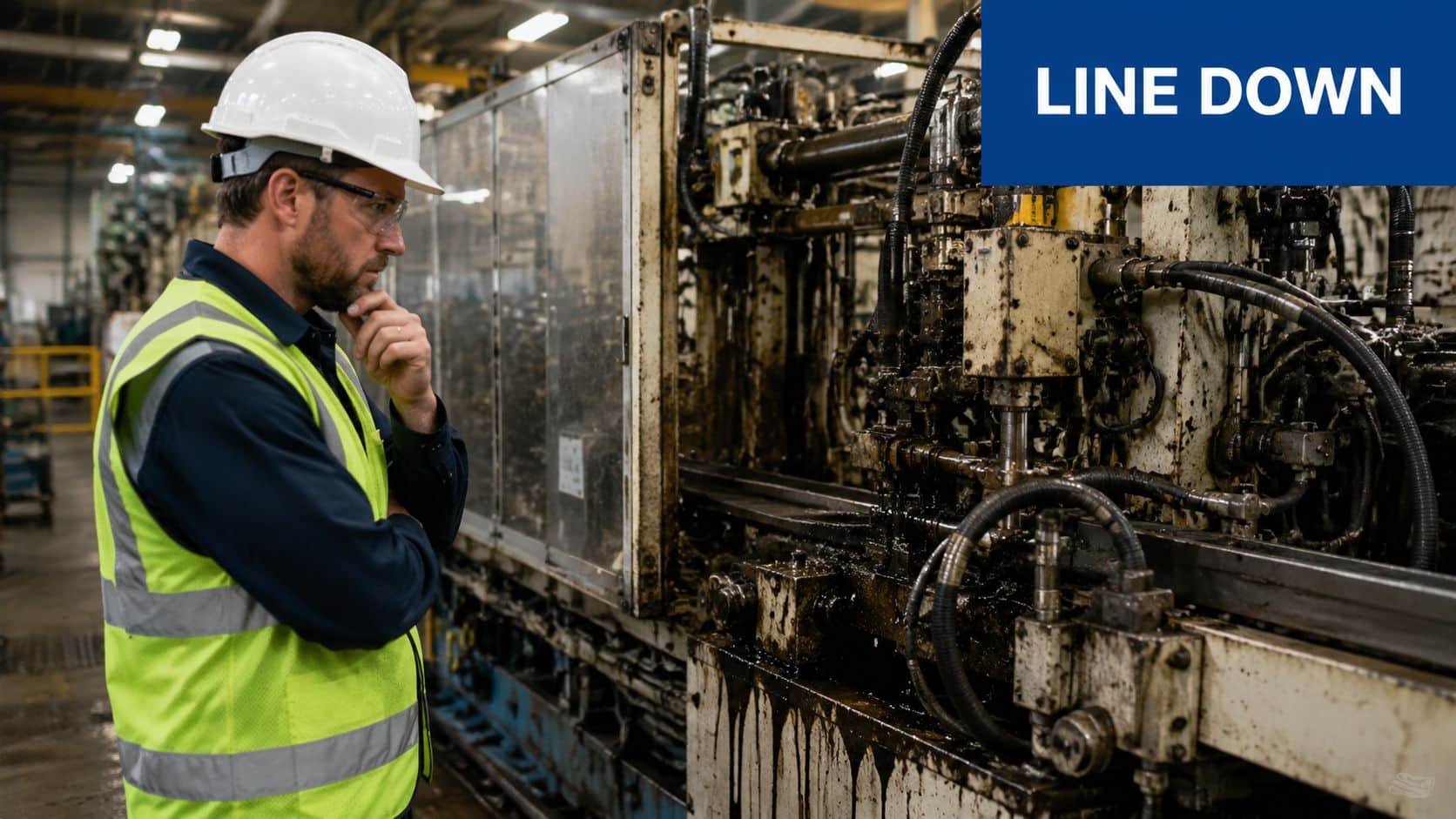
In industrial settings, the damage spreads quickly. Production loses time. Fitters wait. Engineers get dragged into avoidable checks. Buyers place expedited orders to recover a situation that should never have slipped. The “cheap” vendor ends up costing more than the well-managed one.
Low unit price can hide a high operating cost
A hydraulic component is never just a component. A pump affects flow stability, heat, energy draw and service life. A valve affects controllability and fault-finding time. A filter affects contamination risk across the wider system. If the supplier doesn't understand the application, you're not just buying a part. You're buying uncertainty.
That's why vendor relationship management should sit alongside total cost of ownership thinking, not apart from it. Good procurement teams don't only ask, “What does it cost today?” They ask, “What will this choice do to reliability, maintenance effort and future availability?”
Practical rule: If a supplier only becomes visible when something goes wrong, you haven't got vendor relationship management. You've got order processing.
There's also a UK governance angle that buyers can't ignore. The Procurement Act 2023 received Royal Assent on 26 October 2023, and with UK public procurement spending at around £300 billion per year, its emphasis on transparency and supplier performance makes structured vendor relationship management more important for companies working in public-sector supply chains.
What works in practice
The strongest supplier relationships are built before the first failure. That means agreeing technical expectations early, defining who owns issue resolution, and reviewing performance regularly rather than arguing after a late delivery.
A useful companion read is Comfi's guide to supplier management, especially for teams trying to move from transactional buying to a more disciplined supplier model.
Poor supplier relationships usually follow the same pattern:
- Price leads everything: Technical fit, lead time risk and after-sales support get ignored.
- No ownership exists: Purchasing, stores, maintenance and engineering all assume someone else is managing the supplier.
- Reviews only happen after failure: The first serious conversation takes place during a breakdown.
Well-run vendor relationship management does the opposite. It makes supplier performance visible before it becomes painful.
What VRM Means for Your Hydraulic Supply Chain
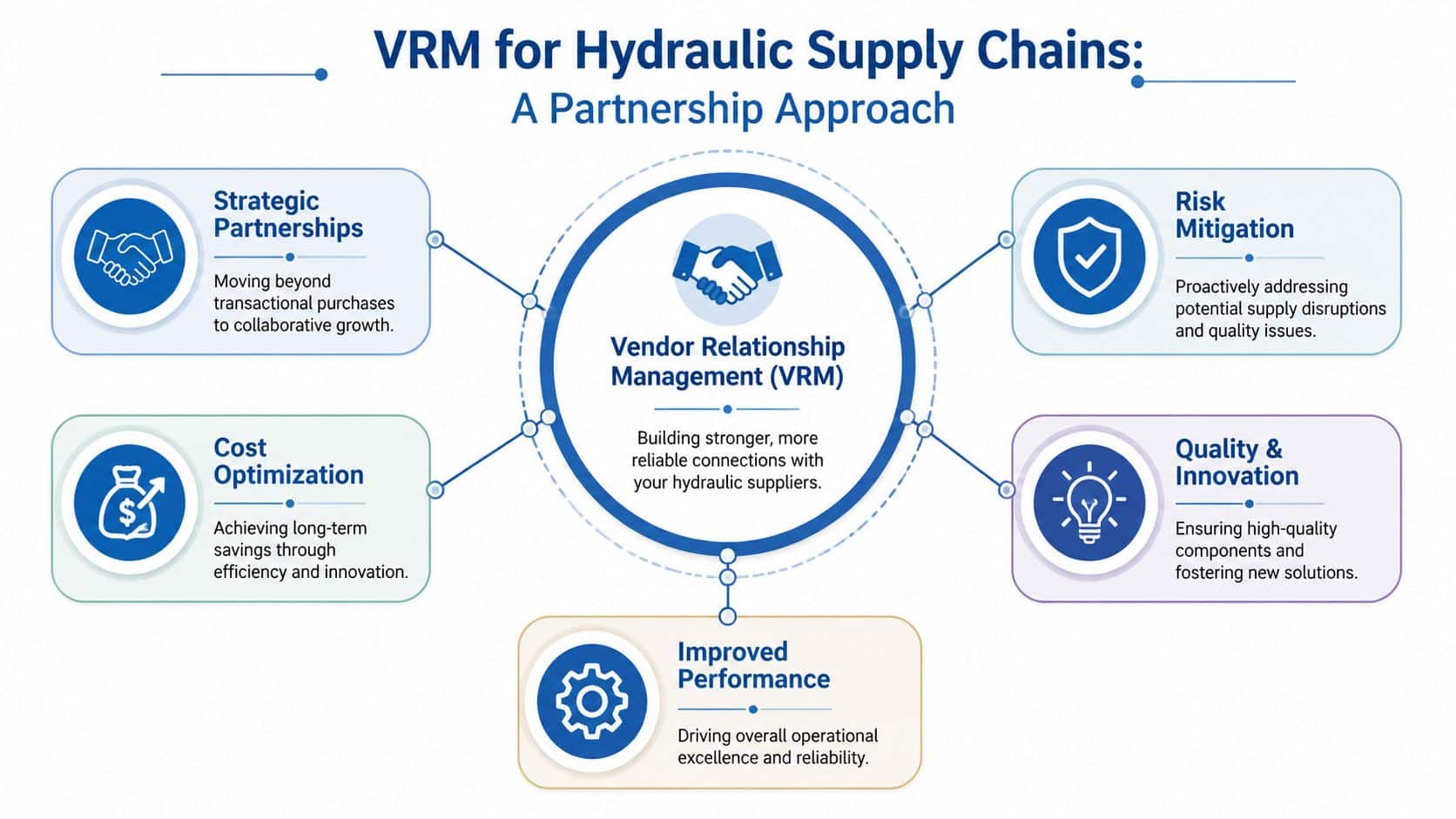
In hydraulic terms, vendor relationship management means treating key suppliers like part of your operating system, not like a vending machine.
If you buy purely on spot price, every order is a fresh negotiation. Every issue starts from zero. Every technical query becomes a chase. That approach might work for low-risk consumables. It fails quickly when you're buying pumps, motors, bellhousings, manifolds, proportional valves or bespoke power pack assemblies.
Pit crew, not petrol station
The simplest way to explain it is this. A basic purchasing model treats suppliers like a petrol station. You turn up, buy what you need, pay the bill and leave. Vendor relationship management treats them more like a pit crew. The value isn't just supply. It's readiness, fit, speed, technical judgement and coordinated support when conditions change.
That matters in hydraulic systems because small specification errors create larger downstream problems. A mismatched gear ratio, incorrect flange option, unsuitable filtration arrangement or poorly selected relief valve doesn't stay a purchasing issue for long. It becomes a machine issue.
For buyers sourcing hydraulic equipment supply for industrial and mobile applications, the shift is straightforward. Stop assessing suppliers only on quoted price. Start assessing them on whether they help your operation run with less friction.
What a good vendor relationship actually gives you
A capable supplier relationship should deliver practical benefits such as:
- Better technical alignment: The supplier understands the application, duty cycle and installation constraints.
- Cleaner substitutions: If a component is unavailable, alternatives are proposed with proper attention to compatibility.
- Less rework: Parts arrive correctly specified and with fewer surprises around ports, mounting, voltage or flow characteristics.
- Faster fault resolution: Queries go to people who know the product range and can narrow the problem quickly.
Later in the process, the same relationship can support stocking plans, design input and planned obsolescence management.
This short video is useful if your team needs a quick visual view of the mindset shift involved.
Good vendor relationship management doesn't mean being soft on suppliers. It means being clear, consistent and commercially sensible enough to get the best from them.
The mistake many firms make is assuming relationship management is just “keeping in touch”. It isn't. It's a structured way to turn supplier knowledge into better uptime, cleaner procurement decisions and fewer expensive surprises.
The Four Stages of the VRM Lifecycle
Most VRM programmes go wrong because they stay informal. One buyer knows one account manager, problems get solved by phone, and the relationship looks fine until somebody leaves, lead times change, or a compliance issue appears. A proper lifecycle fixes that.
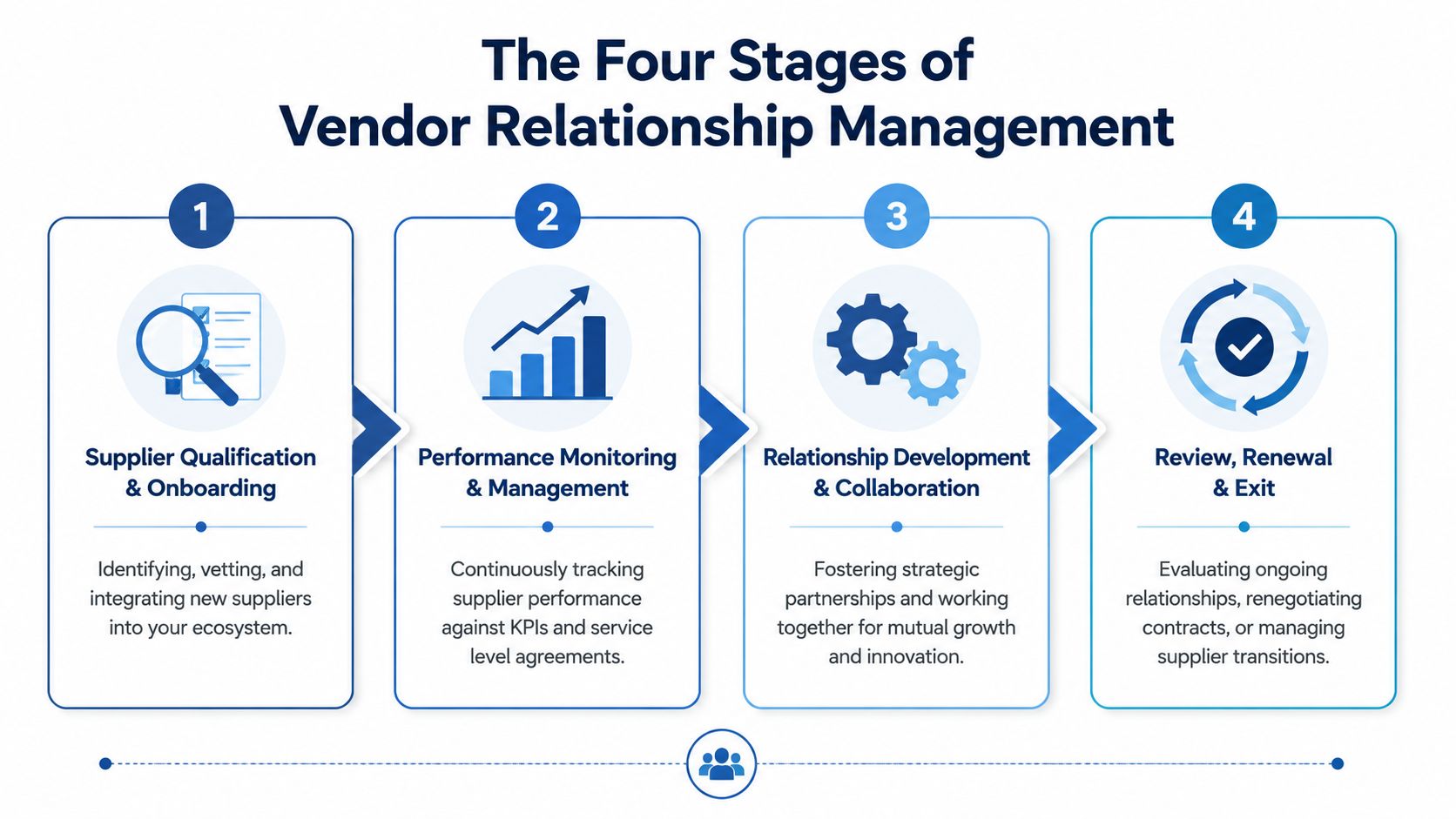
Stage one Qualification and onboarding
Start before the first order. Buyers often rush at this stage.
For a hydraulic supplier, qualification should cover more than commercial terms. Can they supply the product family consistently? Do they understand traceability where it matters? Can they support cross-reference work without guessing? If they handle data, drawings, account access or outsourced processes, what controls exist around that?
A UK-specific weak point is compliance in the onboarding process. A 2025 report referenced by Hyland notes that 68% of industrial firms face delays due to non-compliant vendor data practices, yet only 12% have integrated these checks into their VRM protocols. In sectors tied to mobile machinery and safety-critical use, that gap is asking for trouble.
Use onboarding to document basics properly:
- Commercial setup: payment terms, Incoterms where relevant, order acknowledgements, escalation routes
- Technical capability: product range, engineering support, approved substitutions, documentation quality
- Compliance checks: data handling, relevant certifications, safety obligations, auditability
Stage two Segmentation
Not every supplier deserves the same management effort.
A vendor supplying a standard fitting or common fastener does not need the same level of attention as the supplier of bespoke manifolds, directional valves, filtration assemblies or compact power units that can stop production if they fail. Segment suppliers by operational criticality, not by annual spend alone.
A simple model works well:
| Supplier type | Typical example | Management approach |
|---|---|---|
| Strategic | Key hydraulic assemblies, critical pumps, bespoke power packs | Senior review, joint planning, formal scorecard |
| Operational | Regular valves, filters, couplings, seal kits | Scheduled reviews, performance tracking |
| Commodity | Low-risk standard items | Light-touch controls, price and availability focus |
Stage three Performance management
This is the working core of vendor relationship management. Review delivery, quality, responsiveness and issue handling on a set rhythm. Don't rely on memory or whoever shouts loudest from the shop floor.
If a supplier's lead times drift or defects increase, isolate the cause. Was it a material issue, a process change, a forecasting gap, or poor order clarity from your side? Good performance management is not blame allocation. It's controlled diagnosis.
Check the pattern, not the anecdote: One late delivery is an incident. Repeated slippage on the same product family is a management issue.
Stage four Development renewal or exit
Once a supplier proves capable, move beyond monitoring. Work on packaging improvements, stocking arrangements, design input, standardisation of common parts or rationalisation of variant creep.
If the supplier improves, renew with clearer targets. If they don't, transition out in a controlled way. Exit is part of the lifecycle too. The mistake is hanging on to a weak vendor because the relationship feels familiar.
Practical KPIs and SLAs for Supplier Governance
If you can't measure supplier performance, you'll end up managing by anecdote. One engineer says the supplier is excellent because they solved a problem last month. Stores says they're poor because one order arrived short. Finance says they're expensive. None of that is enough.
The strongest approach is to set SLAs that define delivery times, defect thresholds and improvement targets, then monitor those consistently with a standard scorecard. Guidance for UK industrial buyers supports using quantified evaluation matrices and continuous monitoring so performance data can drive renegotiation or corrective action, rather than opinion alone.
What to measure in a hydraulic supply context
Not every metric belongs in every agreement. The point is to choose measures that connect directly to operational outcomes.
For hydraulic components and assemblies, useful categories usually include:
- Delivery performance: Did the supplier deliver when promised, in the agreed quantity and condition?
- Quality performance: Did the parts conform without rework, concession or early failure?
- Technical support: How quickly and accurately did the supplier respond to specification or fault queries?
- Commercial discipline: Were quotes, acknowledgements and invoice details accurate and consistent?
- Improvement activity: Did the supplier act on recurring issues and close them properly?
Example VRM scorecard for a hydraulic component supplier
| Metric Category | KPI / SLA | Target | Weighting |
|---|---|---|---|
| Delivery | On-time in-full for stocked hydraulic components | Agreed target set in contract | High |
| Delivery | Order acknowledgement accuracy | Agreed target set in contract | Medium |
| Quality | Non-conforming parts received | Agreed defect threshold in SLA | High |
| Quality | Repeat failure on the same product family | Continuous reduction expected | High |
| Technical support | Response time for urgent application queries | Agreed response window | Medium |
| Technical support | Time to resolve quality or fitment issue | Agreed escalation and closure window | High |
| Commercial | Quote accuracy against final supply | Agreed tolerance and process standard | Medium |
| Improvement | Corrective action closure on agreed issues | Closed within agreed review cycle | Medium |
How to write SLAs that are actually usable
Weak SLAs are full of soft wording. “Best endeavours”, “reasonable lead times” and “quality to standard” sound fine until you need to enforce something. Better SLAs are specific enough to review.
Focus on points such as:
-
Delivery commitments
State the promised lead time basis, order cut-off rules, and what counts as late. -
Quality thresholds
Define what constitutes a non-conformance. Include documentation errors if they create operational delay. -
Corrective action rules
Say when root-cause analysis is required and who owns closure. -
Escalation paths
Name contacts and response expectations for urgent production issues.
The best scorecards don't punish suppliers. They remove ambiguity. A strong supplier will usually welcome that.
Use the data in review meetings to decide what happens next. If a valve supplier hits delivery but misses quality, the answer may be tighter incoming checks and a corrective action plan. If a pump supplier performs well but communication is slow, the answer may be a clearer support route. Governance only works when the result is action.
Advanced Supplier Collaboration Models
Once a supplier is stable on delivery and quality, significant gains often come from changing the operating model. Standard purchase orders are fine for one-off buys. They're not always the best method for repeat hydraulic demand, fluctuating maintenance requirements or OEM build schedules.
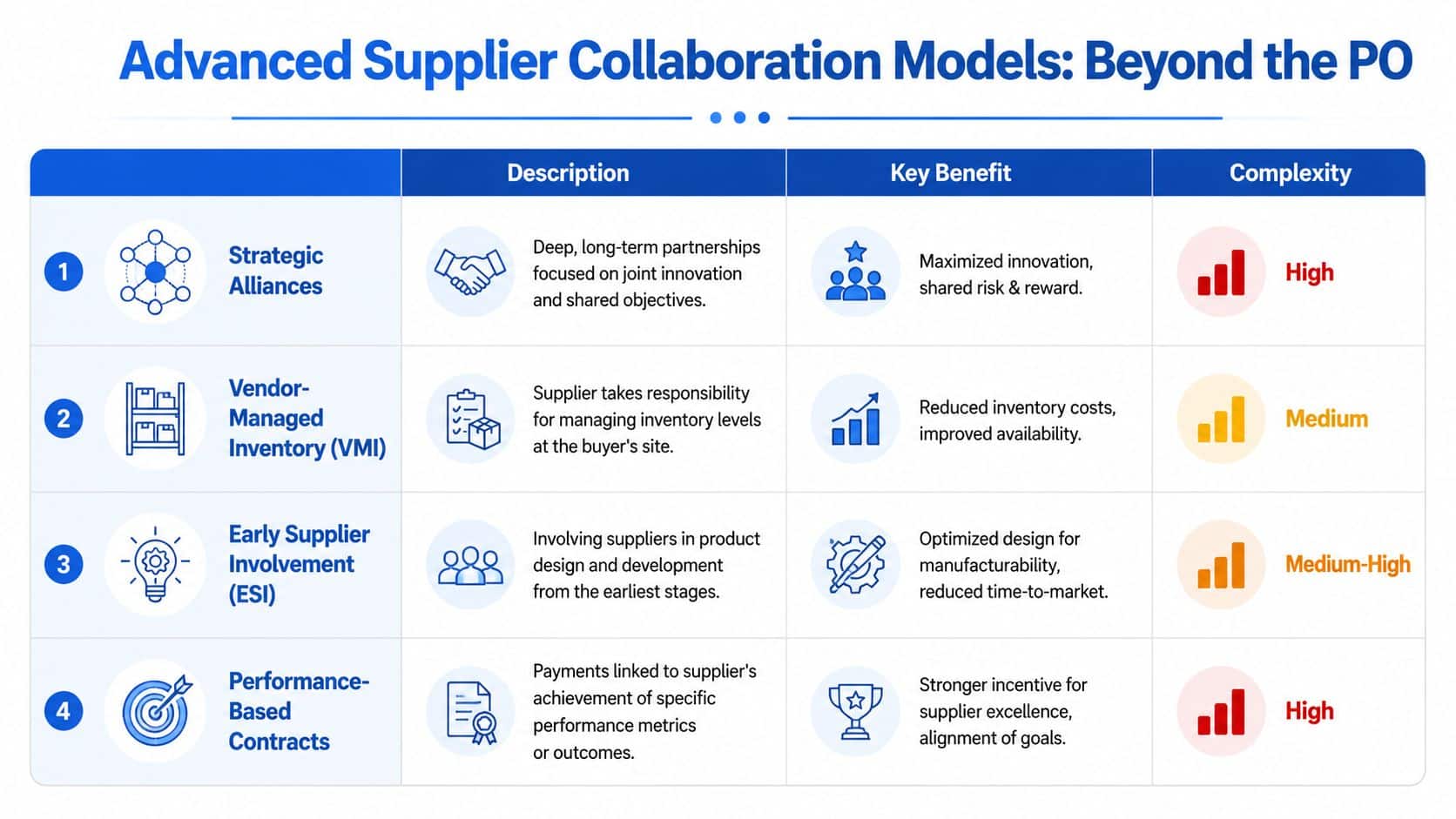
Comparing the main options
| Model | Best use case | Main advantage | Main caution |
|---|---|---|---|
| Consignment stock | Fast-moving filters, seals, hose fittings | Availability without immediate ownership | Stock discipline must be tight |
| Vendor-managed inventory | Predictable repeat demand for pumps, valves, kits | Buyer workload drops, stockouts reduce | Forecast quality still matters |
| Early supplier involvement | New machinery design, power pack development | Better design fit and fewer late changes | Requires trust and engineering engagement |
| Technical support partnership | Fault-heavy or bespoke applications | Faster diagnosis and cleaner specification | Needs clear scope and access routes |
Consignment stock versus VMI
These two get mixed up, but they're different.
With consignment stock, the supplier places stock at your site and you pay when the items are used. That can work well for service parts with regular call-off demand, especially where downtime risk is high but usage varies.
With vendor-managed inventory, the supplier takes responsibility for replenishment based on agreed signals, consumption or minimum levels. If you're considering that route, this guide to vendor managed inventory control gives a useful operational overview.
Where collaboration pays off in hydraulics
The strongest gains usually come from parts that are operationally critical but administratively repetitive.
Examples include:
- Seal and filter ranges: Regular service demand, easy to standardise, high nuisance value when unavailable.
- Common gear pumps and couplings: Predictable consumption across a fleet or machine platform.
- Power unit subassemblies: Better managed through planned build schedules and supplier visibility.
A technical support partnership can be just as valuable as a stock model. If your team routinely needs help with cross-references, valve function checks, manifold logic or compact power pack selection, formalising that support saves time and avoids specification drift.
The trade-off is simple. More collaboration usually reduces friction and surprise, but it needs better data, clearer responsibilities and a supplier you'd trust with more visibility into your operation.
Navigating Common VRM Risks and Pitfalls
Vendor relationship management fails for ordinary reasons. Not because the idea is wrong, but because firms either overcomplicate it or treat it as a one-off tidy-up exercise.
The first pitfall is lack of ownership. If procurement sets the supplier up, engineering approves the parts, stores books the receipts and maintenance raises the complaints, somebody still needs to own the relationship. Without that, every issue circles and nothing improves.
The most common failure points
- Senior backing is weak: The business says supplier performance matters, then only rewards lowest purchase price.
- Reviews are irregular: Problems are discussed only after a line-down event or warranty dispute.
- Technology arrives before discipline: Teams buy systems, but they haven't agreed scorecards, segmentation or escalation rules.
- Communication is too loose: Suppliers get mixed messages from buyers, engineers and planners.
There's also a less obvious risk that now belongs firmly in supplier governance: cyber security. The UK Government's Cyber Security Breaches Survey 2024 found that 70% of medium-sized businesses and 74% of large businesses experienced a cyber attack in the last year. In practical terms, a supplier with weak controls can become a direct route into your systems, data or operations.
Sensible mitigations that actually help
A practical VRM programme should include:
- A single supplier owner: One person coordinates reviews, escalations and follow-up.
- Routine review cadence: Monthly for critical suppliers, lighter touch where risk is lower.
- Basic cyber and governance checks: Especially for suppliers handling data, portals, shared systems or remote access. Teams looking at broader governance and risk management frameworks often find it easier to anchor supplier checks inside a wider control model.
- Lead time and contingency planning: Critical parts should have agreed backup paths, drawing control and substitution rules. That's closely tied to lead time reduction in industrial supply, not just better expediting.
A supplier review that only asks about price is incomplete. You also need to ask what happens if they fail, drift or get compromised.
The biggest mistake is assuming good relationships remove the need for controls. In reality, the better the relationship, the easier it is to put proper controls in place without constant friction.
Start Building Your VRM Roadmap Today
Most firms don't need a grand transformation project to improve vendor relationship management. They need a disciplined start.
Begin with the suppliers that can stop production, delay a build or create repeat engineering effort. If you try to govern every vendor at once, the process will collapse under its own admin.
A practical starting roadmap looks like this:
-
Identify your top five critical suppliers
Focus on operational dependency, not just annual spend. -
Book a review meeting with each one
Keep the agenda on delivery, quality, support and foreseeable risks. Don't make it a price-only discussion. -
Set three core measures
Delivery, quality and responsiveness are usually enough to start. -
Tighten one SLA
Pick a vague area and turn it into a clear commitment. -
Choose one collaboration improvement
That might be stocking policy, better order acknowledgement, cleaner technical escalation or planned substitutions. -
Review quarterly and act
Good vendor relationship management is repetitive by design. That's why it works.
Done properly, VRM gives MRO managers fewer shortages, gives engineers fewer specification headaches and gives procurement stronger control over risk, performance and continuity.
If you need support with hydraulic component supply, technical product matching or bespoke power solutions, speak with MA Hydraulics Ltd. Phone 01724 279508 today, or send us a message.
