
Most advice on oil change frequency is built for cars, not hydraulic systems. That matters more than most maintenance teams realise. A road car engine and a hydraulic power pack don't stress fluid in the same way, don't ingest contamination in the same way, and don't fail in the same way when the oil is wrong.
In hydraulics, arbitrary drain intervals create two expensive habits. Teams either change oil far too early because it feels safe, or they leave deteriorated oil in service because the machine hasn't yet reached a calendar date. Neither approach is disciplined maintenance. A better programme starts with how the machine works, what environment it runs in, and what the oil is telling you.
Why Automotive Oil Change Rules Fail Hydraulic Systems
The most common bad habit comes from automotive folklore. The old 3,000-mile oil change rule came from 1950s car maintenance, not modern hydraulic engineering. A 2021 RAC Foundation report found 42% of UK motorists still follow that myth, costing an estimated £240 million in unnecessary changes, as noted in this review of how oil type affects oil change intervals. That's wasteful enough in cars. In hydraulic machinery, it can be worse because the wrong thinking hides the actual causes of fluid failure.

Hydraulics don't age oil by mileage
Mileage is a crude proxy even for road vehicles. In hydraulics it's irrelevant. A tractor, materials handling unit, compact power pack, or mobile plant circuit lives by load, pressure, temperature, contamination, duty cycle and reservoir condition.
A reversible gear motor on dusty agricultural equipment can punish oil far more severely than a lightly loaded factory power pack. A CETOP valve stack in a damp workshop can suffer from water ingress without any obvious external leak. A machine can also have clean-looking oil and still be well on its way to varnish, additive depletion, or abnormal wear.
Fixed intervals miss the real risk
Hydraulic fluid does more than lubricate. It transmits power, manages heat, protects components, and carries contamination to the filter. When maintenance teams borrow rules from automotive servicing, they tend to ask the wrong question.
They ask, “How often should we change the oil?”
The better question is, “What evidence says this oil still protects the system?”
Practical rule: If your interval is based on habit alone, you're guessing. In a hydraulic system, guessing gets expensive quickly.
What works in the field
A sensible oil change frequency for hydraulics starts with OEM guidance, then gets refined by operating conditions. That means paying attention to:
- Environment: Dust, moisture, washdown, field work and open breather exposure
- Duty cycle: Continuous running, short cycling, shock loading and seasonal use
- System sensitivity: Gear pumps, motors, proportional valves and tight-clearance components
- Fluid type: Mineral and synthetic oils don't age the same way in service
Hydraulic maintenance improves when teams stop treating oil changes as a routine clerical task and start treating fluid as a monitored machine component.
The Three Enemies of Hydraulic Oil Life
Most hydraulic oil doesn't fail because a date on the wall says it should. It fails because something attacks it in service. In UK industrial and agricultural machinery, three issues show up repeatedly: contamination, heat, and mechanical stress.

Contamination does the damage first
Dirt, wear debris and water usually start the trouble. Dust enters through breathers, worn seals, damaged cylinder rods, loose fill caps and poor handling practices. Water arrives through condensation, outdoor storage, washdown, or badly controlled top-ups.
Once contamination gets in, it doesn't sit harmlessly in the tank. Hard particles pass through pumps and valves, erode surfaces, and circulate again. Water strips away film strength and encourages corrosion, while also affecting additive performance.
If you're reviewing fluid health, the filter matters as much as the oil. A neglected element can make a good oil look bad in a hurry. If you need a practical refresher on service procedure, this guide to changing a hydraulic filter correctly is worth keeping in the workshop file.
Heat changes the chemistry
Oil can tolerate normal operating temperature. Persistent high temperature is another matter. Heat accelerates oxidation, darkens the fluid, thickens deposits, and creates sludge or varnish that sticks to fine clearances.
That's when proportional valves start behaving oddly, spool movement becomes inconsistent, and operators report a machine that feels “not quite right” before anyone sees a fault code.
Hot oil isn't just old oil. It's oil whose chemistry may already be moving away from what the pump, valve and motor were designed to run on.
This short video gives a useful visual grounding in why fluid condition matters during service decisions.
Mechanical shearing changes viscosity
Hydraulic oil also suffers physical stress. High-pressure operation through pumps, motors, relief valves and narrow control passages can shear the fluid, especially where the system works hard and reverses frequently.
When that happens, viscosity drifts away from the intended grade. Oil that becomes too thin won't hold a proper lubricating film. Oil that becomes too thick can affect cold-start performance, response and efficiency. Either way, the machine starts operating outside its design assumptions.
A quick workshop check
When a machine starts eating oil life, check the basics before ordering a full drain:
- Breathers and seals: Look for obvious dirt ingress paths
- Reservoir condition: Check for sludge, haze, foam or water signs
- Filter history: Confirm the element is correct and changed properly
- Temperature pattern: Ask whether the machine has been running hotter than normal
- Operating change: Towing, shock load, dusty work, short cycling or recent repair work all matter
Oil change frequency improves when you look at causes, not just age.
Introducing Oil Analysis The Key to Smart Maintenance
The most reliable way to stop guessing is used oil analysis, often shortened to UOA. It turns oil change frequency from a routine estimate into an engineering decision. Instead of draining fluid because the calendar says so, you sample it, trend it, and act on evidence.
In UK hydraulic systems, that approach is proven. Used oil analysis programmes target wear metals such as iron below 5 ppm per 1,000 operating hours, and a structured sampling protocol can extend synthetic oil intervals to 8,000 to 12,000 hours versus 4,000 for mineral oils, cutting downtime by up to 40%, according to this discussion of oil analysis for interval setting.
What a lab report actually tells you
A decent oil report isn't there to impress you with columns of figures. It answers practical questions.
Viscosity
This shows whether the oil is still behaving like the grade you put in. If viscosity shifts too far, you may be seeing oxidation, shear, contamination, or an incorrect top-up fluid.
Water content
This helps confirm whether condensation, washdown, poor storage or a system fault is introducing moisture. In mobile and agricultural machinery, this reading often explains why oil life has shortened despite modest hours.
Particle count and cleanliness
Many hydraulic failures often announce themselves early. ISO cleanliness data tells you whether the system is running clean enough for its components. Gear pumps can tolerate more contamination than precision control components, but neither benefits from dirty fluid.
Wear metals
Iron, copper and similar wear indicators help identify what's wearing and whether the trend is stable or rising. One result in isolation is rarely enough. The trend is what matters.
A single oil sample is a snapshot. A sequence of well-taken samples becomes a maintenance strategy.
Sampling discipline matters
Poor sampling gives poor conclusions. If someone pulls a sample from the bottom of a dirty drain pan, or from a dead leg after shutdown, the report may tell you more about the method than the machine.
Good practice usually means:
- Sample from the same point each time
- Take the sample under comparable operating conditions
- Use clean bottles and clean handling
- Label hours, oil type, top-ups and any recent repair work
- Review trends, not just isolated alarms
Where teams are already checking system condition under load, a hydraulic pressure tester kit complements oil analysis well because it helps connect fluid condition with actual performance symptoms.
Why this approach beats routine drains
Routine drains treat every machine the same. Oil analysis doesn't. It lets a clean, stable system stay in service longer while pushing a contaminated or distressed system into action sooner. That's the right kind of control. You reduce unnecessary oil changes without pretending every machine can safely run to an extended interval.
How to Implement a Condition-Based Monitoring Programme
Many organizations don't need a huge reliability department to improve oil change frequency. They need a repeatable routine that engineers, fitters and supervisors can maintain. The key is consistency.
Real operations rarely match brochure conditions. Hydraulic oil that could potentially last 10,000 hours often averages 6,500 hours in service because of site-specific issues, and 70% of premature oil changes trace back to unmonitored variables such as moisture or contamination introduced during repairs, as outlined in this Machinery Lubrication article on oil change intervals. That's why root cause analysis matters. If the same unit keeps “needing” early oil changes, the oil usually isn't the only problem.
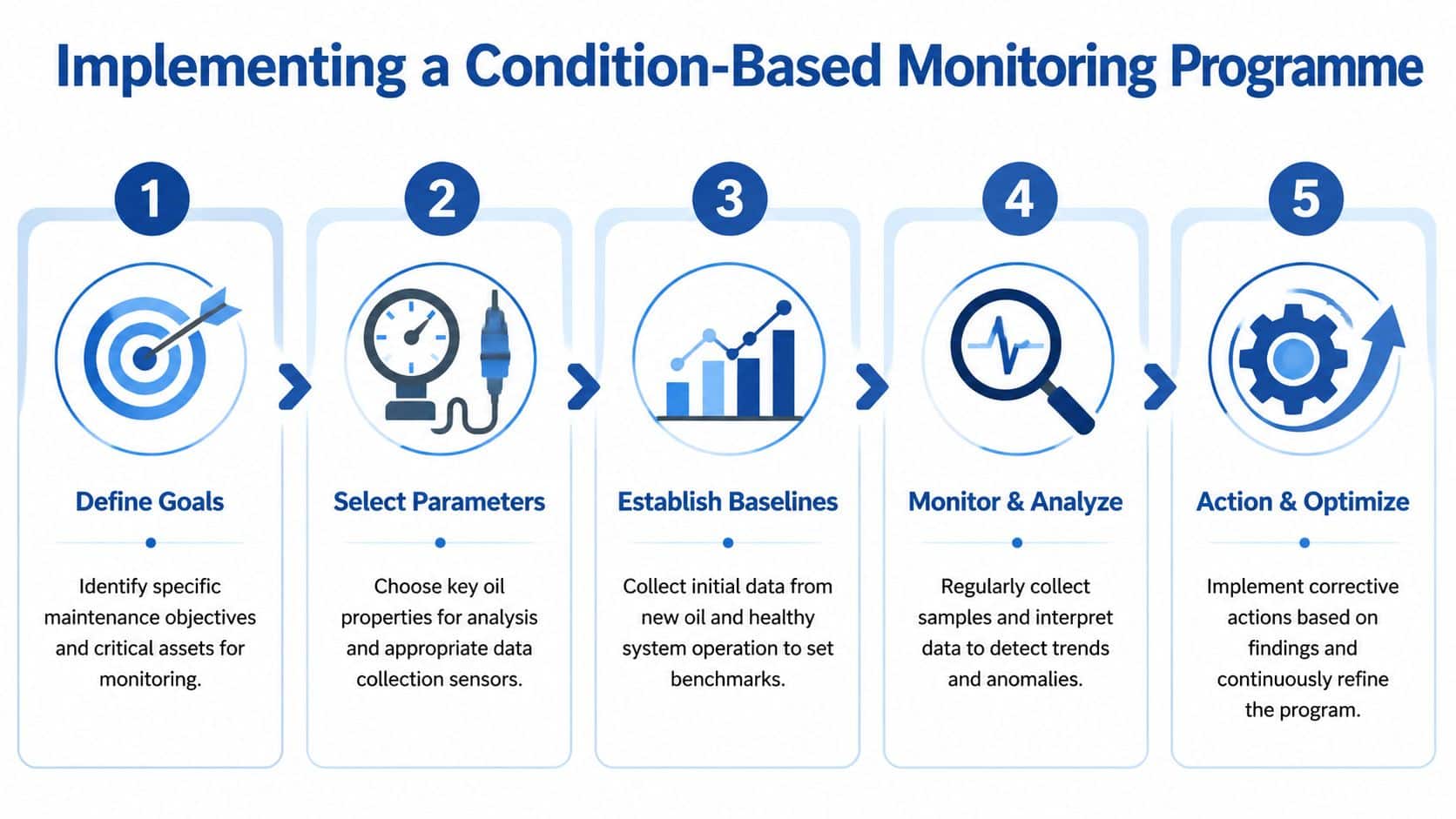
Start with five practical steps
-
Define the critical machines
Pick the assets that hurt most when they stop. That may be a press power pack, a production line hydraulic unit, a loading ramp pack, or a tractor that can't sit idle in season. -
Set a baseline
Record the oil grade, supplier, viscosity class, filter specification, reservoir capacity, normal temperature range and usual operating duty. If possible, sample new oil and then sample again when the machine is known to be healthy. -
Choose proper sampling points
A live zone sample point on the return or circulation line is usually far more useful than draining from the tank base after shutdown. Keep the point consistent across the life of the programme. -
Set a sampling rhythm
High-duty and contamination-prone machines need closer attention than lightly loaded indoor units. The point isn't to sample everything constantly. It's to sample often enough to catch drift before failure. -
Create response rules
Decide in advance what happens when viscosity moves, wear metals rise, or cleanliness falls. If no one owns the response, the report becomes paperwork.
What root cause analysis looks like in practice
When a report flags a problem, don't jump straight to a drain and refill. First ask what changed.
A few common triggers are worth checking:
- Recent repair work: Opened pipework, uncapped hoses or dirty assembly methods
- Top-up practice: Wrong oil, mixed oils or poor storage conditions
- Filtration issues: Incorrect element, bypassing, or overdue replacement
- Breather condition: Damaged or saturated breathers drawing in dirt or moisture
- Operating change: Higher load, hotter ambient conditions, or a shift in duty cycle
Workshop judgement: If two consecutive reports show the same abnormal trend, inspect the cause before you replace the oil again. Fresh oil poured into a dirty system simply starts deteriorating immediately.
Keep the programme simple enough to survive
A condition-based maintenance programme fails when it depends on one enthusiastic person and no discipline. Keep forms short, label machines clearly, and make sure hours, oil additions and interventions are logged in the same place every time.
The best systems aren't glamorous. They're consistent.
Interpreting Oil Analysis Results A Practical Guide
A lab report only helps if someone can translate it into action. The job isn't to admire the numbers. The job is to decide what to inspect, what to correct, and whether the oil can stay in service safely.
Read the pattern, not just the red flag
One abnormal reading doesn't always mean failure is close. Sampling error, recent maintenance, or a top-up can skew a result. What matters is whether the result makes sense with the machine's symptoms and whether the trend is moving the wrong way.
For example, if silicon climbs and the machine operates in a dusty yard, inspect breathers, filler caps, rod seals and fill practice before blaming the oil supplier. If copper rises, look at the components and materials in the circuit that could be shedding it. If viscosity shifts at the same time as heat complaints, check cooling and duty cycle before planning another fluid change.
Example hydraulic fluid analysis action limits
| Parameter | Target normal | Caution / alarm level | Potential cause & action |
|---|---|---|---|
| Viscosity | In line with the OEM-specified grade in service | Noticeable move away from normal trend | Check for wrong top-up oil, oxidation, shear, overheating, or contamination. Confirm the correct fluid grade is in use. |
| Water content | Dry, clear oil with no sign of haze or free water | Any persistent sign of moisture, haze, or repeat water indication | Inspect breathers, storage, washdown exposure, reservoir sealing and condensation risk. Remove water and correct ingress route. |
| ISO cleanliness code | Stable and appropriate for the components fitted | Upward trend or sudden deterioration | Inspect filter condition, service method, transfer equipment and contamination points. Use off-line filtration if needed. |
| Iron | Below 5 ppm per 1,000 operating hours | Rising trend above normal wear pattern | Inspect gear pumps, motors and other ferrous wear sources. Review load, filtration and oil condition. |
| Copper | Stable baseline for that machine | Clear rise from previous reports | Investigate component wear in parts containing copper-based materials. Confirm whether a new component or cooler has changed the background reading. |
| Silicon | Low and stable | Any upward trend in dirty environments | Suspect dirt ingress. Check breathers, seals, filler caps and handling practice. |
| Appearance and odour | Clear and consistent with normal service fluid | Darkening, burnt smell, sludge or varnish signs | Check heat history, oxidation, restricted cooling and varnish-prone operation. |
Turn report data into workshop action
A useful response plan often looks like this:
- High silicon: Inspect dust entry points, clean fill equipment, review storage and topping-up discipline
- Rising iron: Check pump and motor condition, pressure setting, filtration and abnormal loading
- Water indication: Inspect reservoir breathers, tank sealing and whether the machine sits outdoors
- Viscosity loss: Confirm no fluid mixing, then look for shear and overheating
- Dirty cleanliness code: Filter the oil, inspect the source, and review service practice
Don't confuse fresh oil with solved problems
Draining and refilling can hide evidence. If a machine repeatedly shows the same contamination or wear pattern after a fresh charge, the fault sits in the system, not in the oil drum.
The report becomes valuable when it changes a maintenance action. If it doesn't alter what your team does, you're paying for data but not using it.
Sample Schedules for Common UK Applications
There isn't a single correct oil change frequency for every hydraulic machine. The right starting point depends on environment, load, and how costly an unplanned stop would be. What follows are sensible opening schedules that should then be refined by oil analysis and machine history.
Agricultural tractor in North Lincolnshire
This is one of the harshest hydraulic environments. Dust, field debris, seasonal peaks, outdoor storage and mixed operators all shorten oil life. UK farm machinery averages 1,200 operating hours per year, and in severe conditions oil change intervals can be 30% to 50% shorter than OEM recommendations. ISO VG46 that may last 2,000 hours in a clean industrial setting may need attention at 1,000 hours in a dusty agricultural one, according to this oil change frequency guide.
A practical starting approach is:
- Sample frequency: Every 500 hours or ahead of peak seasonal work
- Filter checks: At every scheduled service and after any hose or cylinder failure
- Oil review: Condition-based, with closer attention once the machine is operating in prolonged dusty work
If the machine tows, runs hot, or spends most of its time on short duties with frequent cold starts, shorten the review interval.
Forklift truck in a warehouse
Indoor forklifts live in a cleaner setting, but they aren't carefree. Frequent starts and stops, mast cycling, steering use, battery change areas, and occasional fluid mixing during hurried service all affect oil condition.
A solid starting routine is:
- Sample frequency: Periodic trend sampling tied to routine planned maintenance
- Inspection focus: Leaks, breather condition, mast hose wear and filter condition
- Oil review: Keep to OEM guidance initially, then extend or tighten based on report trend rather than habit
Many teams can safely avoid premature fluid changes, as the environment is more controlled than field equipment.
Industrial power pack on a production line
A bespoke power pack in a manufacturing setting often runs more steadily than mobile equipment. That helps oil life, provided the reservoir is sealed properly, filtration is sound, and maintenance work is clean.
A practical starting schedule is:
- Sample frequency: Regular trend sampling linked to planned shutdowns
- Monitoring focus: Viscosity stability, cleanliness, water ingress and heat pattern
- Oil review: Expect the oil to follow condition more than elapsed time if the environment is controlled
In this setting, a significant risk is assuming a clean factory automatically means clean oil. Repairs, open pipework and poor transfer practices still cause plenty of avoidable contamination.
Your Next Steps Towards Smarter Hydraulic Maintenance
Better oil change frequency starts with one shift in mindset. Stop asking how long oil has been in the machine. Start asking what condition it's in and what the system has done to it.
That change usually produces benefits in several places at once. You reduce unnecessary oil purchases, lower waste handling, avoid needless downtime, and catch wear before it becomes a major rebuild. It also improves technical decision-making because you stop using the same maintenance interval for a dusty tractor, a warehouse truck and a factory power pack.
A practical first move is to choose a small group of critical assets and build a simple monitoring routine around them. Record the correct oil specification, define sampling points, log hours carefully, and agree what actions follow from abnormal results. That gives your team a programme, not just a pile of reports.
There's also a safety and housekeeping benefit to getting this right. Cleaner systems, fewer emergency interventions and better fluid control make day-to-day maintenance easier to manage. If your team also reviews broader fluid handling risks, this guide on whether hydraulic fluid is flammable is a useful companion read.
Condition-based maintenance isn't complicated because it's clever. It's effective because it removes guesswork. In demanding hydraulic service, that's often the difference between a planned filter change and an unplanned pump failure.
If you want help building a smarter oil monitoring and hydraulic maintenance plan, speak to MA Hydraulics Ltd. The team can help with hydraulic components, filtration considerations, power pack support and practical advice for industrial and mobile applications across the UK. Phone 01724 279508 today, or send us a message.
