
A machine comes in with one complaint: slow, weak, or erratic hydraulics. The temptation is always the same. Change the pump, swap the valve, blame the cylinder, and hope the fault disappears. On a busy workshop floor or out on a farm callout, that approach burns time and parts.
A hydraulic pressure tester kit stops the guessing. It tells you what the system is doing, not what it sounds like it might be doing. If a telehandler won't lift properly, a press is dragging through its cycle, or a tipping body hesitates under load, pressure testing is the first proper diagnostic move.
In practice, the tester kit is the hydraulic engineer's stethoscope. It lets you separate supply issues from control issues, and actual pressure loss from a flow or heat problem. Used properly, it saves expensive components from being replaced for no reason and gives you a much cleaner route to a safe repair.
The Essential First Step in Hydraulic Troubleshooting
A hydraulic system can fail in ways that look similar from the operator's seat. Low lifting force, slow cycle times, noisy operation, heat build-up, drifting functions, or a machine that works cold then fades once warm. Those symptoms can point to very different faults.
That’s why pressure testing comes first. Before you touch a relief valve setting or start removing pumps, you need a baseline. A pressure reading at the correct test point tells you whether the system is reaching target pressure, whether it holds pressure, and whether it collapses under load.
Why pressure comes before parts
Pressure is one of the quickest ways to narrow the fault path. If standby pressure is low, you think supply, relief setting, or internal leakage. If pressure is correct at idle but drops badly when the function is loaded, you start looking harder at component condition, leakage paths, or heat-related losses.
A lot of costly mistakes happen because engineers jump straight to component replacement. Pumps get blamed for faults caused by a relief valve. Cylinders get stripped for problems that sit upstream. A proper test avoids that.
Practical rule: Never replace a major hydraulic component until you’ve taken and recorded pressure readings at the relevant points in the circuit.
The foundation of the modern tester is the Bourdon tube gauge, patented in 1849 and later adopted widely across UK industry after 1875. Its design made reliable industrial pressure measurement practical, with capability up to 1000 bar (14,500 psi), which is why it remains central to testing gear pumps and power packs up to 11 kW in everyday workshop use, as outlined in this history of Bourdon gauge development and UK adoption.
What a tester kit tells you quickly
A good hydraulic pressure tester kit helps you answer three basic questions fast:
- Is the system making pressure: If it isn't, you stop chasing downstream components.
- Is the pressure stable: If it hunts, spikes, or fades, you start looking at control behaviour, air ingress, or thermal effects.
- Does the pressure match the operating condition: Idle readings and loaded readings tell very different stories.
For many engineers, pressure and force calculations go hand in hand. If you're checking whether the measured pressure should deliver the expected cylinder force, it helps to revisit how hydraulic pressure is calculated before making a call on whether the fault is mechanical or hydraulic.
Preventative maintenance matters too
Pressure testing isn't only for breakdowns. It’s one of the best ways to catch a developing issue before it becomes a failure in service. A machine that still operates can already be showing pressure behaviour that says wear is underway.
That matters in the UK because compliance and safe operation aren't optional. A pressure issue left undetected can turn into downtime, contamination, seal damage, or a safety incident. On working kit, the pressure tester should be part of routine inspection, not just emergency diagnosis.
Anatomy of a Professional Hydraulic Tester Kit
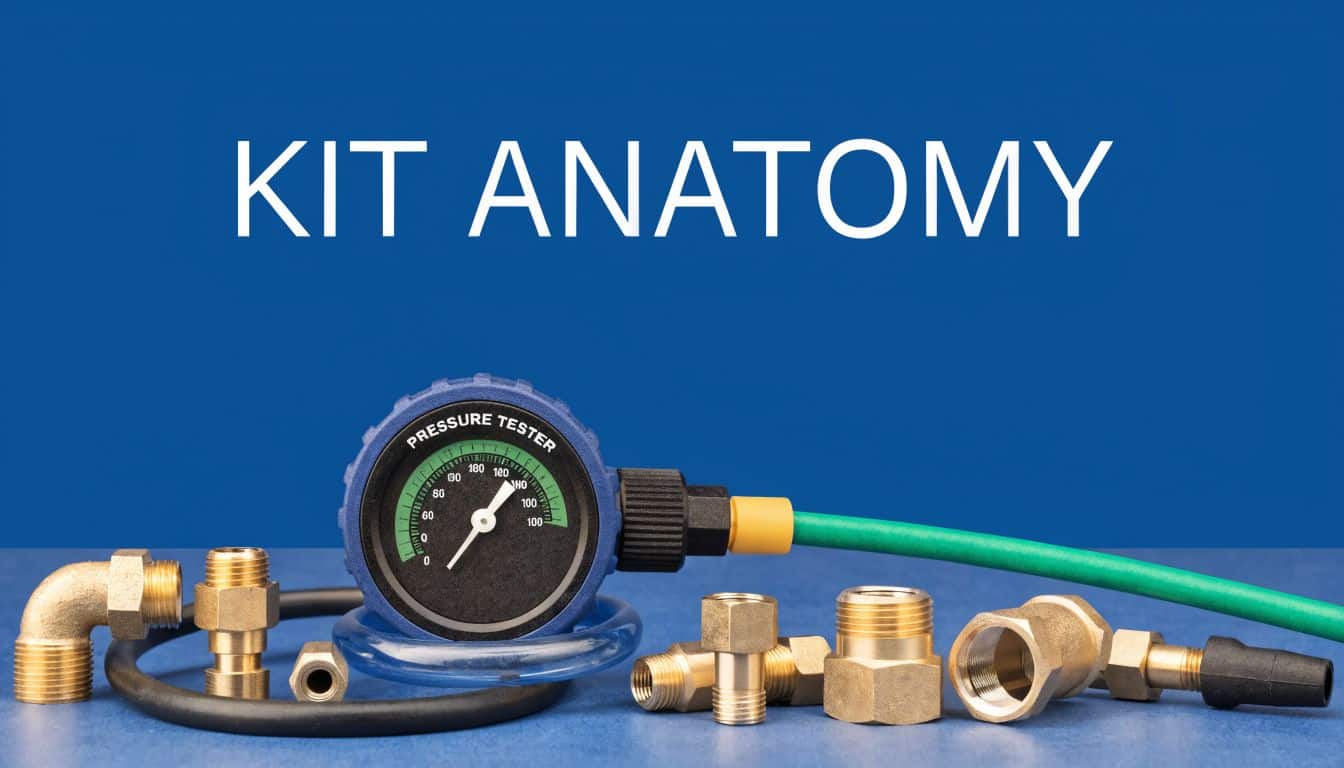
A proper kit is more than a gauge in a box. Every part has a job, and if one part is wrong, the whole test can become misleading or unsafe. Good diagnosis depends on the full chain. Gauge, hose, adaptors, couplings, and the condition of the lot.
The gauge itself
The gauge is the obvious centrepiece, but there are two main routes. Analogue Bourdon gauges are simple, sturdy, and still very hard to beat in rough service. They cope well with everyday workshop use, they're easy to read at a glance, and they don't depend on batteries or screens.
Digital gauges bring higher precision, easier peak capture, and often data logging. They're useful when you're trying to verify transient events, compare readings over time, or document a test for quality or compliance records.
A lot of engineers still keep both. Analogue for rugged first-pass diagnostics. Digital when the job needs tighter verification or traceable records. If you’re comparing options, it helps to understand the range of hydraulic pressure gauge types used in testing.
Adaptors decide whether the reading can be trusted
Plenty of kits fall short in the UK; online listings often assume US thread forms and generic compatibility. That’s fine until you’re standing next to a British or European machine with BSP ports and the adaptor in your hand doesn’t belong there.
A critical issue is adapter compatibility. Most generic guidance focuses on NPT and other US-centric threads, while UK and European machinery commonly uses BSP. According to PCI Hydraulics' notes on hydraulic pressure test kits, mismatched threads can cause 15-20% measurement inaccuracies and introduce a real safety risk.
If the adaptor doesn't seat correctly, the gauge reading becomes suspect before the test has even started.
In day-to-day work, that means the kit needs the thread forms your fleet uses. For UK mobile and industrial equipment, BSPP and BSPT matter far more than many catalogue descriptions admit.
Hoses and quick couplings
The hose often gets treated as an accessory. It isn't. The test hose has to tolerate pressure, flexing, and workshop handling without swelling, cracking, or introducing its own restriction issues. A decent microbore hose also lets you position the gauge where you can see it safely, rather than leaning over a live circuit.
Quick-release couplings matter for speed, but are even more critical for control. They help you connect consistently and reduce the amount of disturbance around the test point. On repetitive fault-finding jobs, that makes a difference.
Here’s what to look for in the hose and connection side of the kit:
- Microbore construction: Helps keep the test line manageable and reduces the amount of trapped fluid in the hose.
- Pressure-rated fittings: Every fitting in the line must suit the intended working pressure.
- Protective caps: Dirt in a test coupling will ruin readings and can contaminate the machine.
- Usable hose length: Long enough to read safely, not so long that it becomes awkward or vulnerable.
The case and layout matter more than people think
A disorganised kit slows the job and increases the chance of thread damage or missing fittings. A professional kit should make it obvious what you have, what range it covers, and what’s absent before you go to site.
A tidy case also encourages better habits. Gauges stay protected. Adaptors go back in the right places. Hoses don’t get kinked under heavier tools. That directly affects long-term reliability.
| Component | What it does | What happens if it’s wrong |
|---|---|---|
| Gauge | Displays system pressure | False diagnosis or unreadable test result |
| Adaptor | Matches machine port to tester | Leakage, thread damage, inaccurate reading |
| Hose | Carries pressure safely to gauge | Burst risk, poor handling, unreliable setup |
| Quick coupling | Speeds and stabilises connection | Awkward test procedure, more leak risk |
| Case | Protects and organises kit | Lost fittings, damaged gauge, slower work |
How to Select the Right Tester Kit for Your Application
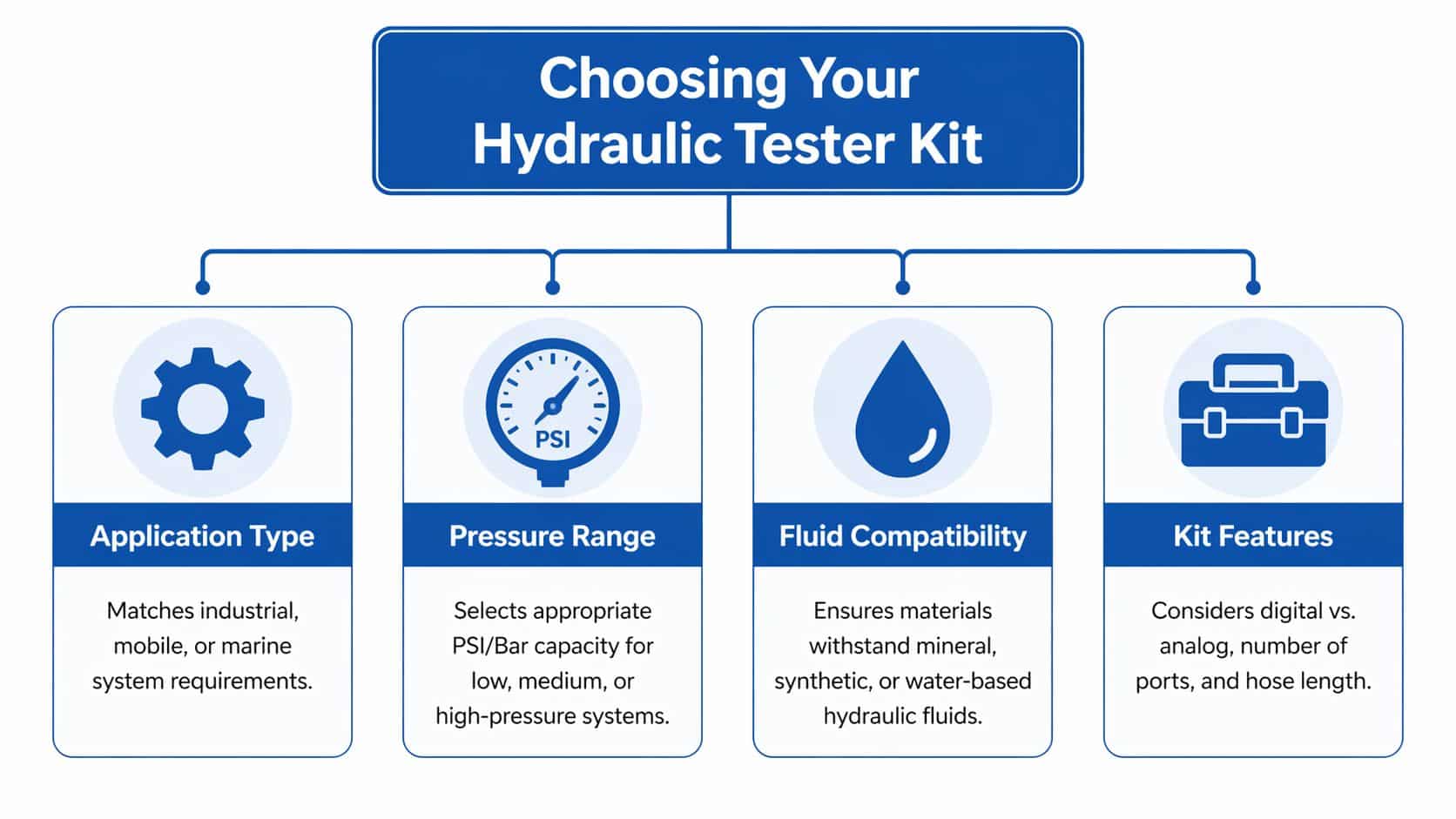
The right hydraulic pressure tester kit depends on the machine in front of you. A compact industrial power pack and a large excavator don't need the same setup. Buy too light and you limit what you can test. Buy too broad and you carry cost and clutter you may never use.
Start with the application, not the catalogue
The best buying decisions come from looking at your machines first. Ask what you service. Agricultural trailers and telehandlers. Factory machinery. Materials handling equipment. Mobile plant. Test points, pressure ranges, environmental conditions, and access all change with the application.
A workshop-based maintenance team can often work with a more delicate digital setup because storage and handling are controlled. A field engineer climbing around plant in the wet usually benefits from tougher hardware and fewer fragile extras.
For large mobile machinery in UK agriculture and construction, high-flow testing becomes its own category. The Webtec CT1500R-HPM product details describe a kit for flows up to 1500 l/min and pressures to 420 bar, aimed at diagnosing power loss in large pumps and motors. That sort of capacity is a different proposition from a basic gauge-and-hose set for routine circuit checks.
Four buying decisions that matter
Rather than buying by brand alone, break the choice into four practical decisions.
- Pressure range: The gauge has to cover the system without living at the top end of its scale all day. Too much oversizing can make lower-pressure readings less useful.
- Machine type: Mobile plant needs durability and flexibility. Fixed industrial systems often reward higher precision and better recording capability.
- Adaptor coverage: In the UK, BSP compatibility should be checked before almost anything else.
- Working environment: Wet, dirty, high-vibration conditions punish delicate gear quickly.
Analogue versus digital in real work
This comparison is usually not adequately nuanced. It isn’t a case of one being old and one being better. Each has a place.
| Feature | Analogue kit | Digital kit |
|---|---|---|
| Workshop abuse tolerance | Usually stronger | Usually more vulnerable |
| Fast glance reading | Very good | Good |
| Peak capture | Limited | Better |
| Data logging | No | Often yes |
| Battery dependence | No | Yes |
| Fine verification work | Adequate to good | Better |
Digital kits make most sense where you need a more exact record of what the system did, especially if a pressure event is brief. Analogue kits remain a solid choice where reliability in rough conditions matters more than recording detail.
Buy for the test you do most often, not the one unusual fault you might see once a year.
Match the kit to your fleet
A mixed fleet changes the answer. If you look after a handful of similar machines, a tightly matched kit is efficient. If you support multiple OEMs or varied plant, broader adaptor and pressure coverage saves repeat visits.
Consider these practical selection points:
- For agriculture: Prioritise BSP adaptors, rugged hoses, and a case that survives travel in service vehicles.
- For manufacturing: Prioritise readable gauges, repeatability, and the option to document results for maintenance records.
- For mobile plant: Vibration resistance and easy connection in awkward spaces matter more than catalogue neatness.
- For OEM test benches: Consistency and accuracy usually take priority over portability.
If you see pricing examples elsewhere in dollars, convert them to pounds before budgeting. As a rough buying frame, a basic kit may sit around £160, while a more advanced digital kit may be around £1,200, depending on specification and included adaptors. The important point isn't the headline price. It’s whether the kit avoids wasted labour, incorrect parts replacement, and repeat attendance.
What doesn’t work
A few buying mistakes come up repeatedly in the trade:
- Buying on pressure range alone: A high-range kit with the wrong fittings is still the wrong kit.
- Ignoring hose quality: A poor hose makes safe testing harder than it needs to be.
- Assuming all machinery uses the same threads: In UK service work, that assumption causes trouble fast.
- Choosing digital without thinking about environment: Screens and electronics don't enjoy every field condition.
The best kit is the one your engineers will trust and use properly. If they have to improvise around poor adaptors, unreadable scales, or awkward hoses, they’ll work around the kit instead of with it.
A Step-by-Step Guide to Safe Pressure Testing
Pressure testing is straightforward when the method is disciplined. It becomes dangerous when anyone rushes it. Hydraulic systems store energy, and stored energy punishes carelessness.

Before you connect anything
Start with machine safety, not instrumentation. Isolate the equipment where required, lower or support any suspended loads, and make sure the circuit you’re working on is understood. Wear gloves and eye protection. If access is poor, sort that first rather than working one-handed around a live line.
If the machine has a known pressure control issue, review the relevant components before the test. On many systems, hydraulic pressure relief valves are central to what the gauge will show, especially where pressure is low, unstable, or rising too early.
A safe testing sequence
Use a repeatable process. That keeps the work safer and makes the readings easier to compare from one machine to the next.
-
Identify the correct test point
Test as close as practical to the part of the circuit you want to assess. Testing in the wrong location can send you in the wrong direction. -
Confirm the adaptor thread and sealing method
Don’t force a fitting because it almost matches. If the adaptor is wrong, stop and get the right one. -
Inspect the tester kit before use
Check the hose for damage, look at the gauge condition, and make sure couplings are clean. -
Connect with the system de-pressurised where possible
This reduces risk and gives you a cleaner start to the test. -
Bring pressure in gradually
Watch the gauge as the system comes up. Sudden spikes, hesitation, or unstable rise can be useful clues in themselves. -
Record static and dynamic readings
Idle pressure and loaded pressure often tell different stories. -
Depressurise before disconnecting
Never rush the last step because the reading looked straightforward.
Static readings and loaded readings are not the same test
A machine can look acceptable at idle and still fail properly under load. Static readings show whether pressure is available. Dynamic readings show whether the system can maintain that pressure during real work.
If a cylinder extends with no load but stalls or slows badly under resistance, the loaded reading is what matters. If pressure remains healthy under load, the fault may sit in flow, mechanical drag, or internal leakage elsewhere in the circuit.
A single pressure number is only useful when you know what the machine was doing at the moment you took it.
Digital kits have become more useful in this area because they capture events that analogue needles can miss. According to Vaetrix gauge information, modern digital tester kits can offer ±0.05% accuracy and data logging. The same source says 72% of UK hydraulic repair firms now use digital kits, associated with a 25% reduction in system failures through better capture of peak pressures during valve and pump tests.
A quick visual example helps if you're training newer fitters or standardising your workshop method:
UK compliance matters in the background
Safe testing is a workshop habit, but it also sits inside legal duties. In the UK, pressure systems work has to be approached with PSSR 2000 in mind. Where those duties apply, inspection and testing intervals matter, and test equipment has to support a safe maintenance regime rather than undermine it.
That means two things on the ground. First, the test method needs to be consistent. Second, the readings need to be credible. A damaged gauge, a poor adaptor, or an undocumented pressure adjustment can create as many problems as the original fault.
Common Hydraulic Faults Diagnosed with a Tester Kit
The gauge doesn’t diagnose the machine by itself. The engineer does that. The value of the hydraulic pressure tester kit is that it turns vague symptoms into a fault pattern you can act on.

Low pressure from the start
If the system never reaches expected pressure, keep the diagnosis broad at first. A worn pump is one possibility, but not the only one. Relief valve setting, contamination holding a valve open, suction-side problems, or internal leakage can all sit behind the same symptom.
Test location matters. If pressure is low upstream and downstream, think supply or control. If it’s healthy at one point and poor at another, you’re narrowing in on the restriction or leakage path.
Pressure falls away under load
This fault catches a lot of people because the machine may appear normal until it’s asked to work. You raise the boom, clamp the load, or drive the motor hard, and pressure won’t hold.
Common causes include worn internal sealing surfaces, bypassing in the cylinder or motor, and valves leaking across lands under load. The pressure reading gives the direction. Whether it points to the pump or the actuator depends on where you tested and how the rest of the circuit behaved.
A useful workshop habit is to compare the suspect function against a known-good one on the same machine where possible. That gives context, especially on older equipment where nominal settings may already have drifted over time.
Spiking and unstable readings
Erratic pressure usually means the problem isn't just raw pressure generation. Air ingress, contamination, sticking valve elements, poor damping, or accumulator issues can all create unstable behaviour. Sometimes the machine fault is reported as noise, judder, or heat rather than obvious loss of force.
Wireless and digital kits can help here because they capture a sequence rather than a moment. According to Motionics kit information, advanced wireless kits offer ±0.25% FS accuracy with temperature monitoring, and logged data can show a 12-18% efficiency drop once fluid temperature exceeds 60°C due to viscosity loss. The same source notes that acting on that data, such as improving cooling or adjusting filtration, can deliver up to a 25% increase in uptime.
When pressure goes unstable only as oil temperature rises, don’t stop at the gauge reading. Look at what the fluid condition and temperature are doing to the whole circuit.
No pressure at all
Zero pressure sounds simple, but it still needs method. Total pump failure is one cause. So is a broken coupling, a severe blockage, a control fault preventing flow, or a test setup error. Before condemning the pump, verify drive, inlet condition, and whether the test point is seeing the circuit you think it is.
A practical troubleshooting pattern looks like this:
| Symptom at the gauge | Likely direction of fault | Next check |
|---|---|---|
| Low all the time | Pump, relief valve, suction issue, major leakage | Check upstream supply and relief behaviour |
| Good at idle, poor under load | Internal leakage or worn component under stress | Test closer to actuator or suspect valve |
| Spiking or hunting | Air, contamination, sticking valve, thermal issue | Check fluid condition, temperature, damping |
| Zero pressure | Pump drive, blockage, major control failure, wrong test point | Verify drive and circuit path before strip-down |
The key point is that a pressure reading should trigger the next sensible check. It shouldn’t trigger random parts replacement.
Calibration Maintenance and Long-Term Reliability
A pressure tester kit is only useful if the reading can be trusted. Once that trust goes, the kit becomes dangerous because it gives false confidence. A slightly damaged gauge can send an engineer down the wrong path for hours. A badly worn hose or fitting can create a safety problem before the diagnosis even starts.
Calibration is not optional
Any tester used professionally should be calibrated on a proper schedule and checked again after knocks, drops, or any event that raises doubt about accuracy. If the gauge lives in a service van, gets used across multiple sites, or spends its life around vibration, assume drift is possible.
That matters for fault-finding, but also for compliance. If you’re making decisions about system condition, pressure settings, or serviceability, the instrument must be defensible. An unverified reading is weak ground for any adjustment or sign-off.
What to inspect in-house
You don’t need to wait for annual calibration to look after the kit. Good workshop habits keep it reliable between formal checks.
- Inspect hoses regularly: Look for cracking, flattening, bulges, and damaged outer cover.
- Protect threads and couplings: Dirty or bruised fittings cause leaks and bad readings.
- Check gauge behaviour: A sticky pointer, cracked lens, or inconsistent zero position means the gauge needs attention.
- Store the kit properly: Keep adaptors capped, hoses coiled correctly, and the case dry and organised.
An inaccurate pressure gauge is worse than no gauge because it sends you confidently in the wrong direction.
Reliability over years, not weeks
Well-kept tester kits last. Poorly kept ones become a jumble of half-matching adaptors, suspect hoses, and a gauge no one quite believes. When that happens, engineers start improvising, and improvisation around hydraulic pressure is never a good habit.
Treat the tester like a precision instrument, not a general workshop accessory. If it gets dropped, contaminated, or borrowed into abuse, pull it back into inspection before it goes out again. That discipline costs less than one misdiagnosed pump or one preventable failure after a poor test.
Your Partner in Hydraulic System Excellence
A hydraulic pressure tester kit turns fault-finding into diagnosis. It helps you work from evidence, not hunches, and that means safer repairs, less downtime, and fewer unnecessary parts changes. The engineers who get the best results are usually the ones who choose the right kit for their machines, use it methodically, and keep it calibrated so every reading means something.
