
If you're searching for a "pump Ingersoll Rand", you're on the right track. You're looking for a piece of equipment built to last, from a manufacturer whose name is synonymous with quality and reliability. These pumps are a familiar sight in workshops and factories across the UK, known for their durability in demanding environments. They come in pneumatic, hydraulic, and electric models, meaning there's a solution for almost any job you can throw at them.
An Introduction to Ingersoll Rand Pumps for UK Industries
In the tough worlds of UK manufacturing, mobile plant, and agriculture, you can't afford downtime. Reliability isn't a bonus; it's the baseline. This is where Ingersoll Rand has earned its reputation, by engineering pumps that just keep going, day in and day out, even under the most punishing conditions. Whether you need to shift abrasive slurries, handle corrosive chemicals, or move high-viscosity fluids, these are the pumps trusted to keep operations flowing.
It’s no exaggeration to say an Ingersoll Rand pump is often the heart of an operation. It provides the critical flow and pressure that powers machinery, transfers materials, and gets the job done. Without it, production lines would grind to a halt and mobile equipment would be dead in the water.
Core Pump Technologies
Ingersoll Rand doesn't offer a one-size-fits-all solution. Their portfolio is built on different core technologies, and knowing the basics is the first step to choosing the right tool. You'll mainly come across three types:
- Pneumatic Pumps: Think of the classic ARO Air-Operated Diaphragm (AODD) pumps. These are the real workhorses for fluid transfer. They run on compressed air, which makes them inherently safe for use in hazardous areas where a spark from an electric motor could be disastrous.
- Hydraulic Pumps: These are the muscle behind most mobile and industrial machinery. They convert mechanical power into high-pressure hydraulic force, powering everything from a tractor's loader arms and an excavator's bucket to massive factory presses.
- Electric Pumps: Driven by a standard electric motor, these pumps deliver precise control and excellent efficiency. You’ll find them in fixed installations everywhere, from water treatment plants and chemical processing lines to the HVAC systems in large buildings.
At MA Hydraulics, we know that trying to navigate this huge range of options can feel overwhelming. Our job is to cut through the complexity. As your UK-based partner, we help you find, source, and fit the perfect Ingersoll Rand pump—or a fully compatible alternative—for your specific system.
Our team has the hands-on experience to cross-reference part numbers and recommend solutions that give you the performance you need without breaking the bank. Whether you're trying to keep old equipment running, specifying parts for a new project, or hunting for a spare part that seems impossible to find, we're here to help. This guide will give you the essential knowledge, and we're ready to back you up with expert support.
For practical advice or to source your next pump, give us a call on 01724 279508 today or send a message through our contact page.
Understanding Different Ingersoll Rand Pump Technologies
To get the right pump Ingersoll Rand has for your job, you first need to look under the bonnet. The brand's reputation is built on a few core technologies, each engineered to solve a specific set of industrial problems. Getting to grips with how these different pump types work is the key to choosing the right tool.
Pneumatic Diaphragm Pumps, which you'll often see under the ARO brand name, are the backbone of countless fluid transfer operations. Their design is beautifully simple and exceptionally tough. Think of them working like a pair of lungs: compressed air is used to alternately fill and empty two chambers, which are separated by flexible diaphragms.
This back-and-forth 'breathing' action pulls fluid into one side while pushing it out from the other. Because there are no spinning parts or intricate seals directly in the fluid's path, these pumps are brilliant at handling difficult materials. We're talking about everything from abrasive slurries and thick adhesives to aggressive chemicals and even fluids with solids mixed in, all without causing damage.
The Power of Pneumatic Diaphragm Pumps
Pneumatic pumps, especially the Air-Operated Double Diaphragm (AODD) models like the workhorse ARO EXP series, are found everywhere in general industry. They run on compressed air, not electricity, which makes them inherently safe for use in explosive or hazardous areas—an absolute must-have in places like chemical plants or distilleries.
Their performance is also incredibly easy to control. By just tweaking the air pressure and volume going into the pump, you can fine-tune the flow rate and output pressure on the fly. This makes them adaptable for a huge range of tasks.
- Flow Rates: A smaller pump might handle just 10-20 Litres per Minute (L/min), while the big industrial units can shift over 1,000 L/min.
- Pressure: Most AODD pumps run on a 1:1 pressure ratio. Put simply, if you feed it 7 bar of air pressure, you get roughly 7 bar of fluid pressure out.
- Fluid Handling: Their gentle pumping action and the huge choice of materials (from polypropylene to stainless steel) mean they can handle almost any fluid you throw at them.
One of the biggest real-world advantages of a pneumatic diaphragm pump is its ability to run dry without destroying itself. If the fluid supply gets cut off, the pump just stops cycling. You can also stall it under full pressure indefinitely without it overheating or wearing out. As soon as the line is clear, it starts right back up. That’s a massive benefit over other pump designs.
Generating High Pressure with Piston Pumps
While diaphragm pumps are the masters of transfer, piston pumps are the specialists when you need serious pressure. The principle is a lot like the pistons in a car engine. A piston slides back and forth inside a cylinder, drawing fluid in on one stroke and then forcing it out at high pressure on the next.
Ingersoll Rand produces a whole range of piston pumps that you'll typically find in high-pressure cleaning, paint spraying, or dispensing very precise amounts of lubricants and sealants. They are designed to act as force multipliers, taking the power from a pneumatic or hydraulic motor and converting it into high-pressure fluid output.
This design lets them hit much higher pressures than diaphragm pumps, often reaching several hundred bar. That power does come with a trade-off, though. Piston pumps aren't fond of abrasive particles, which can score the cylinder walls or damage the seals over time. They really are at their best when working with clean fluids.
Comparing Pump Technologies at a Glance
Choosing between these technologies really comes down to a "horses for courses" approach. Every pump Ingersoll Rand makes is optimised for a specific kind of job.
| Feature | Pneumatic Diaphragm Pump | Piston Pump |
|---|---|---|
| Primary Use | Fluid Transfer & Dosing | High-Pressure Applications |
| Pressure Range | Low to Medium (Typically up to 8 bar) | High to Very High (Up to 400+ bar) |
| Fluid Compatibility | Excellent for abrasives, solids, chemicals | Best with clean, non-abrasive fluids |
| Key Advantage | Can run dry, intrinsically safe, simple | High-pressure generation, precise dispensing |
| Typical Application | Chemical transfer, waste removal, paint supply | Pressure washing, lubrication systems, spraying |
With this foundational knowledge, you can start to see which technology is the right starting point. Whether you need to move a large volume of a tricky slurry or spray a fine coating at high pressure, Ingersoll Rand has a purpose-built solution ready to go.
For help selecting the perfect technology for your specific challenge, Phone 01724 279508 today, or send us a message at our contact page.
Getting to Grips with ARO Product Families and Models
When you start looking into Ingersoll Rand pumps, the ARO brand name will pop up almost immediately. It’s a core part of the Ingersoll Rand family, carrying a long legacy of building tough, reliable fluid handling equipment. To make the right choice for your operation, you first need to understand their main product lines: the EXP, Pro Series, and Compact Series.
Think of these not as competing models, but as different tools for different jobs. Each one is designed with a specific set of strengths. You’ve got the intelligent, highly efficient option; the straightforward, heavy-duty workhorse; and a smaller, nimble solution for getting into tight spots.
Knowing the difference between these families is the key to specifying the right pump Ingersoll Rand offers through its ARO brand, ensuring you get the performance you need right from the start.
ARO EXP Series: The Smart and Efficient Choice
The EXP Series is ARO's top-tier line of air-operated double diaphragm (AODD) pumps. The "EXP" stands for Expert Series, and they really earn that name by packing in smart technology for incredible control and efficiency.
What makes an EXP pump stand out is its ability to connect with an electronic interface controller. This means you can integrate the pump directly into your plant’s wider control system, like a PLC (Programmable Logic Controller). Suddenly, you have precise, automated control over batching, dosing, and fluid transfer. An EXP pump can be started, stopped, or have its flow rate tweaked automatically as part of a modern production line.
But it’s not just about being smart; the EXP series is also built for peak efficiency. A patented, "unbalanced" air valve design is at the heart of the pump, which cleverly prevents it from stalling out, even when running on very low air pressure. This design also slashes air consumption, which can lead to some serious cost savings. In a large-scale chemical transfer operation, for instance, cutting air usage by just 10-15% can easily translate into thousands of pounds saved every year.
Pro Series: Built for Unrelenting Durability
If the EXP series is the brains of the operation, the Pro Series is pure muscle. These pumps are designed with one thing in mind: to work reliably, day in and day out, in the most demanding industrial environments you can throw at them. They are made to take a beating, whether it's from abrasive slurries in a quarry or corrosive chemicals in a processing plant.
Engineers and maintenance crews love the Pro Series for its straightforward, rugged design. The bolted construction keeps everything leak-free and makes servicing the pump a much simpler job.
- Heavy-Duty Build: They often have thick-walled metallic or non-metallic bodies designed to stand up to abrasion and chemical attacks.
- Simple Air Valve: The valve design favours absolute reliability over complex features, making it easy for technicians to service in the field.
- Versatile Workhorse: While not as "smart" as the EXP, these are the go-to pumps for general transfer, dewatering, and shifting waste fluids.
Think of a busy fabrication workshop, where a pump is needed to move waste coolant full of gritty metal swarf. This is exactly where a Pro Series pump excels. It isn't a delicate instrument; it's a tough, dependable tool built to handle the messy reality of the shop floor.
Decoding the ARO Model Numbering System
One of the most useful things you can learn is how to read an ARO model number. It’s like a secret code that instantly tells you everything about the pump's size, materials, and capabilities. While the format can vary a little, a typical model number like PD05P-APS-PTT-A breaks down like this:
| Part | Code | Meaning |
|---|---|---|
| Pump Family | PD | Pro Series Diaphragm |
| Port Size | 05 | 1/2 Inch (12.7 mm) |
| Wetted Parts | P | Polypropylene |
| Centre Section | A | Aluminium |
| Seats | P | Polypropylene |
| Balls | S | Santoprene |
| Diaphragms | PTT | PTFE / Santoprene |
| Pump Series | A | ARO Designation |
Being able to crack this code is a massive advantage for maintenance and ordering parts. When a pump is due for a service, you can instantly identify the exact materials you need for a repair kit without having to take the unit apart first. It saves time, prevents ordering mistakes, and gets your equipment back up and running that much faster.
If you need a hand selecting the right ARO pump series or identifying the correct parts for your model, our expert team is here to help. Phone us on 01724 279508 today, or send us a message for specialist advice.
How to Select the Right Pump for Your Application
Choosing the right Ingersoll Rand pump for your operation is one of those decisions that pays dividends for years to come. Get it right, and you'll have a reliable workhorse that boosts efficiency and minimises running costs. Get it wrong, and you're in for a future of frustrating downtime, poor performance, and unexpected repair bills.
Making a confident choice isn’t about guesswork; it’s about methodically matching the pump to the job. This means getting to grips with the fluid you’re moving, the performance you absolutely need, and the environment the pump has to survive in. By working through a few key variables, you can quickly narrow down the options to find the perfect fit for your system.
This decision tree gives you a simplified starting point for navigating the main ARO pump families.
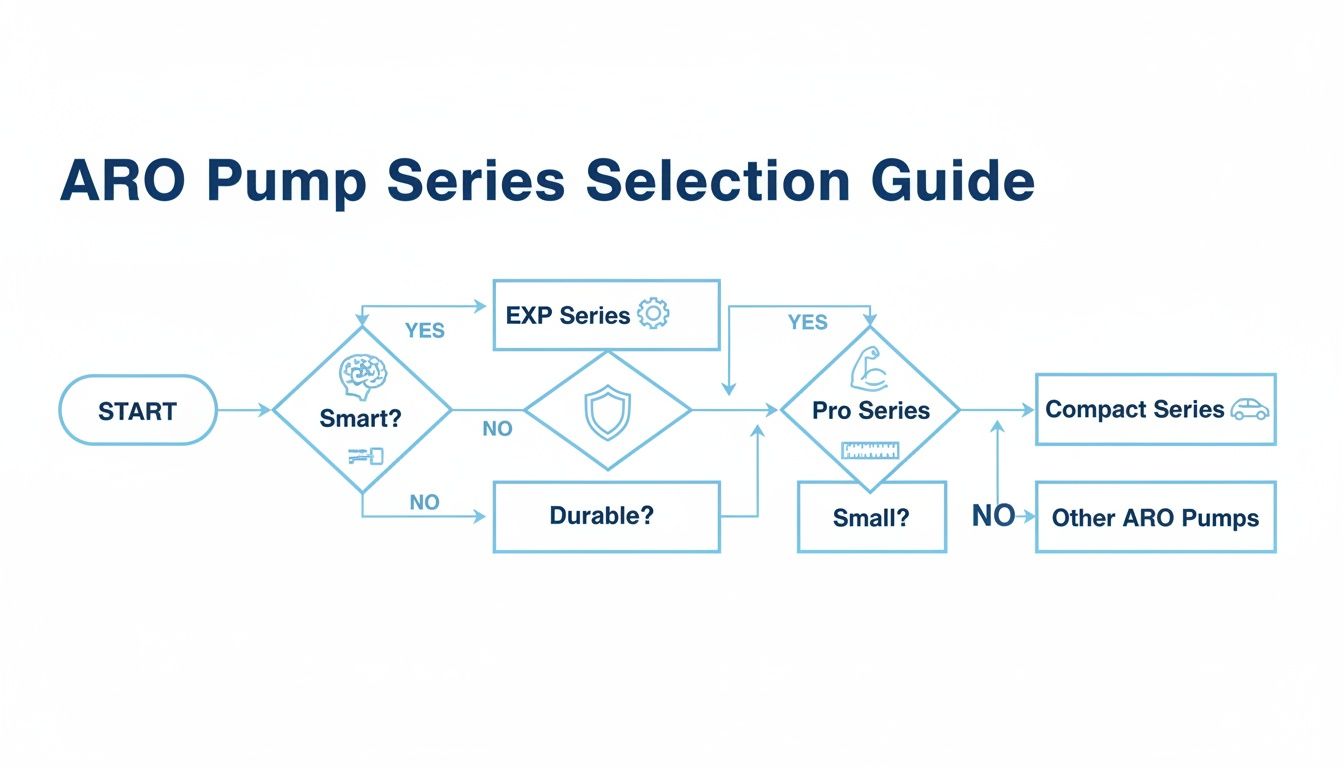
At a glance, you can see how your main priority steers your choice. If you're after smart, automated control, the EXP series is your first port of call. If raw durability in a tough environment is what matters most, the Pro series is likely where you'll end up.
Assessing Your Core Performance Needs
Before looking at any pump model, you first need to define its job in clear terms. For any pumping application, it all boils down to two fundamental parameters: flow rate and pressure.
-
Flow Rate (Litres per Minute – L/min): This is simply the volume of fluid you need to move in a set amount of time. Are you gently dosing chemicals, or do you need to shift the contents of a large tank in a hurry? A low-flow application might only require 5 L/min, whereas a bulk transfer job could demand 900 L/min or more.
-
Pressure (bar): This is the force required to get the fluid where it needs to go. It isn’t just about lifting the fluid; it's about pushing back against all the resistance in the system. This includes friction from the pipework itself, every bend and valve, and any back-pressure at the final destination.
This brings us to a crucial concept: Total Dynamic Head (TDH). Don’t let the technical name intimidate you. Think of it as the total amount of work the pump has to do, expressed as an equivalent height of fluid. It’s the sum of the static lift (how high you’re pumping), friction loss, and final outlet pressure. A solid TDH calculation is the bedrock of correctly sizing a pump.
Matching the Pump to the Fluid
The fluid you're handling is often the single most important factor in your decision. Its unique properties will dictate which materials are safe to use and, in many cases, which type of pump technology is even viable.
-
Chemical Compatibility: Will the fluid eat your pump from the inside out? Moving aggressive acids, alkalis, or solvents demands wetted parts made from highly resistant materials like Stainless Steel, PVDF, or polypropylene. Putting an aluminium pump in a system with a caustic fluid, for instance, is a recipe for rapid, catastrophic failure.
-
Viscosity: How thick or "sticky" is your fluid? Water is a low-viscosity fluid, but materials like grease, molasses, or heavy adhesives are highly viscous. Pumping thicker products demands more power and often a specific pump design—like a piston pump—that can handle the load without stalling or losing efficiency.
-
Abrasives and Solids: Does your fluid contain solid particles? This could be grit in wastewater, pigments in paint, or food solids in a slurry. Diaphragm pumps are a fantastic choice here, as their design lacks the tight-clearance rotating parts that would be quickly destroyed by abrasive materials.
A food processing line moving fruit puree (high viscosity, contains solids) needs a completely different pump than a workshop system circulating clean lubricating oil. The former might require a sanitary stainless steel diaphragm pump, while the latter could happily use a standard piston pump.
Choosing pump materials is always a balance between chemical resistance and cost. While a PVDF pump provides incredible resistance for the harshest chemicals, it's often an unnecessary expense for a simple water transfer task where a polypropylene body will perform perfectly for years. The goal is to choose the material that gives you the longevity you need without over-specifying and over-spending.
Finalising Your Selection Checklist
Once you've defined your performance needs and the nature of your fluid, it's time to build a final checklist. This is about considering the full context of where and how the pump will be installed and operated.
To help you organise these final details, the table below provides a structured way to think through the key selection factors for your specific application.
Ingersoll Rand Pump Selection Checklist
| Selection Factor | Key Considerations for Your Application | Example ARO Pump Series |
|---|---|---|
| Mounting & Footprint | Will it be on a mobile cart or fixed to the floor? What are the space constraints? | Pro Series (versatile mounting options), Compact Series (for tight spaces) |
| Port Size | Must match existing pipework (e.g., 25 mm, 50 mm) to avoid flow restrictions or the need for adapters. | Varies across all series (e.g., 12.7 mm to 76.2 mm ports available) |
| Operating Environment | Is it a hazardous (ATEX) zone? Exposed to weather? A clean room? | EXP Series (ATEX-compliant options), Pro Series (rugged construction) |
| Fluid Properties | What is the viscosity, chemical makeup, and solids content? | EXP Series (for high-viscosity), Specialty Pumps (for specific fluid types) |
| Performance Needs | What are the required flow rate (L/min) and pressure/TDH (bar)? | EXP Series (high performance), Pro Series (general duty) |
| Budget | What is the total cost of ownership (initial price + long-term running costs)? | Pro Series (cost-effective reliability), EXP Series (higher initial cost, lower running cost) |
Considering these factors helps ensure you don't just buy a pump, but invest in the right solution. For example, a top-of-the-line, electronically controlled pump from the ARO EXP series might have a higher initial cost of around £1,500-£2,500, but its superior air efficiency could save you far more than that in energy costs over its lifetime compared to a basic model costing £600-£900.
By systematically working through these practical steps, you transform a vague need for "a pump" into a detailed specification for the right pump.
If you need a hand in selecting the perfect pump for your unique application, our team has the expertise to guide you through the process. Phone 01724 279508 today, or send us a message through our contact page.
Pump Installation, Maintenance, and Troubleshooting
Owning a high-quality pump Ingersoll Rand builds is only half the story. Getting the most out of it—maximising its life and performance—all comes down to proper installation, diligent maintenance, and knowing how to troubleshoot when things go wrong. For any service engineer or maintenance team, mastering these three areas is the secret to cutting downtime and keeping running costs in check.
Getting it right from the moment you unbox the pump prevents a whole host of problems down the line. Think of it as laying a solid foundation for a long, productive service life. A proactive maintenance plan then builds on that foundation, and a clear troubleshooting guide acts as your safety net for when issues eventually crop up.
Best Practices for Pump Installation
A smooth installation is your first and best chance to lock in reliability. If you rush this stage, you’ll often find yourself chasing performance issues that are a real headache to diagnose later. A methodical approach is always the best way forward.
One of the most common mistakes we see is the use of undersized pipework or air lines. For a pneumatic pump, a restricted air supply will literally starve it of power, making it sluggish and unable to hit the pressure you need. It’s the same story on the fluid side; a pipe that’s too narrow creates far too much friction, forcing the pump to work harder than it should.
Always check the manufacturer’s guide for the recommended air and fluid line diameters. It's often a good idea to go one size larger than the pump's port size, particularly on long pipe runs. This simple step minimises pressure drop and ensures the pump can breathe and run as efficiently as it was designed to.
A Proactive Maintenance Schedule
Reactive maintenance—waiting for something to break before you fix it—is an expensive game to play. A much smarter strategy is proactive, preventative maintenance, which lets you spot small issues before they snowball into major failures. For an ARO pump, this really boils down to regular checks and timely servicing.
A basic daily or weekly walk-around inspection can be incredibly valuable. Just look, listen, and take note.
- Listen for Leaks: Check every air and fluid connection for that tell-tale hissing or any visible drips.
- Monitor Performance: Keep an eye on the cycle speed and fluid output. If you notice a drop in either, it's an early warning sign of internal wear.
- Check the Muffler: On a pneumatic pump, if you see excessive fluid or an oily mist coming from the exhaust muffler, it's a dead giveaway that internal seals or diaphragms are on their way out.
When it’s time for a full service, using high-quality repair kits is non-negotiable. It can be tempting to save a few quid with cheaper, non-genuine parts, but this is almost always a false economy. A poor-quality diaphragm or seal can fail prematurely, causing more downtime and potentially wrecking the pump's core components.
Using a genuine ARO service kit, or a high-quality equivalent from a trusted supplier, ensures every component is made to the right tolerances from the right materials. These kits give you everything you need for either the fluid section (diaphragms, balls, seats) or the air section (seals, gaskets, O-rings), making the overhaul process simple and reliable.
Common Pump Problems and How to Fix Them
Even with the best maintenance plan in the world, problems can still happen. Having a logical troubleshooting process helps you find and fix issues fast, getting your operations back up and running with minimal delay. Here are a few of the most common faults and what’s likely causing them.
Problem 1: The Pump Won't Start or Cycles Erratically
This is a classic, especially with pneumatic pumps. Before you start taking the pump apart, always check the simplest explanation first: is it getting enough air?
- Check Air Supply: Make sure the air valve is open and the line pressure is set correctly. A blocked filter or regulator in the air line can easily starve the pump of the power it needs to cycle.
- Inspect the Air Valve: The main air valve can get stuck because of contamination or worn seals. Servicing the air section with the right kit usually solves this.
- Blocked Muffler: A muffler clogged with ice (a common problem in cold, damp air) or other debris can create enough back-pressure to stop the pump in its tracks.
Problem 2: Low Fluid Output or Pressure
If the pump is running but just isn't delivering the performance you expect, the problem is probably on the fluid side. This usually means the pump isn't creating suction properly, or fluid is slipping past worn components.
- Check for Air Leaks: A loose fitting on the suction hose is a very common culprit. If the pump is pulling in air instead of fluid, its output will drop off a cliff.
- Worn Balls and Seats: The check valve balls and seats are what direct the flow. If they get worn or damaged, fluid can slip backwards with each stroke, hammering your overall efficiency. Inspect them for pitting or erosion and replace if needed.
- Diaphragm Failure: A ruptured diaphragm is a major reason for low output. The biggest clue is fluid being blown out of the air exhaust muffler.
This table gives you a quick-reference guide for troubleshooting these common issues.
| Symptom | Most Likely Cause | Solution |
|---|---|---|
| Pump will not cycle | Insufficient air pressure or blocked air valve. | Verify air supply; service the air section. |
| Low fluid output | Worn fluid section components (balls, seats). | Install a fluid section repair kit. |
| Fluid in air exhaust | Ruptured diaphragm. | Replace diaphragms immediately. |
| Pump cycles but no flow | Blockage in suction line or empty fluid source. | Check for blockages and ensure fluid supply. |
By combining correct installation with a disciplined maintenance routine and a logical approach to troubleshooting, you can ensure your Ingersoll Rand pump delivers the reliable, long-term performance it was built for. Proactive care is your best defence against unexpected and costly interruptions.
For expert advice on maintenance or to source the correct service kits for your pump Ingersoll Rand model, our team is ready to help. Phone 01724 279508 today, or send us a message for specialist support.
Getting Your Hands on Ingersoll Rand Spares and Upgrades
Sooner or later, every engineer runs into the same problem: trying to find the right part for an Ingersoll Rand pump. It’s a frustrating search, especially if you’re dealing with an older or discontinued model. Whether it’s a simple service kit or a critical component, sifting through catalogues can eat up valuable hours you just don’t have. This is exactly where having a specialist on your side pays dividends.
At MA Hydraulics, we’ve spent decades getting our hands dirty with this exact problem. Our job isn’t just to sell you a part; it's to get your machinery back up and running. We have a deep well of experience cross-referencing Ingersoll Rand and ARO part numbers, which means we can quickly pinpoint genuine spares or find high-quality, perfectly compatible alternatives when others have hit a brick wall.
Finding Smarter Alternatives When a Direct Swap Isn’t an Option
Sometimes, a direct replacement simply isn't on the table, or frankly, isn't the best value for money. When that happens, our knowledge of the wider hydraulics market really comes into its own. We’ve built strong relationships with trusted European manufacturers like Vivoil and Hydronit, whose products we know inside and out for their reliability.
By taking the exact performance specs of your old Ingersoll Rand pump—its flow rate, pressure rating, and mounting setup—we can specify a modern equivalent that will drop right into your system without any fuss. This isn't just a workaround; it often brings some real advantages:
- Speed: We maintain a large stock right here in the UK. That means we can get a pump or part to your door far quicker than waiting on extended lead times from a global giant.
- Better Value: A high-quality alternative can deliver the performance and long life you need at a much better price, giving you a lower total cost of ownership.
- Improved Efficiency: Swapping out an ageing, tired pump for a modern unit often results in noticeable energy savings.
For MRO teams and OEMs in the UK, the sheer scale of the big manufacturers can be a double-edged sword, affecting both price and availability. Ingersoll Rand, for instance, reported a profit before tax of £748.24 million in a recent financial year—a figure that highlights the vastness of their global operation. Working with a more agile, UK-based expert like MA Hydraulics helps you sidestep these supply chain headaches. You can find more detail on the financials of major manufacturers on HL.co.uk.
Bespoke Builds and Expert UK Support
Our support doesn't stop at off-the-shelf parts. If a standard pump just won’t cut it, we have the in-house expertise to design and build bespoke hydraulic power packs from the ground up, tailored precisely to your application. We handle everything from the initial design and component specification to the final assembly and testing, delivering a complete, plug-and-play solution.
Think of us as your go-to UK hydraulics partner. We’re here to be the first call you make, combining deep technical knowledge with fast, reliable service to make sure you get the right fix, right now.
Whether you're hunting for a single obscure part, need help identifying a replacement for an obsolete pump, or require a fully custom-built system, our team is ready to give you practical, expert advice.
For any pump or hydraulic component needs, give us a call on 01724 279508, or send us a message through our contact form.
Your Questions Answered
We get asked a lot of great questions about Ingersoll Rand and ARO pumps. Here are some of the most common ones, along with practical answers from our team.
Is It Okay to Use Non-Genuine Repair Kits on My ARO Pump?
It’s a tempting shortcut, we get it. Cheaper, unbranded kits are easy to find, but it's a false economy. Using high-quality, manufacturer-approved equivalent parts is the only way to guarantee long-term reliability. A poor-quality seal or diaphragm can fail without warning, leading to costly downtime and often causing more damage to the pump itself.
At MA Hydraulics, we’re firm believers in getting it right the first time. That’s why we only supply service kits and components that meet or exceed the original specifications, giving you dependable performance you can count on.
How Can I Figure Out the Model of My Ingersoll Rand Pump?
Almost every pump Ingersoll Rand makes has a metal data plate or tag fixed to the main body. This little plate is your key, holding all the vital information for servicing, including the full model number and a unique serial number.
With that information, ordering the right service kits or replacement parts is straightforward. But what if the plate is damaged, unreadable, or missing altogether? Don't worry. Our experienced team can often identify the pump from a few good photos and a quick chat about how and where you use it.
A clear picture of the pump, especially any visible markings, is usually all our experts need to cross-reference it and find exactly what you need. It saves a lot of guesswork and prevents ordering the wrong parts.
What Are the Telltale Signs My Diaphragm Pump Needs a Service?
Most of the time, an AODD pump will give you a few warnings before it fails completely. These are often gradual changes in performance, so keep an eye out for them.
The classic signs include:
- A drop in fluid output: The pump is running, but it just isn't moving as much liquid as it used to.
- Air leaking from the exhaust: If you see a mist of fluid or drips coming from the air exhaust muffler, that’s a textbook symptom of a ruptured diaphragm.
- An erratic or slow cycle: The pump's rhythm feels off, or it seems to struggle and labour through each stroke.
Any of these symptoms usually points to worn-out parts in the air motor or the fluid section. It's a clear signal that it's time to get a service kit installed.
For expert help identifying a pump, finding the right parts, or troubleshooting a stubborn problem, the team at MA Hydraulics Ltd is always ready to support you.
Phone 01724 279508 today, or send us a message https://www.mahydraulics.co.uk/contact-us/
