
A new plant manager usually meets preventive maintenance plans the hard way. A hose bursts on a press just before shift change. A forklift attachment goes down in the yard. A power pack starts whining, the oil foams, the filter bypass opens, and suddenly the job isn't one failed component. It's lost production, a safety issue, a rushed parts order, and a maintenance team dragged off scheduled work to fight a fire.
Hydraulic systems punish delay. Small faults rarely stay small. A worn rod seal becomes contamination ingress. Dirty oil scores a pump. A blocked filter starves flow. A valve sticks and the symptom shows up somewhere else, which wastes even more time while people chase the wrong cause.
That's why good preventive maintenance plans matter. In UK industry, they're still the basic discipline that keeps asset-heavy operations stable, even as more advanced methods gain ground.
The True Cost of Hydraulic System Downtime
Hydraulic downtime is rarely just “machine stopped”. In practice, one failure often pulls three teams into the same problem. Production wants the line back. Maintenance wants access and parts. Management wants to know why it wasn't caught earlier.
On hydraulic equipment, the knock-on effects are worse than many new managers expect. Oil leaks create slip risks and housekeeping problems. Emergency strip-downs invite contamination. Parts get changed in a hurry, often without finding the root cause. The machine returns to service, then fails again under load.

Why reactive maintenance keeps losing
Reactive maintenance looks simple because the decision is delayed until something breaks. The trouble is that hydraulics don't fail neatly. A failed hose can contaminate the whole circuit. A tired pump can damage valves and actuators downstream. A leaking cylinder might still move, which encourages people to keep running it until the repair gets bigger and messier.
Preventive maintenance on hydraulics isn't admin. It's damage control done early.
There's also a wider operational point. In the UK, preventive maintenance is the most widely used strategy overall. A 2024 survey of MRO professionals found that while nearly one-third of companies use predictive maintenance, structured preventive plans remain the default starting point for asset-intensive operations (UK maintenance survey findings).
That matters because it reflects how most reliable sites work. They don't wait for full predictive coverage before getting organised. They build a stable preventive routine first, then add condition monitoring where it makes sense.
What hydraulic downtime really exposes
When a hydraulic asset fails unexpectedly, it usually exposes one or more weaknesses:
- Poor inspection quality means leaks, heat, noise, and contamination warning signs were missed.
- Weak planning discipline means filters, seals, hoses, or couplings weren't available when needed.
- Unclear ownership means no one knew who should stop the machine before the fault spread.
- Bad maintenance timing means intrusive work was postponed until the failure chose the shutdown window for you.
A preventive plan won't remove every breakdown. It will stop many avoidable ones, reduce the severity of the ones that still happen, and make the remaining failures easier to diagnose.
Building Your Hydraulic Asset Inventory
Most preventive maintenance plans start too late. People jump straight to service intervals and checklists before they've properly defined the assets. If your inventory is just “Press 1”, “Press 2”, and “Power Pack”, the plan will stay vague and the work orders will stay generic.
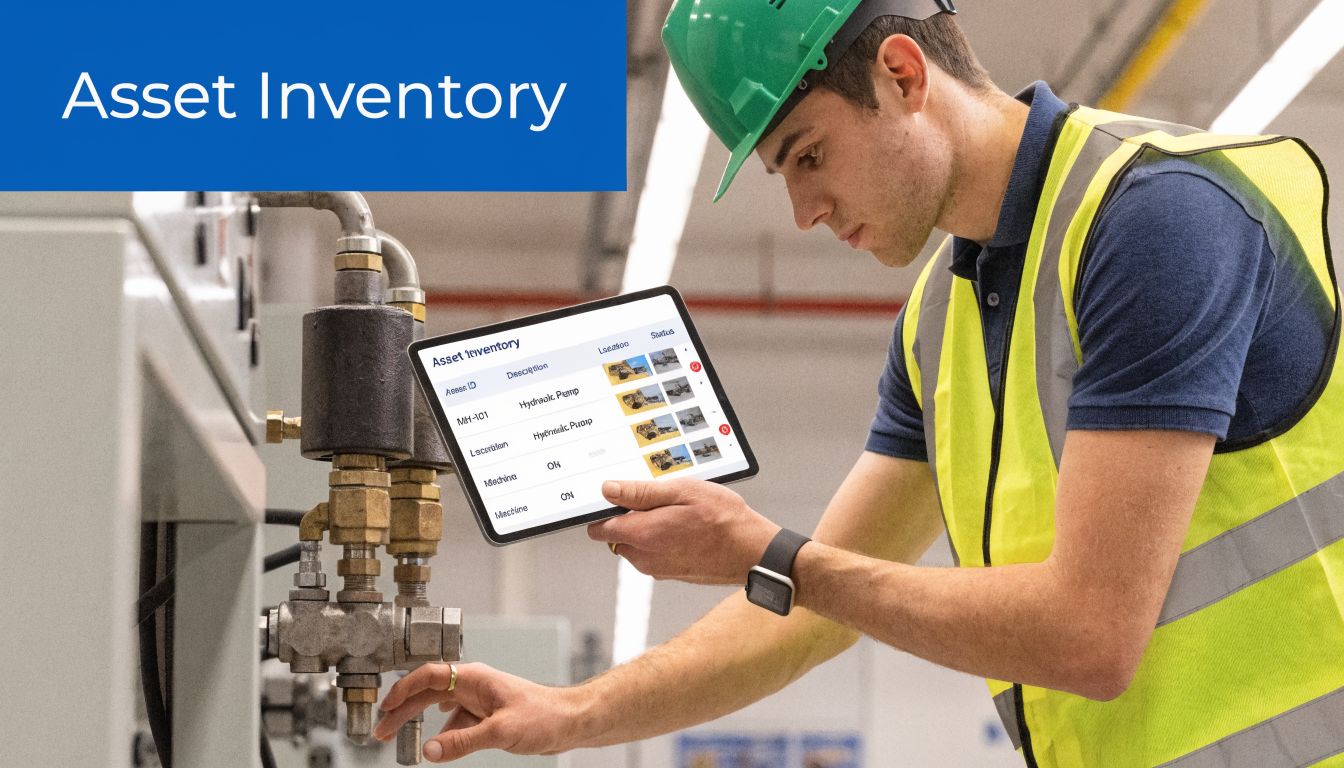
A useful hydraulic asset inventory goes deeper. It identifies not just the machine, but the hydraulic system inside it and the critical subassemblies that fail. That means pumps, motors, cylinders, valve banks, manifolds, filters, coolers, hoses, accumulators, sensors, and power packs.
What to record for each asset
Start with the basics, but don't stop there. The record should help a technician make decisions quickly.
- Asset identity. Machine name, plant location, tag number, manufacturer, model, and serial details.
- Hydraulic configuration. Pump type, valve arrangement, filtration points, reservoir size, working pressure, and fluid type.
- Operating context. Duty cycle, environment, contamination exposure, temperature issues, and whether the machine runs continuously or intermittently.
- Support information. Drawings, schematics, manuals, parts lists, previous work orders, and known recurring faults.
New managers often miss one critical field. Record the function of the asset in plain language. “Runs press ram”, “controls clamp circuit”, “powers conveyor lift”, “steering on mobile plant”. When a fault occurs, function tells you what production loss looks like.
Rank assets by consequence, not by age
Old equipment isn't automatically the highest priority. Some old machines are forgiving and easy to repair. Some newer hydraulic systems are tightly integrated and can stop an entire cell when one valve block misbehaves.
Use a simple criticality review. You don't need a complicated software model to get value from it. Ask:
- If this asset fails, does production stop or just slow down?
- Does the fault create a safety risk, especially from stored pressure or uncontrolled movement?
- Can the machine be bypassed?
- Are the spares common or hard to obtain?
- Does the same failure mode keep returning?
That's enough to separate nuisance assets from line-stoppers.
Practical rule: Build your preventive maintenance plans around consequence of failure first, not convenience of access.
A brief visual guide can help your team think in the same structured way before you start assigning tasks.
A simple hydraulic criticality view
| Asset type | Typical failure effect | PM priority |
|---|---|---|
| Main hydraulic power pack | Multiple functions lost | High |
| Cylinder on non-critical adjustment | Local nuisance or quality issue | Medium |
| Return-line filter assembly | Contamination risk across system | High |
| Hose on auxiliary circuit | Local leak, possible safety issue | Medium to high |
| Standalone service unit | Limited production impact | Lower |
The point of this exercise isn't paperwork. It's focus. If your team has limited hours, they should spend them where hydraulic failure causes the most operational pain.
Defining Hydraulic Maintenance Tasks and Frequencies
A preventive plan fails when tasks are either too generic or too intrusive. “Check hydraulics” is useless. So is stripping healthy components on a fixed calendar just because that's how it's always been done.
The better model is a closed loop. Inventory and rank the assets, define task triggers by time, usage, or condition, and then measure execution with KPIs. That approach is especially practical for hydraulics because triggers can be tied to operating hours, duty cycle, and contamination risk (closed-loop preventive maintenance guidance).
Build tasks around failure modes
Hydraulic systems don't all wear in the same way. Pumps suffer from contamination, cavitation, heat, and poor suction conditions. Cylinders suffer from rod damage, seal wear, side loading, and contamination ingress. Filters become restrictions. Hoses age, rub, crack, or loosen at fittings.
That means your task list should be component-specific.
Pumps and motors
Look for:
- Abnormal noise such as whine, chatter, or signs of aeration
- Temperature drift beyond normal operating behaviour
- External leakage at shaft seals, ports, and casing joints
- Mounting issues such as loose couplings, misalignment, or bellhousing wear
Cylinders
Inspect:
- Rod condition for scoring, pitting, or impact damage
- Seal area for weeping or active leakage
- Mounts and pins for looseness that can introduce side load
- Stroke behaviour for creep, hesitation, or uneven movement
Filters
Check:
- Restriction indicators or pressure drop where fitted
- Housing condition and seal integrity
- Correct element specification during replacement
- Change-out cleanliness so the service task doesn't introduce contamination
Fluid and reservoir
Pay attention to:
- Fluid level
- Visual condition including cloudiness, darkening, or foam
- Breather condition
- Tank cleanliness around fill points, lids, and return zones
For sites refining their oil service intervals, a guide on hydraulic oil change frequency is useful because hydraulic oil shouldn't be changed on habit alone. The interval needs to reflect contamination risk, temperature, and duty.
Choose the right trigger type
Not every PM task belongs on a monthly calendar.
| Trigger type | Best for | Hydraulic example |
|---|---|---|
| Time-based | Ageing parts or routine checks | Scheduled hose inspection |
| Usage-based | Wear linked to run hours or cycles | Pump inspection after operating hours |
| Condition-based | Visible or measured deterioration | Filter change when restriction indicates |
Many plans fail at this stage. Teams rely too heavily on time-based tasks because they are easy to schedule. Hydraulics often respond better to a mix. A machine that runs lightly in a clean environment may need less intervention than an identical machine working hard in dust, dirt, washdown, or temperature swings.
Don't create over-maintenance
Every intervention carries risk. Opening a hydraulic system creates an opportunity for dirt ingress, wrong assembly, trapped air, and damaged seals. If the asset history shows stable performance, no repeat failures, and clean inspection results, shortening intervals may make the plan worse, not better.
On hydraulic systems, maintenance quality matters as much as maintenance frequency.
A solid task sheet should include the job steps, isolation requirements, tools, likely parts, cleanliness controls, and the acceptance standard for completion. “Inspect hose” is too vague. “Inspect hose for abrasion, blistering, twisting, clamp damage, and seepage at fittings” is maintainable.
Organising Work Orders and Spare Parts
A spreadsheet can start a maintenance routine. It rarely sustains one. Once the site has multiple assets, recurring PMs, outstanding defects, and parts dependencies, spreadsheets become a memory aid rather than a control system.
The central issue isn't whether Excel can hold a list. It can. The problem is whether your team can trust it during a busy week when shutdowns move, jobs are rescheduled, and two different technicians touch the same hydraulic asset.
Spreadsheets versus a proper maintenance system
Here's the practical difference:
| Method | What it does well | Where it breaks down |
|---|---|---|
| Spreadsheet | Cheap to start, familiar, simple asset lists | Weak history, poor traceability, easy to miss schedule changes |
| CMMS | Recurring work orders, asset history, parts links, task attachments | Needs setup discipline and consistent use |
If your operation has outgrown manual tracking in other areas too, it's worth reading about integrated systems for manufacturing and wholesale. The same pattern usually shows up in maintenance. Once data lives in too many separate files, people stop trusting the process.
A good work order for a hydraulic PM should include asset ID, isolation method, job steps, parts expected, cleanliness controls, and a clear close-out note. The note matters. “Completed” tells you almost nothing six months later. “Changed return filter, found metallic debris in bowl, sample taken, monitor pump noise next inspection” gives you something to work with.
Stock parts by consequence of downtime
Not every spare belongs on the shelf. Holding everything ties up cash and often leaves you with the wrong variants anyway. But holding nothing is just outsourcing your downtime to lead times.
For hydraulic systems, the best approach is to stock according to criticality and replacement speed.
- Keep on site items that fail predictably, are low cost compared with downtime, or are required to return a critical machine quickly. Think seals, filter elements, common hoses, suction strainers, O-rings, pressure gauges, and often couplings.
- Review carefully higher-value items such as pumps, motors, valve cartridges, and complete manifolds. Their stock position should reflect how critical the machine is and how difficult sourcing will be.
- Order to demand specialist or rarely used components where substitute options exist and downtime exposure is lower.
If a critical machine depends on a specific filter or seal kit, that part should not be “easy enough to get” in theory. It should be physically available or formally covered by a reliable supply route. Practical guides on how to change a hydraulic filter also help standardise simple jobs that often go wrong through poor cleanliness or incorrect element fitting.
One sensible option some sites use is support from MA Hydraulics Ltd for planned preventative maintenance inputs such as filter changes, hose and fitting inspections, fluid analysis, and pressure or performance checks where internal resource is limited.
Measuring Performance with Maintenance KPIs
If you can't show whether the plan is working, the plan will eventually be challenged by production pressure. Maintenance gets judged quickly when the site is busy. That's why preventive maintenance plans need a small set of KPIs that are practical, visible, and tied to execution quality.
Start with the KPIs that expose planning quality
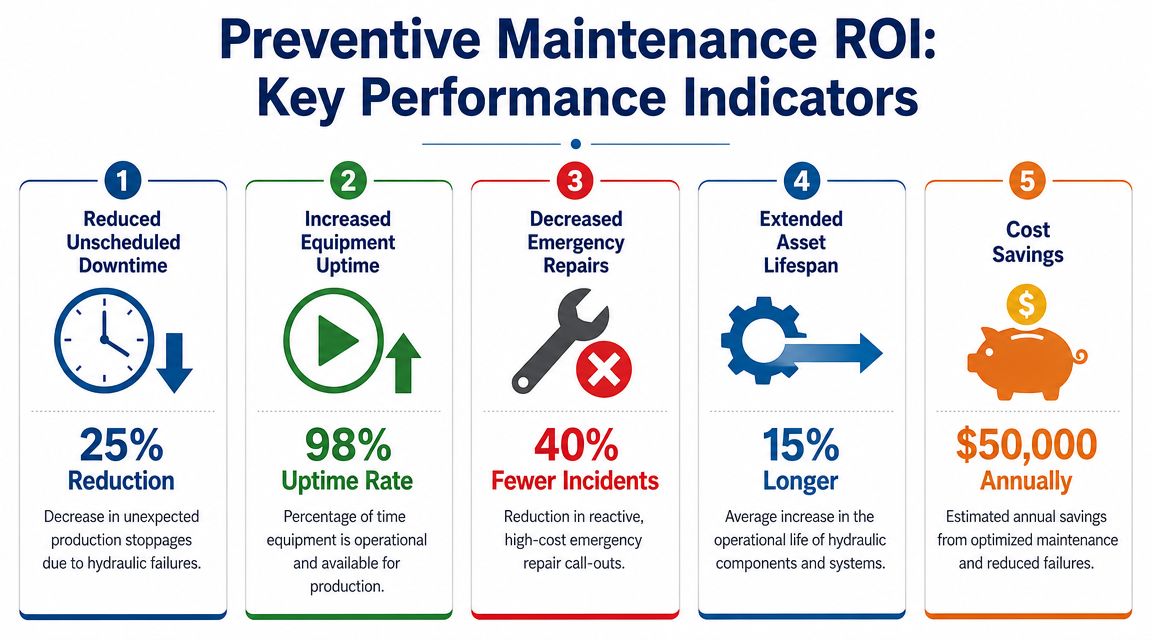
In mature PM programmes, a Planned Maintenance Percentage of 80 to 85% and PM Compliance of 90% or higher are common benchmarks in industry practice (maintenance KPI benchmarks). Those figures matter because they show whether the team is mostly doing planned work or spending too much time reacting.
For hydraulic maintenance, four KPIs usually tell the truth fastest:
| KPI | What it shows | Why it matters |
|---|---|---|
| Planned Maintenance Percentage | Share of labour spent on planned work | Reveals whether breakdowns are controlling the week |
| PM Compliance | Whether PM tasks were completed on time | Exposes missed inspections and weak schedule discipline |
| Schedule Compliance | Whether scheduled work was finished in the agreed window | Shows if planning and execution are aligned |
| MTBF | Time trend between failures | Indicates whether reliability is actually improving |
Read the pattern, not just the number
A single month's result can mislead you. What matters is direction and consistency.
If PM compliance is high but failures keep repeating, your team may be completing the wrong tasks or using poor intervals. If planned maintenance percentage improves but schedule compliance falls, planners may be overloading the week with work that can't realistically be done. If MTBF stays flat on one hydraulic asset class, check whether contamination, heat, duty cycle, or poor repair quality are still present.
A completed PM isn't proof of reliability. It's proof that a task was closed. The reliability question is answered by what happens afterwards.
For hydraulic systems, contamination data often sharpens the picture. If you're trying to understand whether filters, breathers, oil handling, and cleanliness controls are working, particle counting gives a much clearer view than visual inspection alone.
Use KPI reviews to change the plan
KPI meetings shouldn't become blame sessions. They should answer practical questions:
- Which PMs were missed, and why. No access, no labour, no parts, or poor planning?
- Which assets still fail after PM work. That usually points to bad task content or bad intervals.
- Where is reactive work rising. Rising reactive share is a warning that inspections are slipping or the schedule no longer matches the operating reality.
- Which technicians found recurring defects. Their notes often reveal the next improvement before the spreadsheet does.
A useful review rhythm is simple. Look at the overdue PMs, repeat failures, breakdown history by asset class, and whether planned work is displacing reactive work over time. If the plan can't survive that review, it isn't mature yet.
Implementing Your Plan and Ensuring Safety
The hardest part of preventive maintenance plans isn't writing them. It's protecting them once production pressure starts pushing back. That's where many sites fail. The plan exists, everyone agrees with it, and the work still slips because nobody can get the machine stopped at the right time.
That execution gap is common. Industry commentary notes that companies often value PM in principle but still struggle to fit it into live operations. Inconsistent processes and scheduling around production are frequent failure points, and the central question becomes how to do PM without creating backlog or risk (maintenance execution gap in practice).
Stop treating access as an afterthought
Many PM plans assume the machine will be available when the calendar says so. It won't. Operations will always have a reason to keep running, especially if the asset appears healthy.
The fix is operational, not theoretical:
- Agree maintenance windows in advance with production, not the day before.
- Tier PM tasks by deferral risk so everyone knows what can move and what can't.
- Bundle intrusive work to make each stoppage count.
- Stage tools and parts before shutdown so the maintenance window is spent working, not searching.
For hydraulic systems, short stoppages are often enough for inspection, filter checks, hose assessment, leak tracing, and pressure verification. Larger interventions such as cylinder seal work or pump replacement need a properly protected outage.
Safety on hydraulics starts with stored energy
New managers sometimes focus on obvious electrical lock-off and underestimate hydraulic stored energy. That's a serious mistake. Pressure can remain trapped in lines, cylinders can drift, and accumulators can release energy after the prime mover is isolated.
Your PM procedure should always define:
- Isolation points
- Pressure release method
- Mechanical support for raised loads
- Accumulator discharge steps where fitted
- Verification that movement is no longer possible before work begins
Never let a routine hydraulic PM become “just a quick look” if the system hasn't been safely depressurised.
Cleanliness is also a safety and reliability issue. Opening a live or poorly isolated circuit under pressure risks injection injury as well as contamination entry. Both are avoidable with proper procedure.
Technician feedback keeps the plan realistic
A preventive plan written only by managers usually looks tidy and performs badly. The technicians doing the work know which access panels seize, which gauges lie, which hose routes rub, and which OEM intervals don't survive real duty.
Use that knowledge. If a PM routinely overruns, ask why. If the same defect keeps appearing, ask whether the inspection point is too late or too vague. If tasks are skipped because the machine is hard to access, redesign the job pack or modify the asset where justified.
Training matters too. Hydraulic PM is not just wrench work. People need to recognise contamination signs, understand pressure behaviour, interpret symptoms correctly, and close jobs with useful notes. That's how the plan improves instead of just repeating itself.
Start Building a More Reliable Future Today
Good preventive maintenance plans are practical, not complicated. You identify the hydraulic assets properly, rank them by business risk, define tasks around real failure modes, organise the work orders and parts so the plan can happen, and then measure whether reliability is improving.
The strongest plans also accept a hard truth. A calendar by itself won't protect a hydraulic system. Execution, cleanliness, safe isolation, and technician judgement are what turn a schedule into uptime.
If you're new in post, don't try to perfect everything at once. Start with the assets that hurt most when they fail. Tighten the inspection quality. Standardise the common service jobs. Track whether planned work is replacing reactive work. Then refine the intervals with evidence, not habit.
Preventive maintenance works best when it reflects the way your plant really runs. That means protecting maintenance windows, stocking the right spares, and being disciplined enough to stop doing tasks that add labour without reducing failure risk.
If you need practical support with preventive maintenance plans, replacement components, filtration, hose inspections, power packs, or hydraulic fault finding, contact MA Hydraulics Ltd. Phone 01724 279508 today, or send us a message.
