
A hydraulic pressure gauge is a straightforward but crucial tool that measures the pressure inside a hydraulic system. It usually shows this reading in bar or pounds per square inch (PSI).
Think of it as the blood pressure monitor for your machinery. It gives you a live, vital sign reading, telling you exactly what's happening with the force being generated by the hydraulic fluid. More often than not, this simple device is the first and most important window into your system's overall health.
What a Hydraulic Pressure Gauge Reveals About Your System
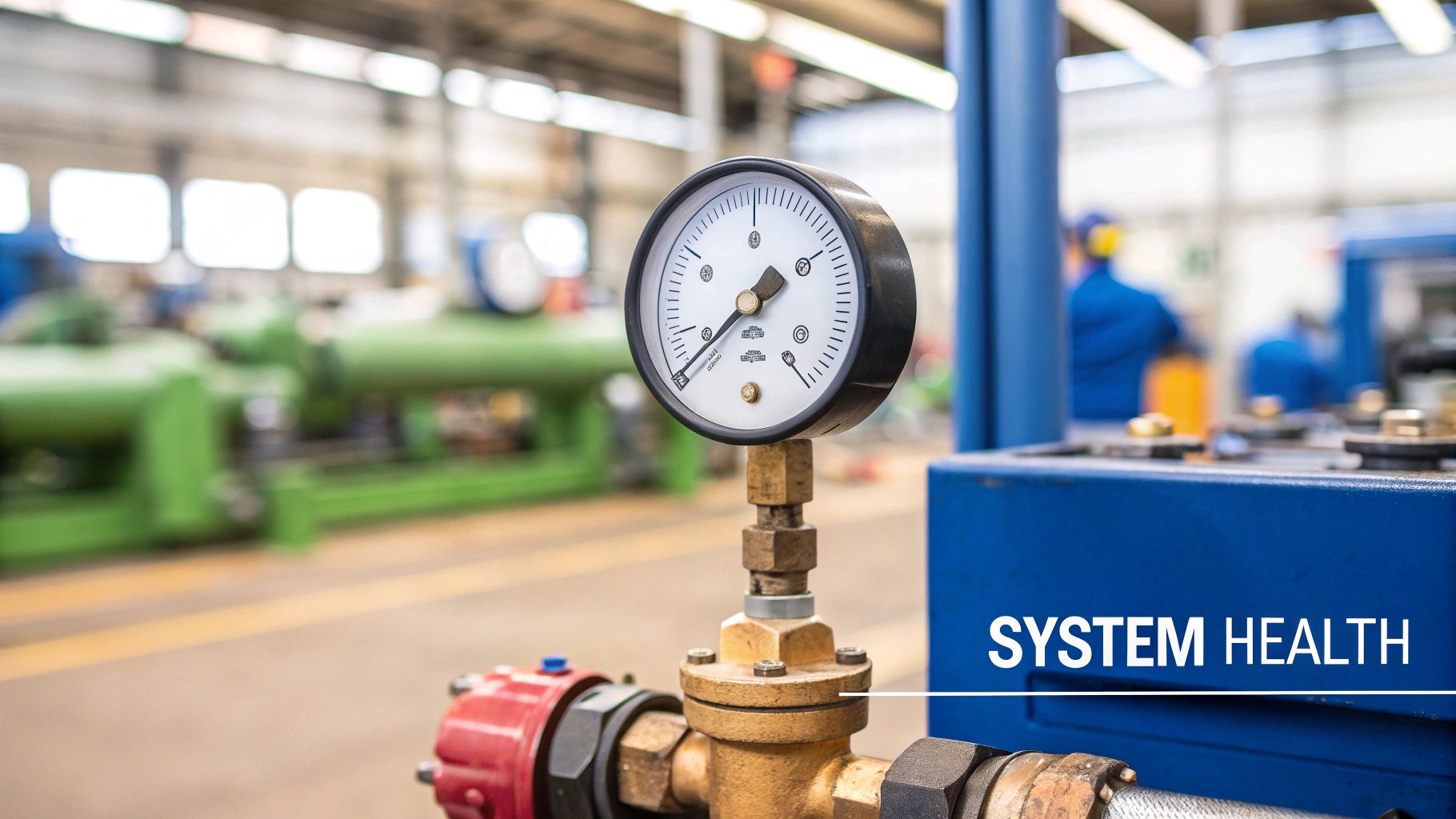
At its heart, a hydraulic system works by putting a liquid—usually a specialised oil—under immense pressure to generate and move force. This pressurised fluid is the lifeblood that drives everything from the lifting arms on a digger to the immense power of a factory press. The hydraulic pressure gauge is what translates that invisible force into a number you can actually read and act on.
Without a reliable gauge, you're flying blind. You have no idea if the system is running at the right pressure, struggling to cope with a heavy load, or creeping towards a dangerous over-pressure situation. That's why accurate monitoring isn't just a nice-to-have; it's fundamental to managing any hydraulic system safely and efficiently.
The First Line of Defence
Consider a hydraulic pressure gauge your system's early warning signal. It gives you instant feedback on how the most important components are performing. By simply watching the needle on the dial or the numbers on a digital display, an experienced technician can spot a whole range of problems long before they turn into costly failures.
For example, if you notice the pressure is consistently lower than it should be, it could point to an internal leak in a cylinder or a pump that's wearing out. On the flip side, a sudden, sharp spike in pressure might tell you there’s a blockage somewhere in the line or a relief valve has failed.
Here’s what a gauge can tell you at a glance:
- Pump Health: A steady and correct pressure reading, both when the system is idling and under load, is a great sign that your pump is in good shape.
- Valve Operation: Watching how the pressure changes as you operate different valves helps confirm they are opening and closing properly.
- Load Conditions: The gauge clearly shows the force the system is generating, letting you know if it’s operating within its design limits.
- System Leaks: A slow, gradual loss of pressure when the system should be static is often the first clue you have a hidden leak.
The Consequences of Neglect
Ignoring a faulty gauge or just not bothering to check the pressure can lead to some pretty serious outcomes. The risks go well beyond a bit of lost efficiency; we're talking about significant financial hits and major safety hazards. A common result is a gradual drop in performance, where machinery feels sluggish and less responsive, burning more fuel or power to do the same job.
A malfunctioning or inaccurate gauge is not just a faulty component; it's a blind spot in your safety and maintenance strategy. The cost of a new gauge, often less than £50, is insignificant compared to the potential cost of downtime or a catastrophic system failure.
Eventually, this neglect can lead to a catastrophic failure. An undetected over-pressure event can burst hoses, blow seals, or even rupture metal components. This means expensive repairs, long periods of downtime, and a very real risk of serious injury to anyone nearby. It’s precisely why a dependable hydraulic pressure gauge, especially on a bespoke hydraulic power unit, is such a critical investment.
For expert advice on your system's needs, Phone 01724 279508 today, or send us a message at https://www.mahydraulics.co.uk/contact-us/.
Understanding the Different Types of Hydraulic Gauges
When you’re looking to select a hydraulic pressure gauge, it’s easy to think they’re all more or less the same. The reality is that different types are engineered with specific operating principles, making each one better suited for particular environments. Getting your head around these core differences is the first step to choosing an instrument that will be reliable and long-lasting.
The most common design you'll come across is the classic Bourdon tube gauge. Its operation is brilliantly simple. Inside the casing, you’ll find a C-shaped, flattened metal tube. One end is sealed, and the other is connected to the system pressure.
As hydraulic fluid pressure enters the tube, it tries to straighten out – think of how a coiled party blower unfurls when you blow into it. This slight movement is then mechanically amplified through a delicate system of gears and levers, which causes the pointer to sweep across the calibrated dial. This robust, purely mechanical design needs no external power and has been the industry standard for decades because it’s so dependable and cost-effective.
Mechanical Gauges for Different Needs
While the Bourdon tube is the undisputed workhorse of the industry, some applications just demand a different mechanical approach.
- Diaphragm Gauges: These use a flexible metal diaphragm to create a barrier between the process fluid and the gauge's internal workings. They are fantastic for measuring low pressures or when you're dealing with corrosive or sludgy fluids that would clog up a Bourdon tube in no time.
- Bellows Gauges: A bit like diaphragm types, these gauges use a spring-like, accordion-style bellows that expands and contracts with pressure changes. They offer fantastic accuracy at lower pressure ranges and are sensitive enough to pick up on very small fluctuations.
Ultimately, the choice between these mechanical types comes down to your system’s pressure range and the kind of fluid you're measuring.
Analogue vs Digital Readouts
The most obvious difference between gauges is how they display the reading. Deciding between a traditional analogue dial and a modern digital screen means weighing up simplicity, precision, and extra features.
Here is a quick look at how analogue and digital gauges stack up against each other.
Analogue vs Digital Hydraulic Pressure Gauges at a Glance
| Feature | Analogue (e.g., Bourdon Tube) | Digital |
|---|---|---|
| Readability | Good for quick “at-a-glance” checks to see if pressure is within a safe range. | Excellent for precise, unambiguous numerical readings, removing guesswork. |
| Precision | Accuracy is suitable for most industrial and mobile applications. | Typically offers higher accuracy and resolution, ideal for testing and calibration. |
| Power Needs | Fully mechanical, requiring no batteries or external power source to operate. | Requires batteries or a power supply, which need periodic replacement or connection. |
| Durability | Robust and simple mechanical design is resistant to electrical interference. | Can be sensitive to extreme temperatures, moisture, and electrical noise. |
| Advanced Features | Limited to showing current pressure, with some models having a max reading pointer. | Often includes features like peak pressure memory, backlighting, and data logging. |
Each type has its place. An analogue gauge is a tough, no-nonsense tool for everyday monitoring, while a digital gauge provides the pinpoint accuracy needed for diagnostics and fine-tuning.
The Importance of Liquid-Filled Gauges
Ever seen the pointer on a pressure gauge flutter so wildly you can't get a reading? This is a common problem on machinery that experiences constant vibration or rapid pressure spikes, like excavators, tractors, or industrial presses. This isn't just annoying; the constant oscillation can quickly wear out the delicate internal mechanism, leading to premature failure.
This is exactly why liquid-filled gauges were invented.
The gauge casing is filled with a viscous fluid, usually glycerine, which surrounds the Bourdon tube and pointer mechanism. This liquid acts as a damper, absorbing vibrations and smoothing out pressure pulsations. The result is a steady, easy-to-read pointer, even in the harshest conditions.
This simple addition makes a world of difference, significantly extending the life of the gauge and ensuring you can always get an accurate reading when it counts. Given the demanding conditions in many UK industries, it's no surprise that the national market for these critical components is growing. In the UK, the pressure gauges market is forecasted to grow steadily at a 3.6% CAGR, a testament to the nation's robust industrial landscape. You can find more insights about the UK pressure gauge market on Future Market Insights.
Whether you opt for analogue or digital, dry or liquid-filled, selecting the right type of hydraulic pressure gauge is fundamental to keeping your system running safely and efficiently.
For help choosing the perfect gauge for your equipment, give us a call on 01724 279508 today, or send us a message.
How to Choose the Right Gauge for Your Application
Picking the right hydraulic pressure gauge isn't as simple as grabbing one off the shelf. It’s about getting a perfect match for your system's specific needs. Get it wrong, and you could be looking at dodgy readings, a busted gauge, or even a serious safety issue. Let's walk through what really matters so you can make a smart, reliable choice every time.
First things first: the pressure range. This is the absolute most important factor. The gauge's scale has to be a good fit for the system it's monitoring.
A golden rule in the industry is to choose a gauge with a maximum reading that’s double the normal working pressure of your system. So, if your machine usually runs at 150 bar, you'll want a gauge that goes up to at least 300 bar. This keeps the needle operating in the middle third of the dial—where it's most accurate—and gives you a vital safety margin for those unexpected pressure spikes that could otherwise wreck the delicate internals.
Key Specifications to Consider
Once you've got the pressure range sorted, a few other details make a huge difference to how well a gauge performs and how long it lasts.
- Accuracy: Gauges come in different accuracy classes. For general day-to-day monitoring on industrial kit or mobile machinery, an accuracy of ±1.6% or ±2.5% of the full scale is usually perfectly fine. But if you're working on a test bench or doing calibration, you’ll need a much higher precision gauge of ±1.0% or even better.
- Dial Size: This is all about practicality. A big 100 mm dial is a breeze to read from a distance, which is ideal for large, stationary industrial power packs. On the other hand, a more compact 63 mm dial is a better fit for the cramped spaces you often find on mobile equipment.
- Connection Thread: Your gauge needs to connect to the system without any leaks. In the UK, the most common thread type is BSP (British Standard Pipe), but you'll also see NPT (National Pipe Taper), which is an American standard. Always double-check the thread size and type on your port to get a secure fit.
Matching Materials to the Environment
The materials a gauge is made from are crucial for its survival, especially when the going gets tough. The main choice you'll face is between brass and stainless steel for the internal parts.
A brass mechanism is a great, cost-effective option for standard hydraulic oil systems in clean, dry, indoor settings. It works well when the gauge isn't going to be exposed to corrosive stuff or harsh weather.
For tougher conditions, a stainless steel gauge is the only way to go. It offers brilliant resistance to corrosion, whether that's from aggressive fluids inside the system or from saltwater, chemicals, or constant washdowns on the outside. This makes it a must-have for marine, offshore, and food processing work.
Thinking about the environment, especially factors like vibration, is a massive part of getting the selection right.
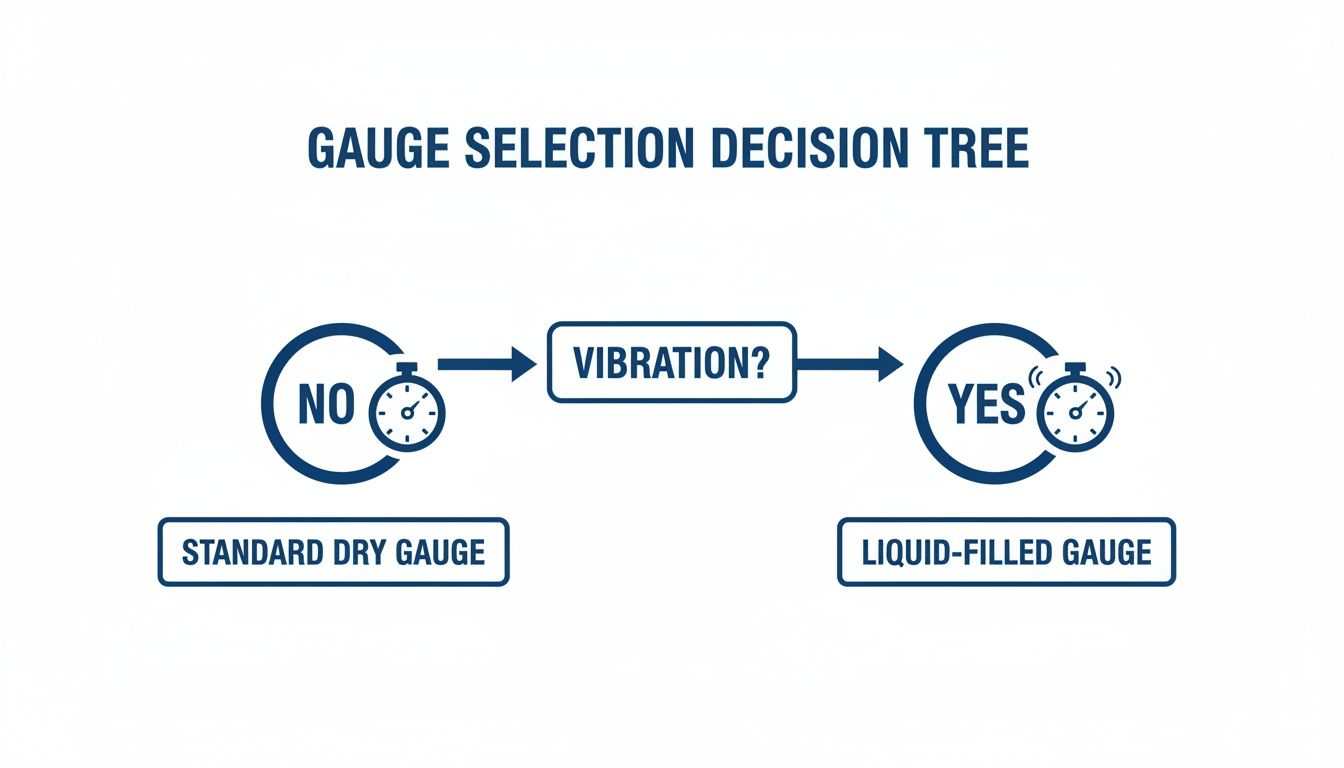
This decision tree nails a key point: if your system shakes and rattles, a liquid-filled gauge is the only sensible choice. It protects the mechanism and keeps the needle steady.
Real-World Application Examples
To see how this all comes together, let's look at how your choice of gauge changes depending on the job.
Across the UK hydraulics industry, the 3.6% CAGR for pressure gauges is being driven by updates in the oil, gas, and marine sectors. Since 2020, the uptake of digital hydraulic gauges has jumped 18% in UK industries, thanks to Industry 4.0 trends. Big offshore wind projects, aiming for 40GW by 2030, require seriously tough models that can handle pressures of 350 bar. While the market has many players, UK specialists like MA Hydraulics are essential for stocking reliable brands and offering proper advice, which can slash procurement time by up to 30% for maintenance teams. You can discover more insights about the hydraulic pressure gauge market on Market Report Analytics.
This trend just goes to show how important it is to get application-specific kit.
- Industrial Power Packs: These are usually kept indoors and don't move. A 100 mm dial, brass-wetted, dry gauge is often the perfect fit. But if that power pack is running a press that causes constant pressure pulses, adding a liquid-filled gauge or a snubber is a smart move.
- Mobile Construction Machinery: Think diggers, loaders, and cranes. They're constantly dealing with vibration, shocks, and bad weather. Here, a smaller (63 mm), stainless steel, glycerine-filled gauge is non-negotiable. It's built to take the abuse and still give a stable reading. This is also true for equipment using smaller components; you can check out our range of hydraulic hand pumps for these kinds of mobile setups.
- Agricultural Equipment: Tractors and harvesters face a similar rough ride to construction machines, but with added dust, moisture, and chemical sprays. A tough, liquid-filled stainless steel gauge is the best bet to ensure it lasts through planting and harvest.
Ultimately, choosing the right gauge is a balancing act between technical specs, the working environment, and pure, simple usability.
For expert help selecting the perfect gauge for your specific application, give us a ring on 01724 279508 today, or send us a message.
Getting it Right: Gauge Installation and Maintenance Best Practices
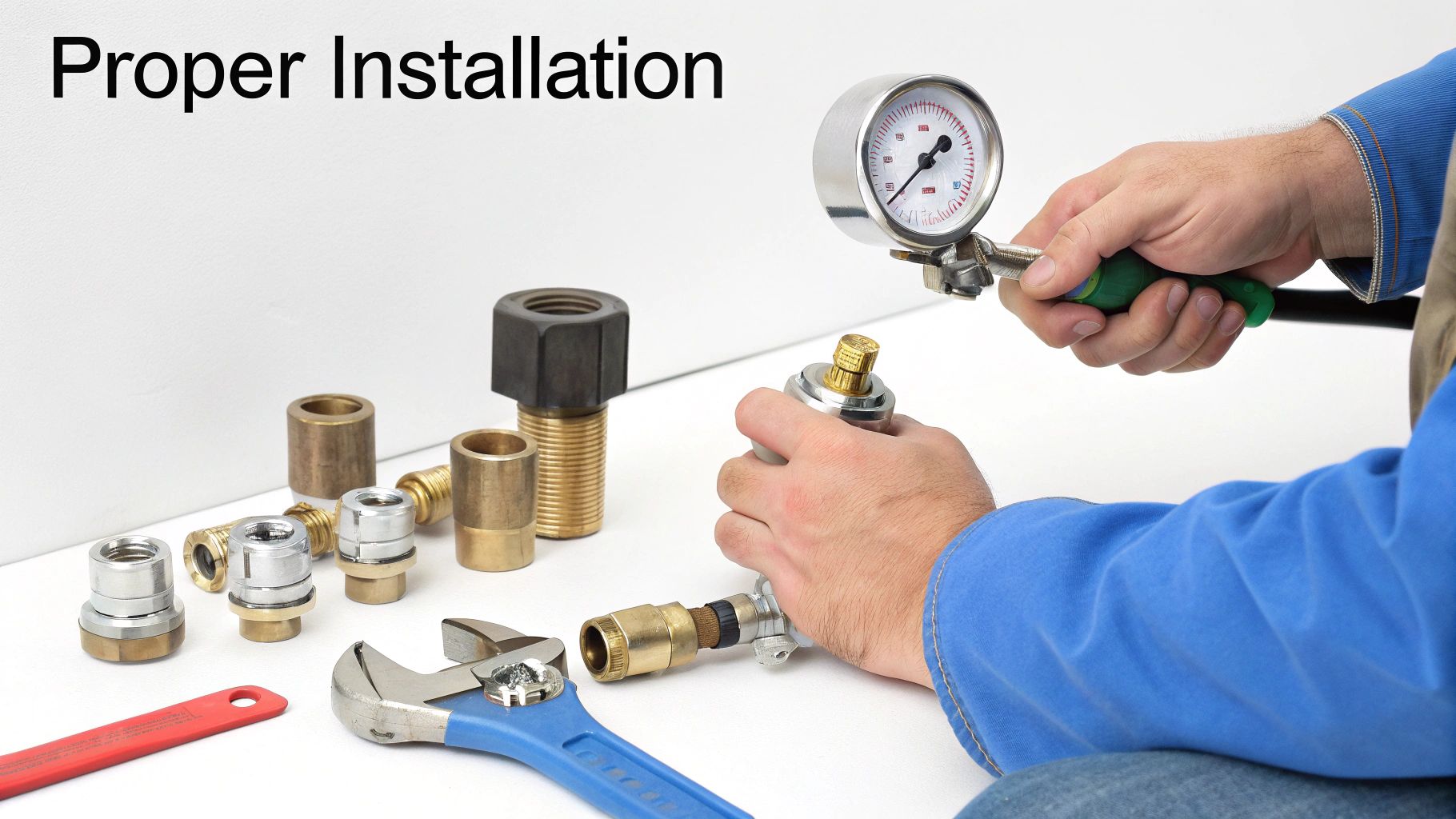
A hydraulic pressure gauge is only as good as its installation. Think of it this way: even the most advanced instrument is useless if it's not fitted correctly. Proper installation and routine checks aren't just 'nice-to-haves'; they're absolutely essential for getting accurate readings and ensuring the gauge has a long, reliable life.
Cutting corners here can lead to all sorts of problems, from premature failure and wonky data to serious safety risks. A few minutes spent doing it right from the start will save you a world of headaches later on.
The Fundamentals of a Solid Installation
When you're fitting a new gauge, the goal is simple: create a secure, leak-free connection that can handle the system's pressure and vibration without a fuss.
First things first, make sure you can actually see the thing! Orient the gauge so the dial is clearly visible from wherever an operator or engineer is most likely to be standing. It’s a simple point, but one that’s often overlooked and makes a huge difference for quick, accurate checks.
Next, you need to create a good seal. Use a quality thread sealant that’s compatible with your hydraulic fluids, like PTFE tape or a liquid sealant. A crucial tip is to apply it only to the male threads of the gauge itself. This stops any excess from breaking off and getting into the hydraulic system, where it could cause blockages in sensitive components like valves.
One of the biggest mistakes we see is people over-tightening the gauge by grabbing the case. You should never do this. Always use a spanner on the wrench flats provided on the gauge's socket. Turning the case itself can twist and wreck the delicate internal mechanism, leading to instant failure or inaccuracy.
Tighten the gauge just enough to form a seal and no more. The natural instinct is to really crank it down, but this can distort the threads and put immense stress on the Bourdon tube, permanently damaging the instrument.
Protecting Your Gauge with Smart Accessories
Hydraulic systems can be harsh environments. Pressure spikes, pulsations, and vibrations can take their toll. Thankfully, a few key accessories can act as bodyguards for your gauge.
- Pressure Snubbers: These are small but mighty fittings that act like shock absorbers for your gauge. They smooth out the rapid pressure fluctuations that make the needle flutter, preventing premature wear on the internal gears.
- Gauge Isolator Valves: An isolator valve is a simple way to shut off pressure to the gauge. This is a lifesaver when you need to replace a faulty gauge, as you can do it without having to shut down and drain the entire hydraulic system.
- Overpressure Protectors: If your system is prone to sudden, massive pressure spikes that go way beyond the gauge's range, an overpressure protector is a must. It automatically blocks the flow when a preset pressure is hit, saving the gauge from being destroyed.
These accessories are a tiny investment that pays huge dividends in extending the life of your gauge and keeping your readings trustworthy.
Your Simple Routine Inspection Checklist
Regular checks are the best way to catch small problems before they become big ones. A quick visual inspection during your regular equipment walk-arounds can tell you everything you need to know.
Keep an eye out for these tell-tale signs:
- A Flickering Pointer: If the needle is vibrating wildly, it's a dead giveaway of pressure pulsations. If you don't have a liquid-filled gauge, it's a clear signal that you need to install a pressure snubber.
- Pointer Isn't at Zero: When the system is off, the needle should rest perfectly on zero. If it's sitting above that, the gauge has been over-pressurised at some point and is no longer reliable. It needs replacing.
- Signs of Leaks: Look for any weeping hydraulic fluid around the connection point. Even a tiny leak is a problem waiting to get worse, leading to fluid loss and safety hazards.
- Cracked or Foggy Lens: A damaged lens is an open door for moisture and dirt to get inside, which will lead to corrosion and failure. If the lens is compromised, it's time for a new gauge.
Following these straightforward installation and maintenance steps will ensure your hydraulic pressure gauge remains a dependable window into the health of your system.
For advice on the right accessories or to source a replacement gauge, give us a call on 01724 279508 today, or send us a message.
Troubleshooting Common Hydraulic Pressure Gauge Issues
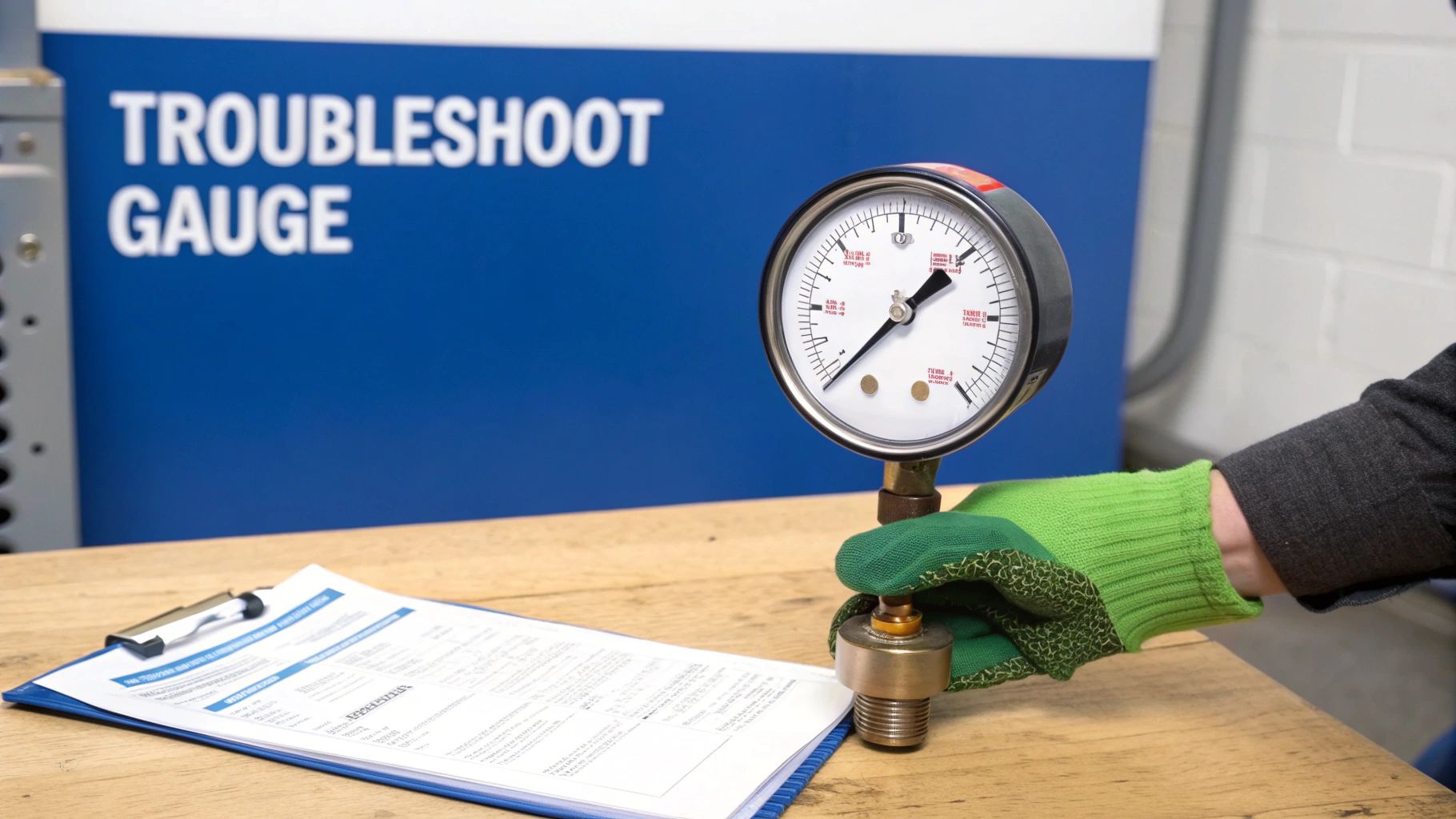
Even the best pressure gauges can run into trouble. Knowing what to look for can turn a major headache into a quick fix, getting your machinery back up and running with minimal downtime.
When a gauge starts giving you strange readings, a bit of methodical troubleshooting is all you need. Most problems fall into just a few categories, so learning to spot the symptoms will point you straight to the cause.
Stuck Pointer That Won't Return to Zero
One of the most common failures we see is a pointer that's stuck above zero, even when the system is switched off and completely depressurised. If the needle won’t go home, you’ve got a problem.
This is almost always a tell-tale sign of over-pressurisation. A massive, sudden pressure spike that goes way beyond the gauge's maximum rating will physically bend the delicate Bourdon tube inside. Once it’s bent, it’s not going back, and the pointer can no longer return to its resting position.
A gauge with a pointer stuck off zero is permanently damaged. Its readings will be wrong across the entire scale, making it a serious safety hazard. It must be replaced immediately.
When you fit the new one, it’s worth asking why the spike happened in the first place. You might need a gauge with a higher pressure range, or it could be a sign of a bigger issue elsewhere. A faulty hydraulic pressure relief valve is a common culprit.
Wildly Fluttering Pointer
Is the needle on your gauge vibrating so much you can't get a proper reading? This is known as pointer flutter, and it’s a direct result of heavy vibration or rapid pressure pulses hammering the system.
You’ll see this a lot on mobile equipment like diggers and tractors, or on industrial presses that cycle very quickly. It's not just annoying; that constant vibration puts huge stress on the gauge’s internal gears, leading to a much shorter lifespan. Luckily, the fix is simple:
- Switch to a liquid-filled gauge: The glycerine inside acts as a dampener, absorbing the shock and steadying the pointer so you can get a clear reading.
- Fit a pressure snubber: This is a small, inexpensive part that you can install just before a dry gauge. It smooths out the pressure pulses before they even reach the instrument.
Gauge Reading Zero Under Pressure
So, the machine is running, you know there's pressure in the system, but the gauge is stubbornly sitting at zero. Before you blame the gauge, run through this quick checklist.
- Check the Isolator Valve: Many systems have a small shut-off valve before the gauge. Make sure it hasn't been accidentally closed. It needs to be fully open.
- Inspect for Blockages: The tiny hole leading into the gauge can easily get clogged with dirt or debris. Safely disconnect the gauge and have a look at the connection port.
- Confirm Gauge Failure: If the valve is open and the port is clear, then it’s likely the gauge itself has failed internally. It’s time for a replacement.
Having accurate gauges isn’t just a matter of convenience; it’s critical. With the UK automotive hydraulics market projected to hit £1.7 billion by 2030, precise instruments are non-negotiable for service engineers. Given that hydraulic faults can account for 15% of commercial vehicle downtime, sourcing reliable parts from a trusted UK supplier is just good business sense.
If you’re stuck with a gauge issue you can’t get to the bottom of, our team is here to help. Just give us a call on 01724 279508 or send us a message for some expert advice.
Your Partner for Hydraulic Components and Expertise
Picking your way through the world of hydraulic components can feel a bit daunting, but you don't have to go it alone. At MA Hydraulics, we’re more than just a supplier; think of us as your technical partner, here to make sure your machinery runs exactly as it should. Choosing the right hydraulic pressure gauge is a crucial final step, and we've got the expertise to help you nail it.
Our warehouse is stocked with a huge range of high-quality pressure gauges for just about any job you can think of, from tough mobile plant to high-precision industrial systems. These are ready to slot into systems built with parts from top brands like Vivoil, Hydronit, and Luen, so you know everything will work together perfectly.
Bespoke Solutions and Expert Advice
Where our experience really shines is in custom projects, especially when we're designing and building bespoke industrial power packs. In these situations, selecting the perfect hydraulic pressure gauge isn't just a finishing touch—it's absolutely fundamental to the system's safety, efficiency, and long-term health. We get that every application has its own unique pressures.
So, whether you need a rugged, liquid-filled stainless steel gauge to handle the constant vibration on a piece of farm machinery, or a large-dial, high-accuracy model for a stationary factory press, we can point you to the right solution.
Our commitment is to give you practical, hands-on advice and solid after-sales support. We want to ensure you don’t just get any part, but the right part for the job, every single time.
This approach means you get the most out of your investment, with the confidence of knowing you're backed by a team that truly understands the forces your equipment is up against.
Your One-Stop Shop for Hydraulic Needs
Working with MA Hydraulics means you get a partner who's genuinely invested in your success. We mix our deep product knowledge with a real-world understanding of hydraulic challenges to deliver solutions that simply work. From one replacement gauge to a full system build, our team is ready to help. We offer competitive pricing, fast availability, and the peace of mind that comes with using reliable, industry-proven brands. Component selection shouldn't be a headache.
For expert guidance on choosing the right hydraulic pressure gauge for your next project, give us a call today on 01724 279508, or send us a message to talk through what you need.
Frequently Asked Questions
Even with a solid grasp of hydraulics, questions about specific parts like pressure gauges pop up all the time. Here, we'll tackle some of the most common queries we get from customers, giving you straightforward answers to help you with practical, on-the-job challenges.
We've covered everything from pressure ratings to lifespans, all designed to give you quick, dependable information.
How Much Pressure Should My Gauge Be Rated For?
This is probably the most important decision you'll make when picking a gauge. The rule of thumb, and it's a good one, is to choose a gauge with a maximum pressure rating that's double your system's normal operating pressure.
So, if your hydraulic power pack usually hums along at 175 bar, you need a gauge that reads up to at least 350 bar. This simple "2x rule" does two critical things for you:
- It keeps the needle operating in the middle third of the dial, which is where gauges are at their most accurate.
- It builds in a vital safety margin, allowing the gauge to handle unexpected pressure spikes without failing.
What Is The Difference Between a Dry and a Liquid-Filled Gauge?
The real difference comes down to how they cope with vibration and pressure pulses. A dry gauge is your standard mechanical gauge, with nothing but air inside the case. It's absolutely fine for stable environments where there's little to no vibration.
A liquid-filled gauge, however, has its casing filled with a thick fluid like glycerine. This liquid acts as a damper, soaking up vibrations from pumps and engines and smoothing out the rapid little flutters in pressure. This gives you a steady, readable needle and helps the gauge last much longer in tough conditions. That’s why you’ll almost always find them on mobile machinery like diggers and tractors.
How Often Should I Replace My Hydraulic Pressure Gauge?
There’s no hard and fast rule here. A gauge's lifespan is all about its working environment. A gauge sitting on a clean, steady industrial system indoors might work perfectly for years. In contrast, one bolted to a piece of heavy mobile machinery getting rattled about all day will have a much shorter life.
The real answer is this: replace it the moment it shows any sign of trouble. If the needle doesn't return to zero when the pressure is off, if the lens is cracked, or if there's any sign of a leak, it’s time for it to go. Never trust a faulty gauge—it’s not just giving you bad information, it’s a safety risk.
Can I Use a Water Pressure Gauge for My Hydraulic System?
In a word, no. You should never substitute a gauge designed for water or air in a hydraulic system. Gauges are engineered with specific materials that are compatible with the fluid they're meant to measure.
A water gauge simply isn't built to handle the chemical makeup of hydraulic oil, nor can it withstand the intense pressures and sudden spikes that are part and parcel of hydraulic circuits. Using the wrong gauge is a recipe for quick failure and could cause a dangerous, high-pressure leak. Always stick with a gauge built specifically for hydraulic fluid.
For expert advice on choosing the right hydraulic pressure gauge for your system, or for help with any other components, the team at MA Hydraulics Ltd is always on hand. Phone 01724 279508 today, or send us a message https://www.mahydraulics.co.uk/contact-us/
