
The loader arm lifts cleanly when the tractor first starts, then slowly sinks while you're moving across a cold yard. Before replacing the cylinder, it's worth checking what the unit is being asked to do, how it's mounted and what could happen if it stops holding position. A small hydraulic cylinder may be compact, but its job can affect the whole machine.
A cylinder converts pressurised oil into straight-line movement. Think of a bicycle pump: pressure acting on a piston creates movement, though a hydraulic system uses oil and machine power to produce far greater force. The right replacement is about more than matching bore and stroke. Mounting, duty, load-holding and maintenance all affect performance, safety and service life.
Why Small Hydraulic Cylinders Power So Much UK Machinery
A compact cylinder can lift a heavy attachment, but size alone does not explain how it performs. The force comes from hydraulic pressure acting on the piston area: a larger bore gives more force at the same pressure, while the stroke sets the rod's travel. It works like pushing on a larger or smaller area with the same effort. The machine's linkage then turns that straight-line movement into a lift, tilt or push.
The cylinder is only one part of the job. The pump supplies oil, valves direct it, and the mounting points guide the cylinder as it moves. If those parts do not suit one another, the unit may bind, load the rod sideways or fail to move the attachment through its intended range. A replacement that matches the old dimensions can still be wrong for the application.
Why compact cylinders matter
Small hydraulic cylinders make controlled movement possible where space is limited. A short stroke may be enough to position a guard or operate a clamp; a longer one may be needed to raise an arm or tip a body. The useful choice depends on both travel and mechanical advantage. A cylinder mounted close to a pivot may need to produce more force than one mounted farther away, much as a short wrench needs more effort than a long one.
Tractor linkages show how hydraulic power can control an implement's position and movement. The historical account of Ferguson's tractor linkage describes the development of that system. It is a useful example of hydraulic actuation in machinery, but it does not by itself explain the history of small cylinders across British equipment.
Check what a replacement changes
For an OEM engineer, repairer or operator, start with the machine's actual duty. Note the load, required travel, operating position and mounting geometry. Check whether the cylinder must hold a raised load while the machine is stationary, and what could happen if pressure is lost. Those questions matter to safe operation and lifting-equipment compliance, not just to whether the replacement fits.
The purchase price is only part of the cost. A poor match can mean restricted movement, added strain on pins and brackets, repeat repairs or downtime. Treat the old unit as evidence, not a complete specification: record what it moves, how it attaches and how the load behaves. That information helps you judge the replacement's effect on service life, compliance and total cost of ownership.
Single-Acting, Double-Acting and Telescopic Types Compared
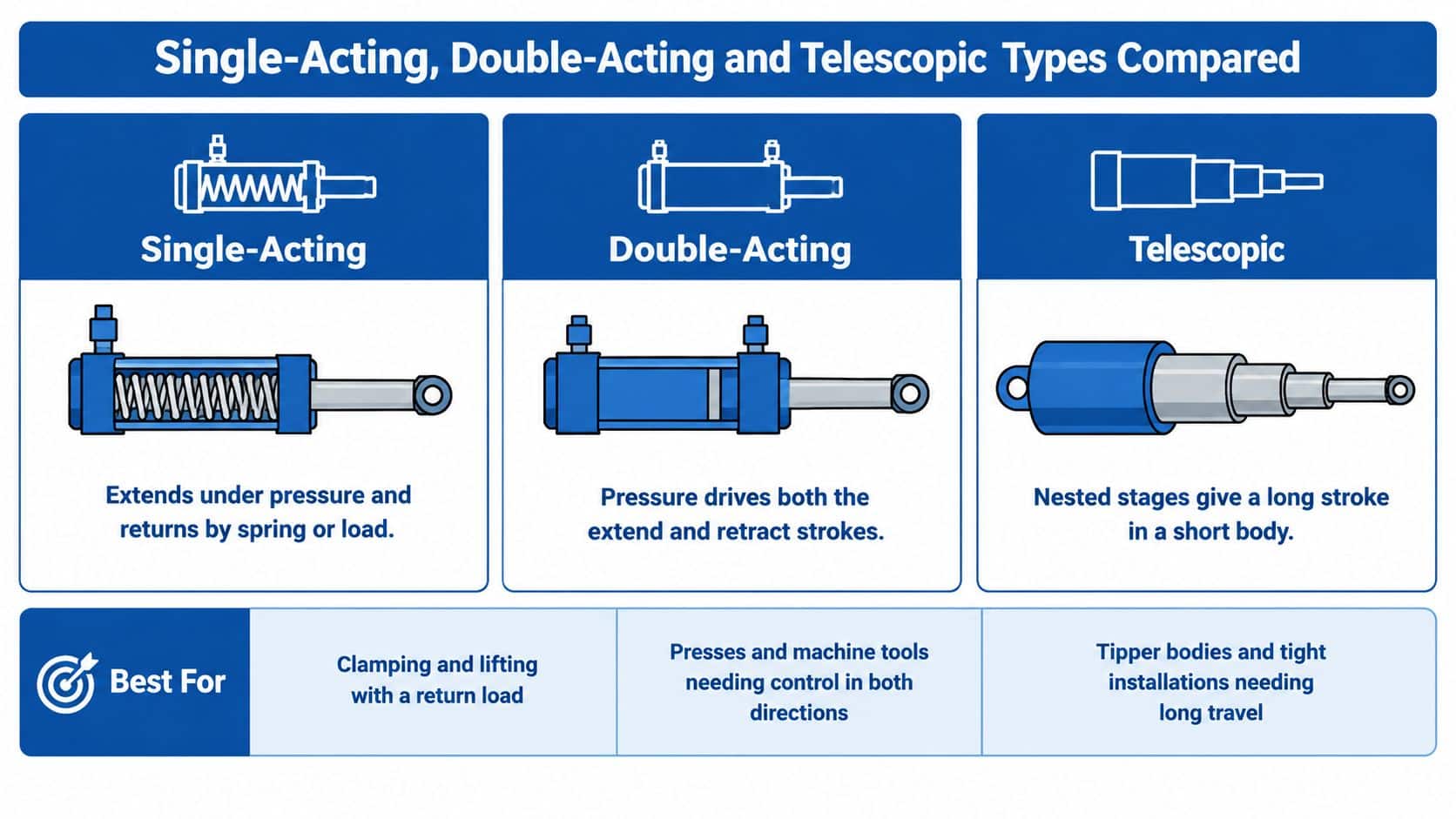
The first choice is how the cylinder should move. Some jobs need powered movement in one direction and a simple return. Others need the machine to control both extension and retraction. A third group needs long travel despite limited room for a fully extended cylinder.
One powered direction or two
A single-acting cylinder uses hydraulic pressure to move in one direction. A spring, gravity or the load itself returns it. It's a little like a spring-loaded door closer: pressure does the working stroke, while another force brings the mechanism back. This arrangement can suit lifting or clamping where the return path is straightforward and predictable.
A double-acting cylinder uses pressure on both sides of the piston. The hydraulic circuit controls extension and retraction, which is useful when the machine needs positive movement in either direction. A press, machine tool or powered linkage may need that control, especially where relying on gravity or a spring would be unreliable. If the job requires controlled travel both ways, compare the configuration with a double-acting hydraulic cylinder.
Long travel from a short body
A telescopic cylinder has nested stages that extend one after another, much like a collapsible tripod. The design can provide long travel from a comparatively short closed length, which is useful where the machine has limited space to store the cylinder but needs significant movement. Tipper bodies are a familiar example.
The trade-off is that an extended telescopic unit needs careful consideration of stability and loading. As the stages extend, the cylinder's geometry changes, so the machine's linkage and support must suit the full travel. A long stroke isn't automatically the right answer if the load becomes unstable or the installation places unwanted side force on the stages.
Practical rule: Choose the cylinder type from the job's return requirement and available space first. Then check whether its movement and load path suit the machine throughout the stroke.
When comparing alternatives, don't stop at the number of ports or the closed length. Check how the circuit controls movement, what returns the cylinder, and whether the design can hold or position the load as required.
Sizing Bore, Stroke and Rod for Your Application
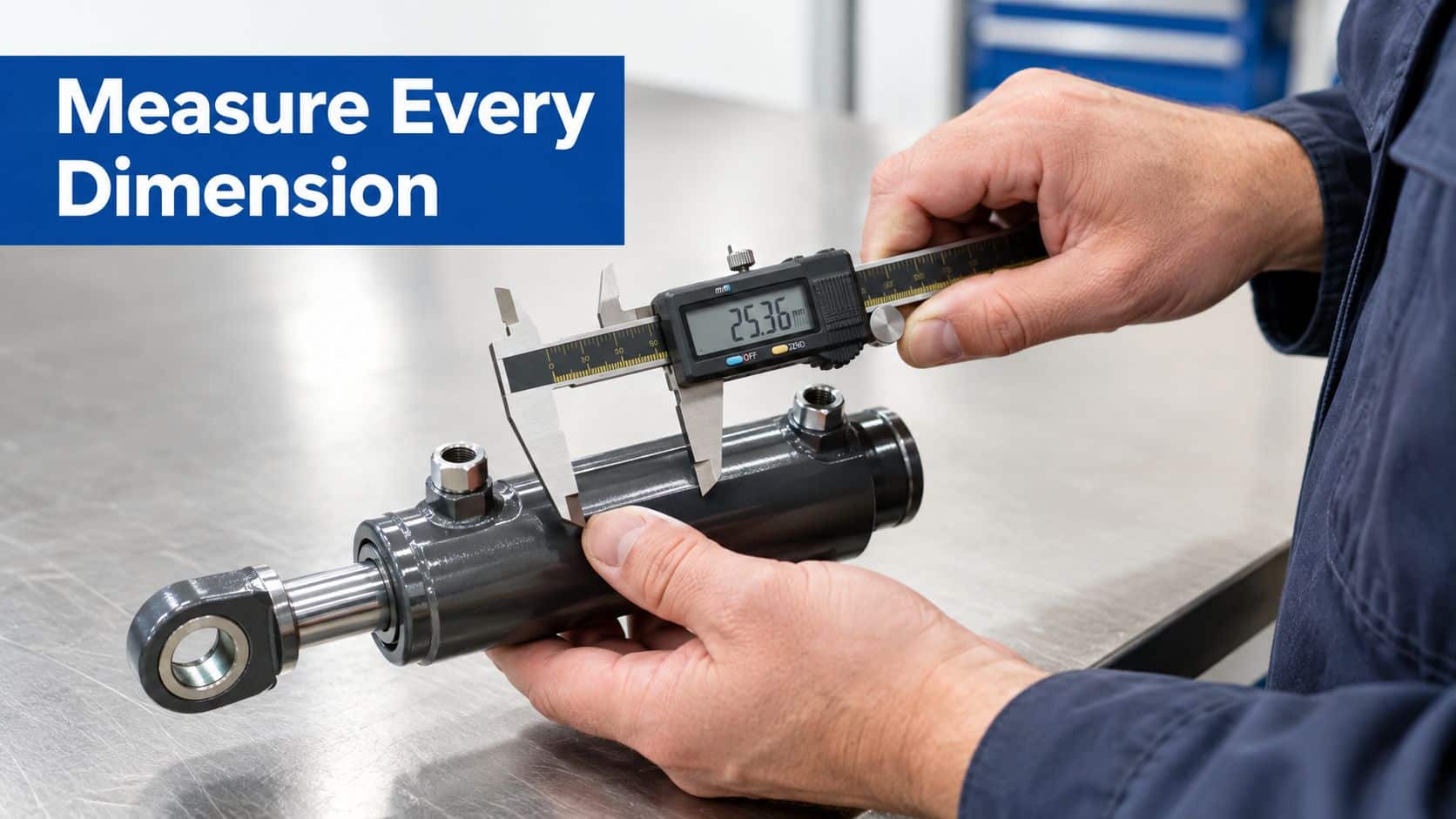
Measure the existing cylinder before choosing a replacement, but don't assume its dimensions prove it was correctly specified. Start with the force and travel the machine needs, then check the mounting geometry and rod strength.
Work through the dimensions in order
Bore is the diameter of the cylinder barrel, and it determines the piston area. At a given pressure, a larger piston area produces more force. In a simple push-force estimate, pressure multiplied by piston area gives the theoretical force; real performance also depends on friction, the circuit and how the cylinder is installed.
Stroke is the distance the rod travels. Measure the machine's required movement, not just the exposed rod on a parked machine. Too little stroke may prevent the mechanism reaching its working position. Too much can cause interference or take the linkage beyond its safe geometry.
Rod diameter matters because the rod carries the load and must resist bending or buckling. A slender rod paired with a long stroke can be vulnerable if the cylinder is in compression or the machine applies a side load. The rod end and its connection also need to suit the force and movement.
A worked sizing example
Suppose a design needs a theoretical push of 20,000 N at 160 bar. Convert pressure to pascals, then divide the required force by pressure to estimate piston area. The resulting area is about 0.00125 m², which corresponds to a bore close to 40 mm. This is an illustrative calculation, not a final specification: friction, available system pressure, load direction and safety margins must be checked before selecting a cylinder.
Next confirm the stroke and the closed length. Measure the pin-to-pin or mounting-centre distances with the cylinder fully retracted and extended, and note the connection sizes and mounting type. A cylinder with the right bore and stroke can still fail to fit if the closed length or pin centres differ.
Measure the machine, not only the old part. If the previous cylinder bent, drifted or repeatedly damaged seals, copying its dimensions may reproduce the fault.
Keep a record of bore, rod diameter, stroke, closed length, mounting centres, port details and operating conditions. If the cylinder supports or moves a load, also describe how the load acts through the linkage. That context matters when assessing load-bearing capacity.
For a visual overview of cylinder components and movement, the embedded video is included below.
Mounting Styles, Seals and Materials Explained
A replacement cylinder can match the bore and stroke yet bind because its mounts do not follow the machine's movement. Check the installed cylinder at both ends of its travel. Like a door hinge, a pivot mount lets the assembly follow an arc instead of forcing it to move in a straight line that the linkage cannot support.
Look at how the cylinder attaches. A clevis mount has two parallel ears with a pin through them, often at the rod end or base. An eye mount has a single circular lug with a pin hole. Both suit a joint that needs to pivot; compare pin diameter and the space around the bracket before choosing. Trunnion mounts have pins projecting from opposite sides of the cylinder barrel, held in supports so the body can pivot around those pins. They suit machines where the cylinder must swing around a fixed axis. Flange mounts use a plate, usually bolted to a machine surface, to hold the cylinder firmly in line. They fit rigid installations where the mounting face can keep the load aligned. Match the replacement's pin centres, flange pattern and available clearance, not just its mount name.
Alignment protects the rod and seals
The rod is built to push or pull along the cylinder's axis. A linkage that pulls sideways is like pushing a drawer while it is caught at an angle: the rod guide and seals wear faster, and the rod can be damaged. If leakage returns, check pin wear, loose brackets and linkage alignment before replacing seals again.
Seal material should suit the hydraulic fluid, temperature and contamination level. NBR (nitrile rubber) is a common choice for mineral oil in ordinary service conditions. Polyurethane seals can offer good wear resistance in demanding reciprocating service, while PTFE-based seals can suit applications needing low friction or wider fluid and temperature tolerance. These are starting points, not interchangeable specifications. Confirm the supplier's fluid and temperature limits for the actual cylinder.
Materials and surface condition
Many cylinder rods use hardened steel with a chrome-plated surface, which resists wear and helps the seal run over a smooth finish. A scratched or pitted rod can cut or abrade a seal each time it retracts. In wet or corrosive surroundings, ask whether the rod has corrosion-resistant plating or stainless-steel construction, and whether the barrel material and coating suit the exposure. Stainless steel may help with corrosion, but the grade and seal compatibility still need checking.
When comparing specifications, check mount dimensions, seal type, rod material and finish alongside bore and stroke. Dirt, moisture and restricted access affect service life and maintenance cost. A cylinder that fits the machine but binds, corrodes or is difficult to inspect can cost more to keep in service, and lifting equipment may also require the replacement to preserve the intended movement and load path.
Typical Applications and Performance Considerations
A clamp in a clean factory and a loader working outdoors may use cylinders of similar size, yet face very different demands. Small hydraulic cylinders operate in stationary machinery such as presses, conveyors, machine tools and robotics, as well as agricultural implements and mobile plant. Their job may be to position, clamp, lift or move a component. The machine's working conditions determine how reliably they can do it.
Match the design to the duty
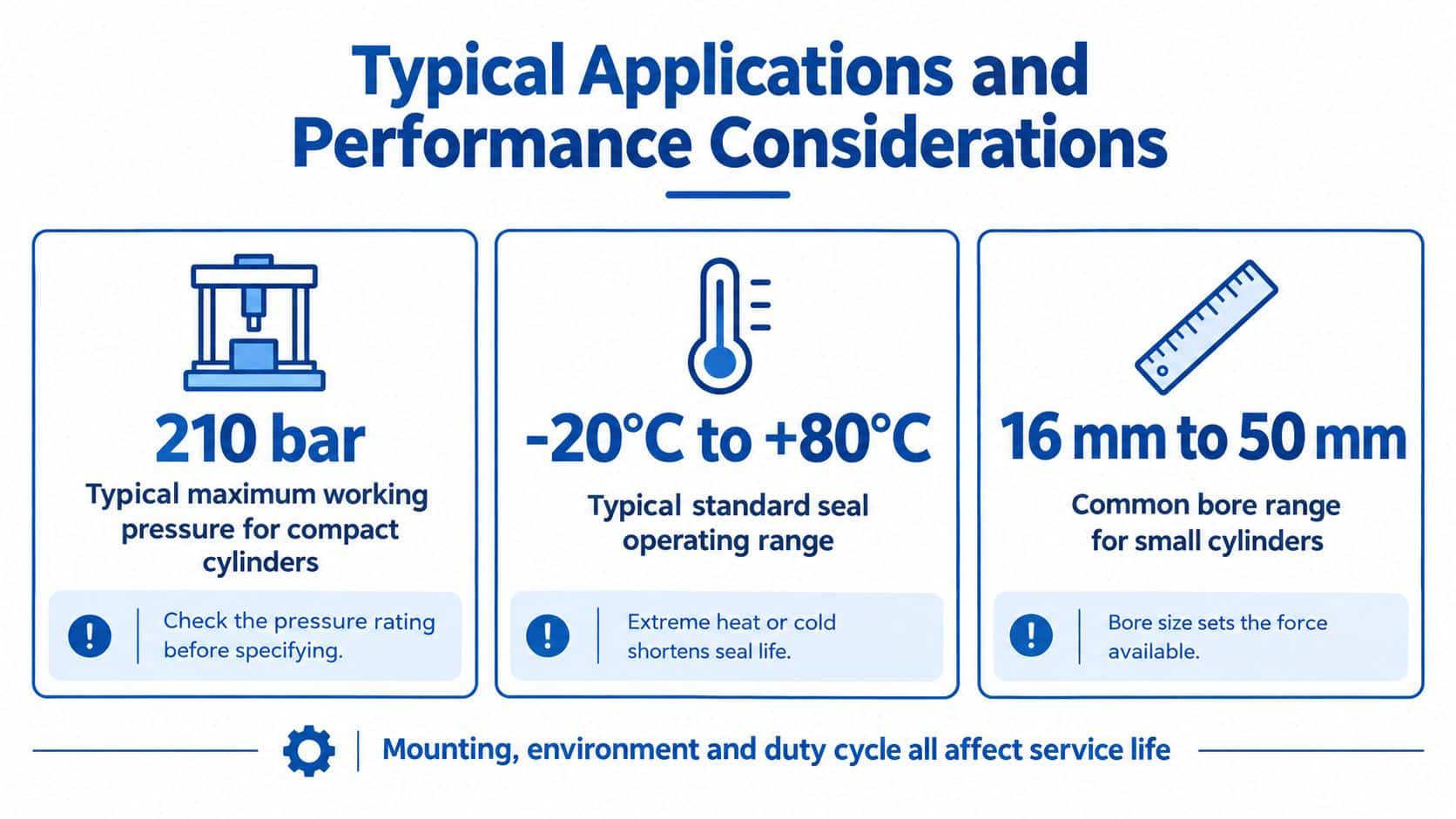
System pressure can reach 690 bar, or 10,000 psi, in correctly designed and protected hydraulic systems. That illustrates how a compact cylinder can produce substantial force, but it is not a working-pressure recommendation for every unit. Use the cylinder's own rated pressure and check that the circuit's protection suits the load and operating conditions.
Consider a factory clamp that repeats the same short movement in a clean, controlled setting. A tractor implement may face mud, vibration and occasional impact, while a loader can remain outdoors for long periods and work under changing loads. A cylinder's bore and stroke affect the force and travel available; the mounting arrangement also determines how it fits the machine's linkage. Replacing a cylinder with one that fits the space but changes those dimensions can alter how the equipment moves and performs.
What changes performance in service
Duty cycle is the amount and frequency of work the cylinder performs. Repeated cycles mean more seal movement and frictional heat, so a cylinder working continuously may wear sooner than one that moves only occasionally. Service life depends on the whole installation and conditions, so don't treat a cycle count alone as a guaranteed lifespan.
Temperature affects both hydraulic fluid and seals. Check the cylinder and seal manufacturer's stated operating range against the temperatures the machine encounters, including cold starts and heat built up during repeated operation. A seal suited to moderate conditions may not retain its performance at temperature extremes.
Contamination can enter through the hydraulic circuit or collect on exposed parts. Particles carried in the fluid can score internal surfaces, while dirt on the rod can be drawn past the seal as it retracts. Keep fluid filtration and maintenance suited to the machine's working environment, and inspect exposed rods for deposits or damage. For a replacement on lifting equipment, confirm that its bore, stroke, rated pressure and mounting remain suitable for the machine's intended duty, not merely that it fits the available space.
Maintenance and Lifting Compliance Boundaries
A small replacement cylinder may still hold up a loader arm or another suspended load. If it fails, the consequences depend on what the cylinder supports and who or what is beneath it. A cylinder that positions a component has a different role from one that holds a load above people. Check the whole machine, not just the actuator on the bench.
LOLER places a duty on employers to keep lifting equipment in efficient working order and good repair under Regulation 5. Thorough examination is generally required every six months for lifting equipment used to lift people and for lifting accessories, and every 12 months for other lifting equipment. A written examination scheme or a competent person may set different intervals. The cylinder's role can affect the examination arrangements and what measures are needed to prevent a load moving if hydraulic pressure is lost (HSE guidance on lifting equipment).
Pressure rules are not all the same
In Great Britain, the Pressure Equipment (Safety) Regulations 2016 cover pressure equipment and assemblies with a maximum allowable pressure above 0.5 bar, subject to specified exclusions. They address design, manufacture and conformity assessment. Which requirements apply depends on the equipment and how it is placed on the market (HSE overview of the Pressure Equipment Regulations).
That product-safety regime is separate from the Pressure Systems Safety Regulations (PSSR). HSE explains that hydraulic oils are not relevant fluids under PSSR and hydraulic systems do not store energy for the purposes of those regulations, even when they operate at high pressure. As a result, a hydraulic cylinder installation does not automatically need a PSSR written scheme. Other workplace and product-safety duties still apply to the machine and its use (HSE guidance on PSSR scope).
Make maintenance safe before opening the circuit
Before servicing, isolate the hydraulic supply and release stored energy. Lower attachments to the ground or support them with rated equipment. A cylinder is not a safe prop: a leak or pressure loss can let the load descend. HSE's vehicle-hydraulic guidance recommends resting attachments on the ground or using suitable supports before maintenance.
If a cylinder is supplied as part of a new pressurised assembly, check which conformity requirements apply. HSE says new equipment and assemblies within scope must meet relevant essential safety requirements, complete the appropriate conformity assessment, carry required marking and identification, and include instructions and safety information in English (HSE guidance for pressure-equipment manufacturers and suppliers). For a replacement, consider whether its bore, stroke or mounting changes the machine's function or risk. A different stroke can alter travel, while a changed mounting can affect how the load reaches the frame, so the compliance and maintenance consequences may extend beyond the cylinder's purchase price.
Specifying and Sourcing Bespoke Small Cylinders
A replacement cylinder can fit the old mounting points and still change how the machine behaves. Start by deciding whether a like-for-like unit, a cross-referenced standard cylinder or a bespoke design suits the job. A direct replacement can make installation simpler if the original specification is sound. A standard alternative needs matching dimensions, ratings and connections. A bespoke unit can accommodate unusual mounting geometry or duty, but its effect on the machine's movement, load support and compliance still needs checking.
The purchase price is only one part of the cost. Extra fitting work, lost production, oil clean-up and repeat failure can make a cheaper cylinder costly overall. Compare those likely costs, too. If changing bore, stroke or mounting points, check how the change affects force, travel and the equipment's intended use. The cylinder may be a small component, but its dimensions can affect the wider assembly.
Before ordering, give the supplier the measurements and operating details collected during inspection: load direction, movement, mounting centres and port arrangement. Include any leakage, drift or recurring damage. If the old cylinder failed early, look for misalignment, contaminated oil, rod damage or shock loading. Replacing a seal or cylinder alone will not correct those causes.
MA Hydraulics Ltd, based in Scunthorpe, North Lincolnshire, supplies hydraulic components and bespoke power solutions for mobile and industrial applications. Its team can advise on component selection, cross-references, hard-to-find parts and complete assemblies. Review its hydraulic equipment supply and consider what support is needed alongside the component.
For help checking a replacement specification or discussing a bespoke assembly, phone 01724 279508 or send MA Hydraulics a message.
MA Hydraulics Ltd can help with cylinder-related component selection, cross-references and bespoke hydraulic assemblies for mobile and industrial applications. Visit MA Hydraulics Ltd to discuss your cylinder's dimensions, duty and mounting requirements.
