
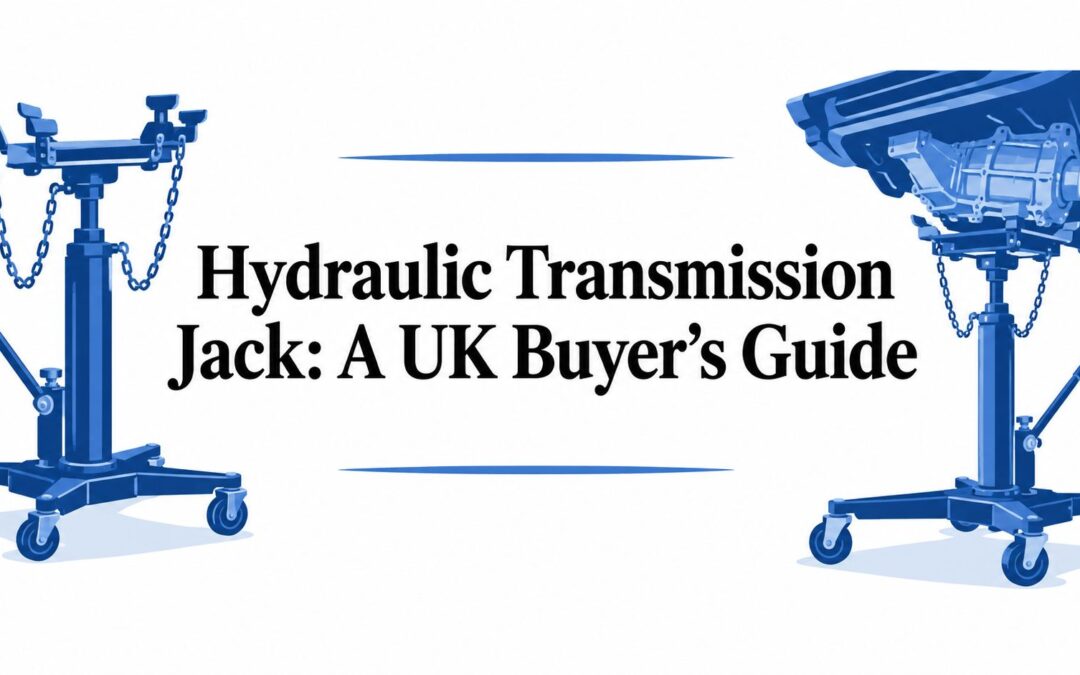
A hydraulic transmission jack is a low-profile, high-clearance lifting device with a tilting or telescopic saddle, designed to support, raise, lower and align a removed gearbox or drivetrain component while the operator stays in control of descent. In a UK workshop, it generally falls within LOLER when used as workplace lifting equipment, with thorough examination for garage jacks typically required every 12 months.
The situation is familiar. A technician is under a van with ATF draining into a tray, the gearbox is unbolted, and the casing needs to come down without touching the subframe. A normal trolley jack may lift the weight, but it won't hold an awkward casing securely or let the technician make the small angle adjustments needed for removal.
That difference is why buying on maximum tonnage alone is a mistake. The useful question is whether the complete handling system, including the saddle, retention, height range, castors and hydraulic controls, gives your team a repeatable way to move the transmission without fighting its centre of gravity.
What a Hydraulic Transmission Jack Actually Does
A hydraulic transmission jack is a handling tool first and a lifting tool second. It supports a gearbox, transfer case or differential after the vehicle's own mountings have been released, then lets the technician lower, move and realign that component in a controlled position.
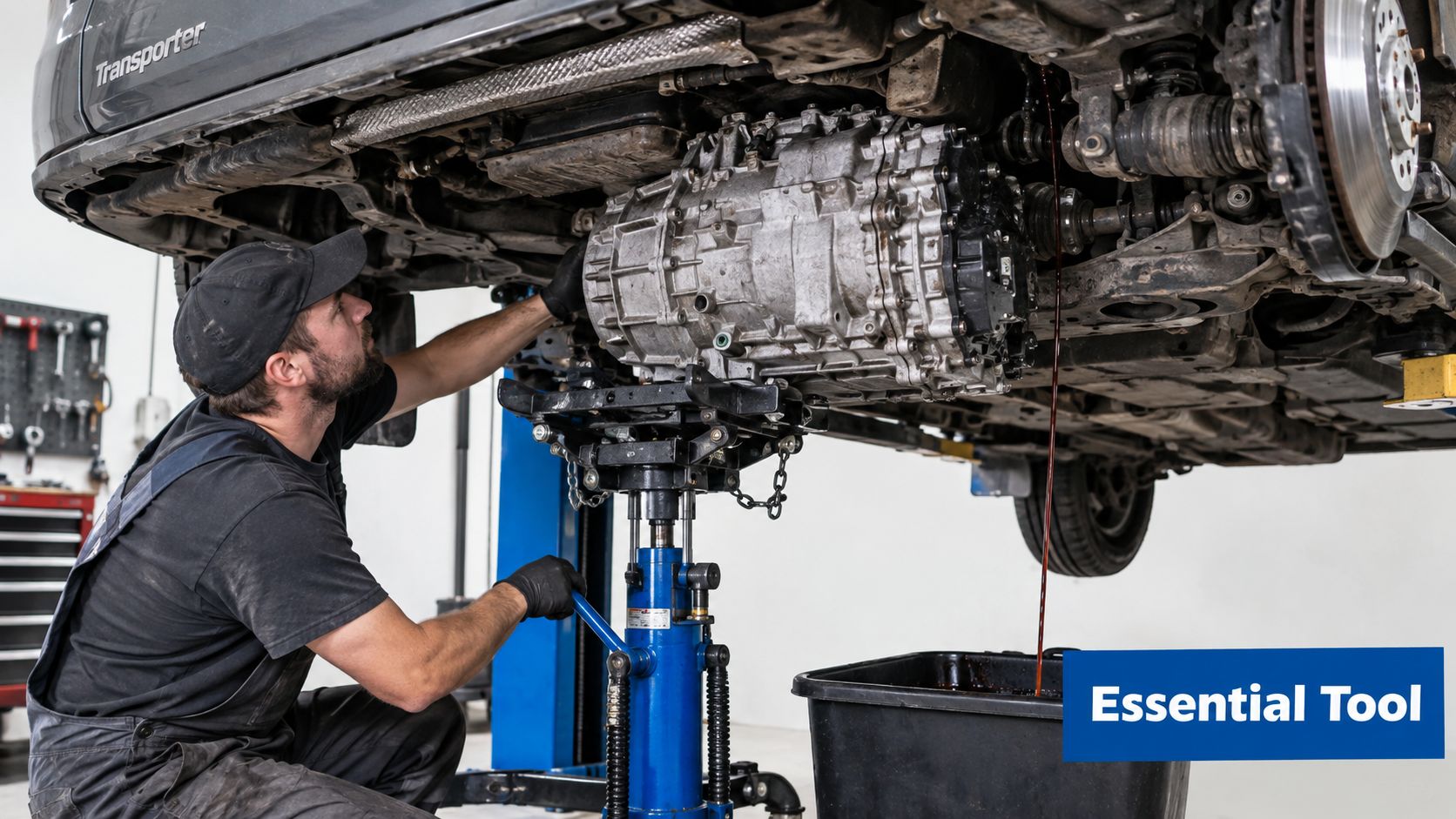
The job a floor jack can't do well
A bottle jack is useful where the load point is fixed and the base remains stable. An axle stand supports a vehicle structure once it has been positioned. An engine crane lifts from above and needs a suitable lifting point, enough clearance and room to move its legs.
A transmission jack solves a different problem. Its saddle is shaped or adjustable so it can carry an irregular casing, while its hydraulic ram provides height adjustment and its tilting mechanism helps match the angle of the gearbox to the vehicle. That matters when the transmission must move away from a subframe, clear a driveshaft tunnel or align with mounting holes during installation.
A standard trolley jack often has a small, relatively flat contact area. It may raise a load, but it doesn't positively restrain an asymmetric gearbox, and its geometry rarely gives the operator enough control over tilt. Using one as a makeshift transmission support can leave the casing balanced on a narrow point, with the load path changing as soon as the gearbox starts to move.
Practical rule: If the transmission needs to be tilted, rolled or aligned after its mountings are removed, choose equipment designed for that movement rather than adapting a jack designed to lift vehicles.
Lowering is part of the lifting operation
The most demanding moment often comes after the bolts are out. The technician needs to release hydraulic pressure gradually, watch the casing clear surrounding components and stop the descent when the next obstruction appears. A controlled bleed-down is more useful than a fast lift because the real job is positioning.
The jack must also remain a positioning device, not a substitute for vehicle stands or a permanent support. HSE guidance makes clear that workplace lifting equipment must be appropriate for the task, marked with its safe working load and used in a planned way. A transmission jack should carry only the load it was designed to support, and it shouldn't be relied on to support a vehicle while anyone works beneath it. The relevant HSE guidance for working under vehicles sets out that distinction between workplace lifting equipment and equipment supplied only for emergency roadside use.
A well-matched unit therefore earns its place by reducing manual handling, improving alignment and giving the operator control of the load path. A larger capacity rating is useful only if the chassis can reach the job, the cradle fits the casing and the load remains positively restrained throughout the movement.
How the Hydraulic System Lifts and Holds a Load
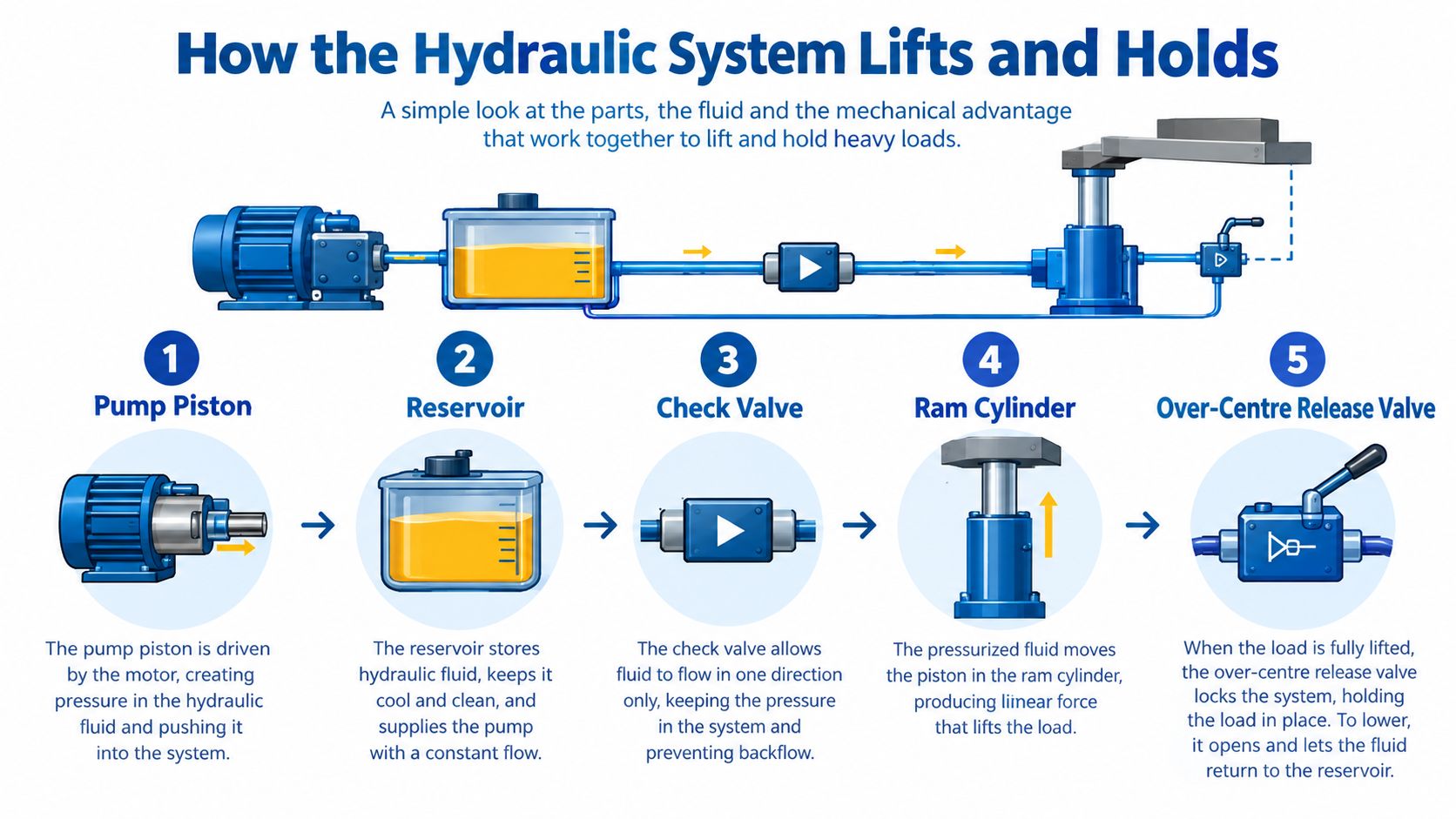
Start with a simple comparison. A long lever lets you apply a modest effort over a longer movement to produce greater force at a shorter movement. A hydraulic jack achieves a similar result through fluid. The operator moves a small pump piston repeatedly, and the hydraulic fluid transfers that effort to a larger ram piston.
From pedal movement to ram movement
The reservoir stores the working fluid. When the pump piston moves, fluid passes through an inlet path and is directed towards the ram cylinder. A check valve allows flow in the lifting direction but prevents the fluid from returning when the pump is released. Repeated strokes raise the saddle because the ram receives fluid a little at a time.
The check valve is safety-critical because it helps retain the load when the operator stops pumping. If contamination damages the valve seat, or a seal allows fluid to bypass the piston, the jack may rise poorly, drift or descend in a way the operator can't predict. Fluid leakage around the ram, pump or hose is not cosmetic damage. It indicates that the load-retention system needs attention.
An over-centre or release valve controls the return flow from the ram to the reservoir. Opening it allows the saddle to descend, but the operator must open it gradually. The load's weight supplies the force that drives the fluid back through the circuit, so a release valve that is opened too quickly can produce an uncontrolled drop.
Why retention needs more than pressure
Hydraulic pressure alone shouldn't be the only thing holding a raised transmission. HSE technical guidance recommends non-return check valves close to jack ports to prevent piston movement after a hose or pipe bursts, hydraulic fluid is lost or power fails. It also calls for an effective mechanical lock-out that prevents further load transmission to the hydraulic fluid once the structure reaches its final position. The HSE technical guidance on jacking systems also specifies that lowering must be controllable, with the maximum average descent speed under rated load set at 0.15 metres per second.
Look for a jack with a positive mechanical retention feature, load-securing straps or chains where appropriate, and a cradle that supports the casing rather than merely touching it. Use the mechanical feature whenever the transmission is stationary, and never treat a closed hydraulic valve as an equivalent to a mechanical lock.
A two-stage or telescopic ram gives extra height without requiring an excessively tall fixed cylinder. A toe-lift or foot pedal can bring the saddle into position while both hands remain available for guiding the casing. Air-hydraulic versions add compressed-air assistance where the jack is cycled repeatedly, but the final approach and descent still need precise hydraulic control.
For a practical explanation of the underlying fluid principles, see how hydraulic systems work. The same principle applies to a sealed jack: clean fluid, sound seals and disciplined bleed-down determine whether the mechanism remains predictable.
Key Specifications That Decide a Purchase
Treat the specification sheet as a decision document, not a brochure. The rated capacity is only the starting point because the load path changes when the saddle tilts, the gearbox moves away from the vehicle and the centre of gravity shifts.
A gearbox's quoted mass isn't always the complete supported load. Add the fluid that remains in the casing, adapters, chains, cradle components and any offset created by the mounting position. The jack must also remain stable when the load is no longer centred over the ram. A unit that has ample nominal capacity but a poor cradle fit can be less controlled than a smaller unit designed around the actual transmission pattern.
Read the height range as a pair
Minimum saddle height decides whether the chassis can enter the bay or pass beneath the vehicle. Maximum lift decides whether the saddle reaches the transmission once the vehicle is on a ramp or lift. Checking only one figure creates an avoidable mismatch.
A low floor pan may favour an extra-low trolley chassis, while a commercial vehicle on a lift may require a telescopic or high-lift format. The correct range is the one that leaves useful adjustment at both ends, rather than forcing the ram to work at its mechanical limit.
Capacity is not the only stability figure
The chassis footprint, castor arrangement and saddle width affect how the jack behaves while rolling or turning. A wide base can improve stability, but it may not pass between ramp rails or fit around a subframe. A broad saddle can look reassuring on a catalogue page and still foul a bell-housing arch.
| Jack Class | Rated Capacity | Min Saddle Height | Max Lift | Typical Saddle |
|---|---|---|---|---|
| Extra-low workshop jack | Selected for routine vehicle transmissions | Suited to restricted floor clearance | Limited to low and medium working heights | Compact tilting cradle |
| General floor jack | Matched to the workshop’s complete load path | Designed for standard bay access | Medium lift range | Adjustable universal saddle |
| Telescopic high-lift jack | Selected for heavier or elevated applications | Requires sufficient entry clearance | Extended range for ramp work | Tilt-adjustable or telescopic saddle |
| Air-hydraulic workshop jack | Chosen for frequent cycling and controlled handling | Dependent on chassis design | Suited to repeated raised-vehicle work | Wide cradle or adjustable platform |
Pump type is a productivity decision. A single-speed pump keeps the mechanism straightforward. A two-stage pump brings the saddle towards the load more quickly before switching to finer movement. An air-hydraulic pump reduces repeated manual effort in a busy bay, but it doesn't remove the need for a controlled release circuit or competent operation.
The best choice is often a lower-profile jack with a properly engineered cradle, not the biggest unit in the catalogue. It can fit the bay, keep the load closer to the floor and provide better access around the vehicle. Before ordering, measure the vehicle clearance, ramp geometry, bell-housing shape and required saddle movement, then compare those measurements with the complete jack drawing rather than relying on capacity alone.
Saddle Types and Chassis Formats Compared
The saddle determines how the load is held. The chassis determines whether the jack can reach it, roll beneath it and remain stable while the transmission is moved. Treating those as separate buying decisions is how workshops end up with a strong ram attached to an unsuitable head.
Four saddle approaches
A flat saddle pan is straightforward and can work well for a gearbox, differential or transfer case that has a stable underside. It is less forgiving when the casing is sloped or the centre of gravity sits away from the middle.
A universal saddle with four-way tilt is the most adaptable option for mixed vehicle work. It lets the operator accommodate irregular housings and make small alignment corrections, but every pivot, pin and adjustment mechanism becomes part of the inspection requirement.
A telescopic boom arm helps with transverse removals and installations where the attachment point needs to move relative to the chassis. It can improve access around front-wheel-drive powertrains, although its extended geometry needs careful attention to deflection and load position.
A low-profile roller cradle suits restricted bays and workshop pits where the transmission must be moved horizontally after it has been lowered. Rollers can assist repositioning, but they don't replace positive retention. The casing still needs to be secured against sliding or rolling off the support.
| Saddle Type | Typical Chassis | Best For | Watch-Out |
|---|---|---|---|
| Flat saddle pan | Standard floor chassis | Stable gearboxes, differentials and transfer cases | Limited compensation for sloped housings |
| Four-way tilting saddle | Extra-low or standard trolley | Mixed passenger vehicle and light commercial work | Pivots, pins and adjustment locks need inspection |
| Telescopic boom arm | High-lift or under-hoist format | Transverse removals and precise alignment | Extended load position can change stability |
| Low-profile roller cradle | Low trolley chassis | Restricted bays and controlled horizontal movement | Rollers need positive load restraint |
Match the chassis to the bay
An extra-low trolley suits a workshop working close to the floor, provided its maximum height is enough for the vehicles serviced. A standard floor chassis offers a useful compromise for general repair work. A telescopic high-lift version is more appropriate for vehicles raised on a hoist, while an air-hydraulic format makes sense where the same operation is repeated throughout the day.
A wider chassis normally gives the operator a more stable platform, but it may obstruct pit rails or fail to enter a service van. A tilting head improves alignment, yet it introduces moving parts that must remain secure and visible during examination.
For a double-clutch transmission in a ramped bay, a high-lift chassis with a broad, tilting saddle gives the operator height and alignment control. A Sprinter gearbox lowered onto the workshop floor may favour a lower trolley with a stable cradle and enough reach for the vehicle's mounting position. A JCB telehandler gearbox being handled in the field demands a sturdy chassis, suitable ground clearance and a cradle that can restrain an offset load. The same saddle format won't be ideal for all three jobs.
For non-automotive lifting context, Utah RV levelling advice is a useful reminder that stabilising equipment must be matched to the ground, load and intended movement. A transmission jack has the same practical constraint: stability comes from the entire setup, not from the cylinder rating in isolation.
Workshop and Mobile Plant Use Cases
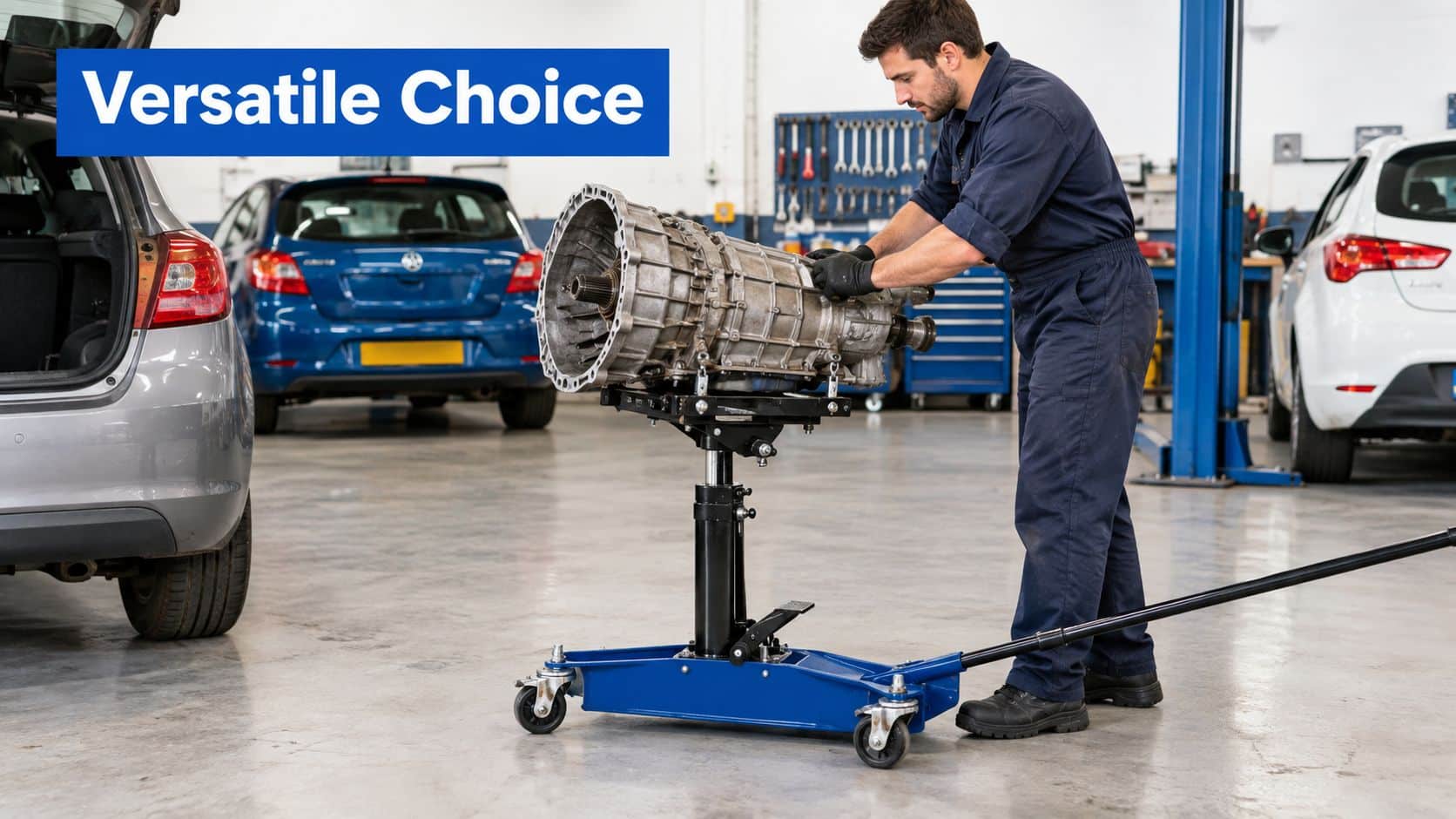
A mixed independent garage usually needs flexibility more than extreme reach. The foreman may handle manual gearboxes, transverse automatics, transfer cases and occasional light commercial work in the same week. A compact low-profile jack with a tilting saddle can be the right answer if its rated capacity, height range and cradle fit cover the actual jobs.
The mistake is assuming that a larger unit automatically covers everything. A heavier chassis may be harder to steer beneath a car, while a high saddle may not enter a low vehicle bay. If the jack's head cannot sit squarely under the casing, the technician spends the job compensating for the equipment instead of controlling the transmission.
Repeated dealer work
A main dealer ATF bay has a different priority. If a DSG or ZF 8HP is removed repeatedly, the team benefits from an air-hydraulic jack, a telescopic column, a wide saddle and controls that let the operator manage the approach and descent without taking both hands away from the casing.
That configuration costs more and occupies more space, but it can be justified where the jack is cycled frequently. The valuable feature isn't merely faster lifting. It's the ability to make small, controlled corrections while the technician lines up the bell housing, mounting points and surrounding components.
Mobile plant and service-van work
A mobile plant engineer working on a JCB, Manitou or Merlo telehandler faces a harsher load path. The jack may need to cross uneven concrete, fit between chassis rails and support a transmission that is low, offset or difficult to access. A compact telescopic design can be more practical than a wide workshop unit, provided the wheels, frame and retention system are suitable for the surface.
A roadside HGV technician has a similar space problem inside a service van. Storage footprint, saddle adjustment and the ability to move the unit into position can matter more than maximum capacity. The jack must still be selected for the complete supported assembly, not an optimistic estimate of gearbox mass.
The right jack is the one that keeps the transmission predictable through the whole movement, from first contact to final alignment.
These examples also show why buying by vehicle category alone is too vague. Record the actual casing shapes, mounting points, access restrictions and working heights your team encounters. Then ask a supplier to confirm cradle and adapter compatibility before the purchase order is raised.
Safety, LOLER and Routine Maintenance
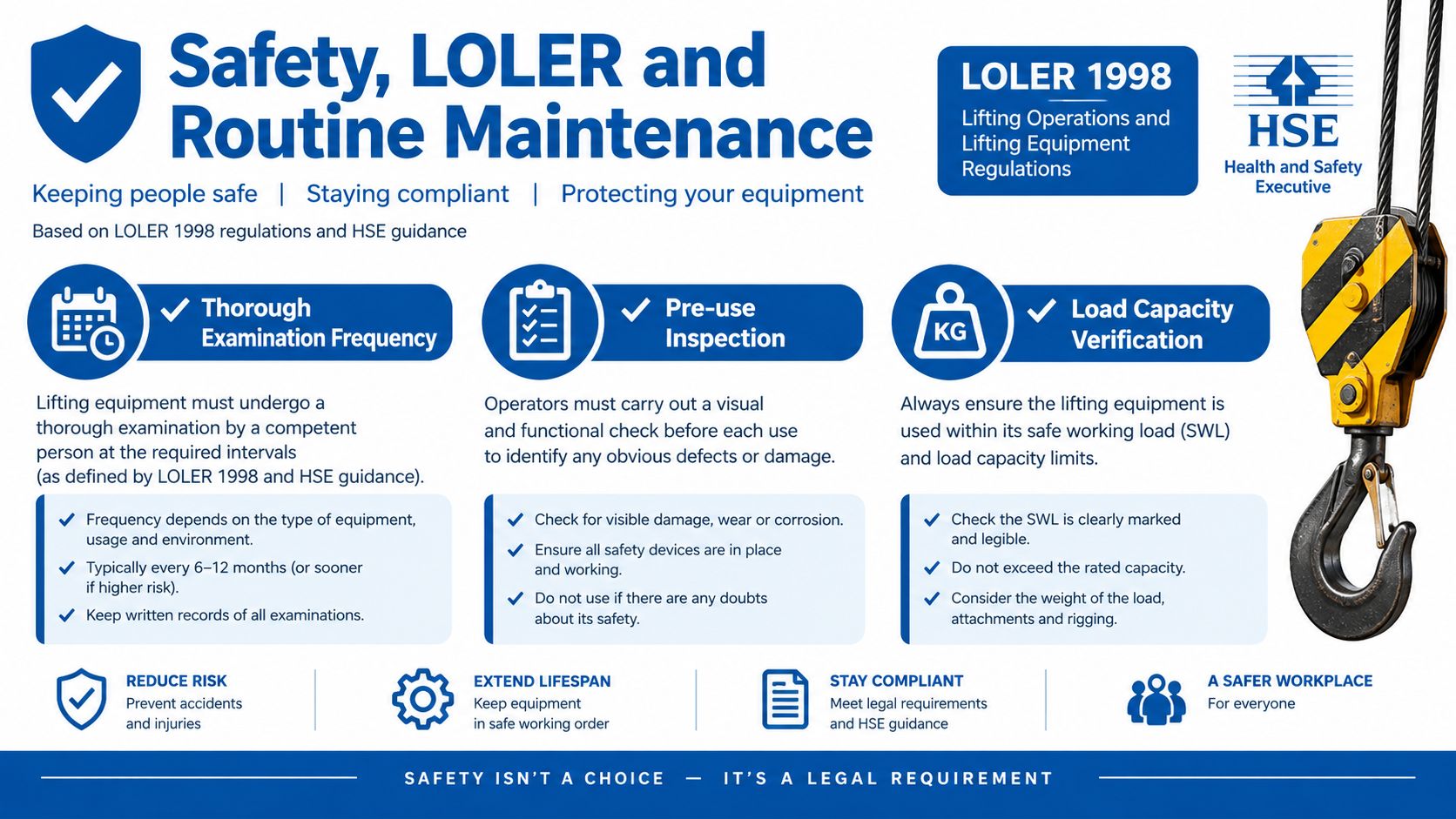
A hydraulic transmission jack used repeatedly in a UK workshop is workplace lifting equipment. LOLER applies to equipment provided for use at work, and HSE expects lifting equipment to be fit for purpose, suitably marked, stable and examined where deterioration could create danger. The HSE guidance on lifting equipment used under vehicles explains the distinction between routine workshop equipment and a vehicle jack supplied only for roadside puncture changes.
What the foreman should check
Start with the load information. Confirm that the safe working load marking is legible and that the planned transmission, fluid, adapters and offset loading remain within the design rating. Don't select the jack solely by gearbox mass.
Then work around the equipment in the order a technician sees it:
- Saddle and retention: Check that the cradle, chains, hooks, straps, pins and adjustment locks are present, secure and compatible with the casing.
- Hydraulic circuit: Look for wetness around the ram, pump, hose, fittings and release valve. A leak can become a loss of load control.
- Controls: Operate the pump and release valve without a load first. The saddle should rise smoothly and descend progressively.
- Frame and castors: Inspect welds, wheels, castors, axles and fasteners. Confirm that the jack rolls without a wheel binding or steering unexpectedly.
- Markings and records: Make sure the rated capacity is visible and the equipment register shows the examination status, defects and corrective actions.
The jack should be positioned on a strong, stable surface and used by competent people as part of a planned operation. Never stand on the saddle, overload it, use loose packing as a substitute for a designed cradle or leave a transmission held only by hydraulic pressure when a mechanical retention feature is provided.
Examination and maintenance records
A transmission jack generally requires a thorough examination before first use unless a valid Declaration of Conformity issued within the previous 12 months accompanies it, and examination is also required where safety depends on installation conditions. For trolley and bottle jacks used in garages, HSE identifies 12 months as the typical thorough-examination interval. The competent person should issue a report, and serious defects must be reported to the responsible person.
Keep the equipment register with the jack's safe working load, examination due date, defects and corrective actions. Planned servicing should cover seal condition, hydraulic oil condition, hose and fitting integrity, lubrication of saddle pins and castor operation, with the interval determined by use, manufacturer instructions and risk assessment rather than an invented calendar rule.
The preventive maintenance checklist can help structure those checks. After use, lower the saddle to its safe storage position, wipe fluid from the ram, remove adapters and secure loose parts. The next shift should find a clean, stable jack with its status clear, not a half-extended unit leaving oil across the bay.
Selection Checklist Before You Buy
A good purchase order answers four questions: what load will the jack carry, how will the casing be restrained, will it fit the bay and can you demonstrate compliance? If the supplier can answer only the first question, the selection is incomplete.
Check the load path
Write down the heaviest complete transmission assembly your team handles. Include retained fluid, adapters, cradle components and any offset position that changes the centre of gravity. Compare that working load with the jack's safe working load, then check how the rating applies when the saddle is tilted or extended.
Next, inspect the contact arrangement. Ask whether the saddle matches the common bell-housing patterns, sump shapes and mounting brackets in your workshop. Confirm that chains, hooks, straps or mechanical restraints can secure the unit without crushing sensors, pipes or covers.
Measure the working environment
Measure the lowest access point beneath the vehicle and the height at which the jack must meet the transmission. Check the maximum saddle height against your ramp or hoist, then compare the chassis width with pit rails, ramp arms and the available turning space.
A high-capacity jack with a wide chassis may be unusable in a restricted service bay. A low-profile unit with insufficient lift may force the team to improvise with a second jack. Both outcomes increase handling risk and undermine the reason for buying dedicated equipment.
Demand evidence before payment
Ask for the Declaration of Conformity where relevant, the safe working load marking, operating instructions and the available thorough-examination documentation. Confirm who will carry out the competent examination and how defects will be recorded. Check that seal kits, hoses, saddle adapters and other service parts can be obtained through a dependable UK supply route.
Use the principles in this guide to assess the load-bearing capacity of lifting equipment against the actual load path, not just the headline rating.
UK trade descriptions should use metric units as the primary measurements. List capacity in kilograms, dimensions in millimetres and fluid quantities in litres. The government guidance on measurement markings and sales allows imperial equivalents as secondary clarification, but metric values must be more prominent.
If you show a product price to a UK consumer, display a clear selling price in pounds sterling with applicable taxes included, and make delivery or mandatory charges clear before purchase. The government guidance on price marking supports treating pricing transparency as part of a proper specification, not an afterthought.
Finally, score every line as yes or no before spending. A marginal no on cradle fit, positive retention, safe working load, examination evidence or bay access should stop the order until the supplier resolves it. That discipline is more valuable than choosing the biggest number on the catalogue page.
For hydraulic components, bespoke power solutions and practical application support around workshop and mobile equipment, speak to MA Hydraulics Ltd on 01724 279508 today, or send us a message. The team can help you assess the load path, select compatible hydraulic equipment and source dependable parts for your application. Visit MA Hydraulics Ltd to discuss your requirements.
