

You're usually looking at 6mm push fit connectors when time is tight and the job isn't happening on a clean bench. It's a machine down in a yard, a cramped cabinet on a production line, or a pilot air line routed through a mobile chassis that never stops vibrating. In those situations, speed matters, but so does knowing where a push-fit will serve you well and where it will subtly become the weak point.
That's the part generic fitting guides often miss. A 6mm push-fit can be a tidy, reliable answer for pneumatic lines, low-pressure fluid circuits and control plumbing. It can also become the source of nuisance leaks, repeat call-outs and hard-to-trace faults if the tube choice, fitting material or installation standard is wrong.
In UK industrial and mobile work, that difference usually comes down to practical details. Tube prep. Seal material. Vibration exposure. Whether the line sees clean, steady service or repeated cycling and shock. If you treat every 6mm fitting as interchangeable, you'll get mixed results. If you match the connector to the duty properly, they're an efficient tool in the right part of the system.
Your Guide to 6mm Push Fit Connectors
A 6mm push-fit earns its place when you need a fast connection without bringing in extra assembly steps. In a maintenance setting, that usually means replacing a damaged line, rerouting a pneumatic control circuit, or getting a machine back into service without threading, soldering or flaring tube ends.
On paper, they look simple. In practice, they sit in very different environments. A static factory air circuit is one thing. A mobile machine with dirt, shock loading and constant vibration is something else entirely. The fitting might be the same nominal size, but the duty isn't.
Where they make sense
They're well suited to applications such as:
- Pneumatic control lines where quick assembly and service access matter
- Low-pressure fluid lines where tube routing is tight and space is limited
- Pilot circuits on hydraulic equipment where the line isn't carrying main system pressure
- Machine build and retrofit work where clean installation and repeatability are important
The attraction is obvious. You push the tube in, confirm engagement, and the line is made. No hot works, no separate ferrules, no time lost on small threaded adaptors where space is poor.
Practical rule: A 6mm push-fit is a good engineering choice when the circuit conditions suit the fitting, not just because the tube happens to be 6mm.
Where people get caught out
The trouble starts when a convenient fitting gets used outside its comfort zone. In mobile applications, engineers often assume a connector that seals on day one will stay sealed after vibration, tube movement and repeated thermal change. That isn't always the case.
Reliability with push fit connectors 6mm comes from disciplined selection and careful installation. If those two parts are right, they're efficient and dependable. If they're rushed, the fitting gets blamed for a problem that usually started with the application or the tube end.
How Push Fit Connectors Work and What They Are Made Of
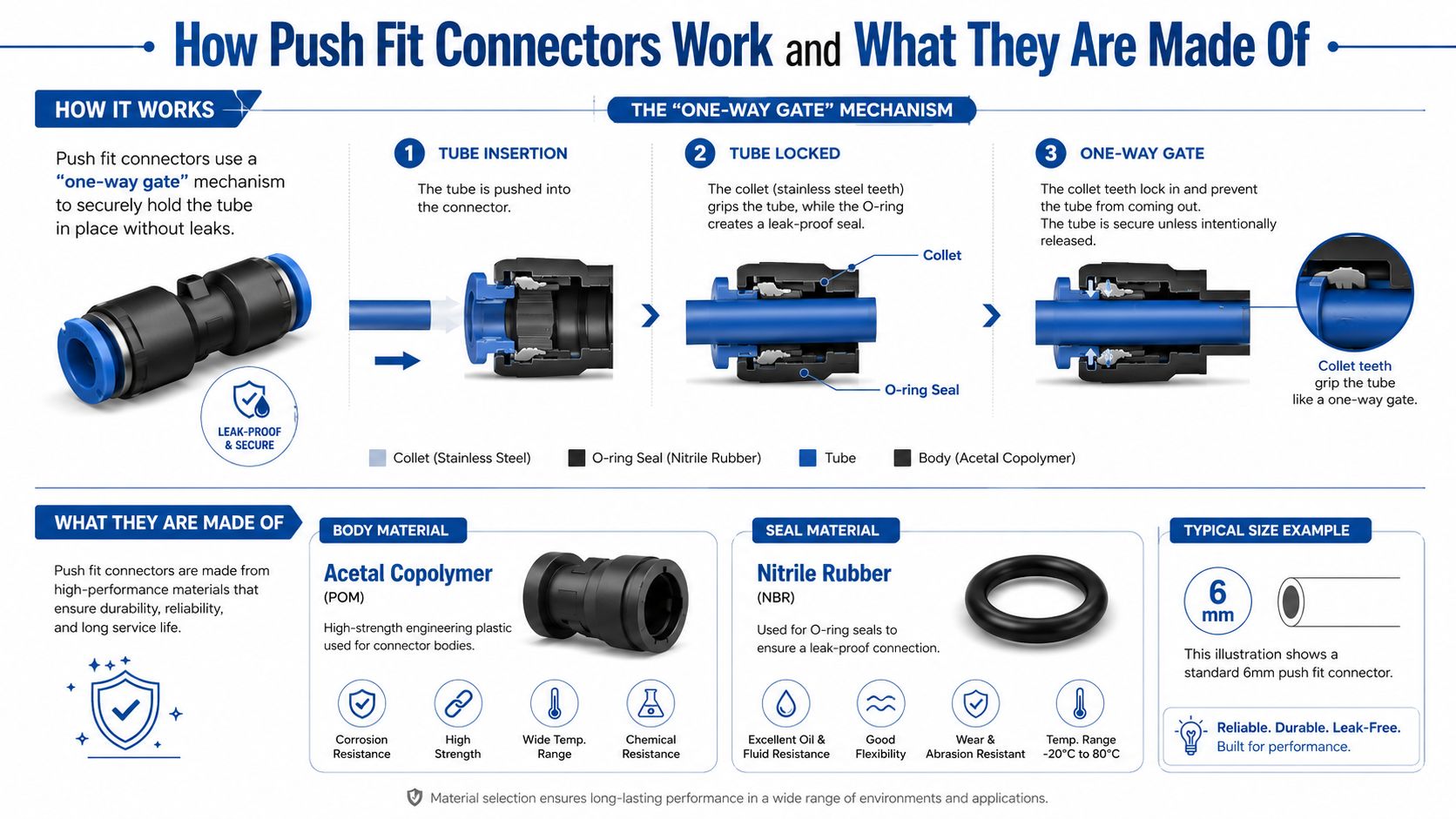
A 6mm push-fit connector usually gets judged in the first few seconds of assembly. The tube goes in cleanly, the fitter feels it bite, and the line looks finished. In a factory or on a mobile machine, the actual test comes later, after heat cycling, vibration, tube movement and repeated service handling. That is why the internal mechanism and body material matter more than the fitting's convenience suggests.
The internal mechanism
Inside the fitting, the tube passes through a release collar, across the grab ring or collet, and into an elastomer seal. The seal does the sealing work. The collet handles tube retention. The body keeps those parts aligned under load.
That distinction matters in service. Engineers often talk about a push-fit "holding pressure", but pressure retention and pull-out resistance are not the same thing. A connector can seal on day one yet still become unreliable if the tube is marked, oval, poorly cut or free to vibrate against the collet in service.
In 6mm pneumatic and low-pressure fluid circuits, this layout is common because it gives fast assembly and compact packaging. It also depends heavily on tube condition. If the tube outer diameter is inconsistent, or the end has a slight burr from blunt cutters, the seal can be damaged during insertion and the collet may not grip evenly around the circumference.
What each internal part does
-
Collet
Usually an engineered polymer with metal gripping teeth or an integral gripping profile, depending on fitting design. Its job is to resist axial pull-out while still allowing release when the collar is depressed. -
Seal
Commonly nitrile for general industrial duty. This is the part that has to cope with surface finish, temperature variation and whatever fluid or compressed air quality the system delivers. -
Body
Usually brass, nickel-plated brass, stainless steel, or a polymer composite. Body stiffness affects how well the seal and collet stay in the correct position when the fitting is knocked, side-loaded or repeatedly disconnected.
A push-fit only works as well as the tube surface it seals on.
Material choices in real service
For UK industrial equipment and mobile hydraulic support circuits, nickel-plated brass is often the practical default. It has the mechanical strength to survive routine handling, enough corrosion resistance for many plant environments, and better durability than lightweight plastic-bodied fittings where lines are likely to be disturbed during maintenance.
Stainless steel earns its place where corrosion risk is persistent rather than occasional. Washdown areas, outdoor exposure, aggressive fluids and contaminated atmospheres all push the choice in that direction. It costs more, but that cost can be justified quickly if a failed fitting means downtime on a machine that is hard to access.
Polymer or composite bodies still have a place. They are lighter, resist corrosion well, and work well in cleaner pneumatic systems. I would be cautious using them on equipment that sees constant vibration, incidental impact, or frequent rework, because body damage and thread damage are less forgiving there.
Why manufacturing detail matters
The tolerances inside a push-fit are tight enough that moulding quality and material stability directly affect performance, especially for collets, collars and polymer-bodied fittings. If you work with engineered plastic components regularly, this overview of DFM for injection molding is useful because it explains how material behaviour, tolerances and geometry influence whether a part performs consistently after production.
That is not a theoretical concern. In demanding service, small variation in seal groove dimensions, collet geometry or moulded part stiffness can show up as inconsistent insertion feel, uneven grip, or early leakage after vibration exposure.
The practical takeaway is straightforward. Push-fit reliability starts with the fitting design and manufacturing quality, then depends on disciplined tube preparation and a material choice that matches the environment. In tough industrial and mobile applications, those details decide whether a 6mm connector stays trouble-free or turns into a recurring callout.
Application and Compatibility Factors
The right question isn't “Will a 6mm push-fit fit my tube?” The right question is “Will this connector stay reliable in this circuit, with this tubing, under this duty?”
That's where most specification mistakes happen. Engineers match nominal size and overlook the combination of tube behaviour, pressure exposure and operating conditions around the fitting.
Pressure boundary
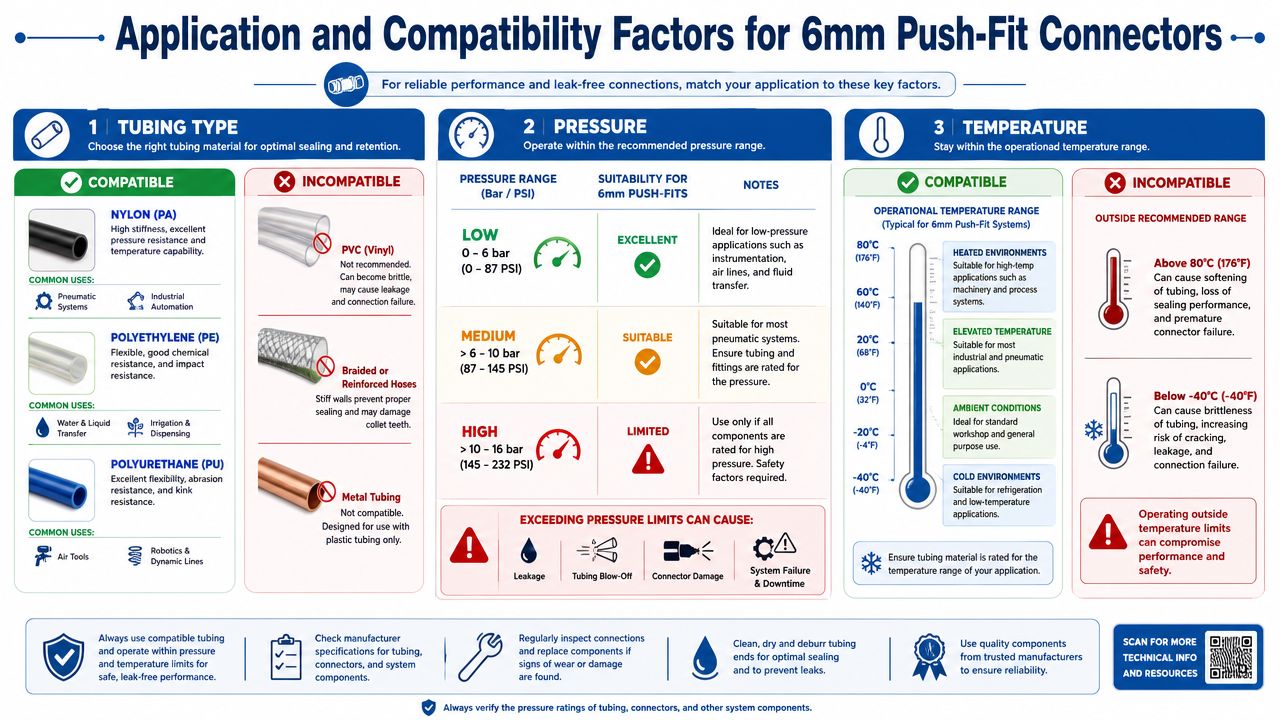
A useful baseline is this. Push-fit connectors with a 6mm tube bore are engineered for hydraulic pneumatic systems operating at a maximum working pressure of 10 bar (1.0 MPa) when using standard nitrile rubber seals, which suits low-pressure industrial duties such as mobile machinery air circuits, according to the GT Air push-fit fittings range.
That doesn't make them a universal answer for every hydraulic package. It means they sit comfortably in low-pressure service where the fitting style, seal and tube all remain within rating.
Tubing compatibility in practice
The tube often determines whether the installation stays trouble-free.
Nylon
Nylon is generally a good choice where you want a cleaner, firmer engagement and less tube movement at the fitting. It's common in control and pneumatic circuits because it balances flexibility with shape retention.
Polyethylene
PE can work well in lighter-duty, less aggressive service where the circuit isn't seeing severe movement or impact. Specification discipline matters because not every PE tube behaves the same at the fitting mouth.
Polyurethane
PU is attractive because it routes easily through tight spaces. That flexibility is useful on compact machinery, but softer tube can become less confidence-inspiring where pressure pulses and vibration are working the joint constantly.
Why bespoke systems need caution
In power pack and automation work, especially on custom builds, engineers often ask whether a 6mm push-fit used on ancillary lines will satisfy dynamic duty expectations. There's a genuine information gap here. UK design engineers regularly raise the question of ISO 4413 pressure pulsation suitability for bespoke power packs up to 11 kW, yet there's no UK-based technical white paper or HSE guidance that explicitly validates 6mm push-fit compliance under dynamic UK grid-pressure fluctuations, typically ±15% from nominal 20 bar, for those builds.
That doesn't automatically rule them out. It does mean you shouldn't assume formal validation exists where it hasn't been clearly published.
For bespoke hydraulic and pneumatic systems, “commonly used” isn't the same as “proven for this duty”.
Think at system level
Compatibility isn't unique to fluid power. Anyone who has looked at the benefits of whole house filtration will recognise the same basic engineering principle. Component performance depends on the wider system, not just on the individual part in isolation.
For 6mm push fit connectors, the system view means checking:
- Tube material against movement and stiffness requirements
- Pressure duty against the fitting's actual rating
- Temperature exposure against seal suitability
- Fluid or air quality against contamination and seal wear risk
If one of those is wrong, the fitting may still go together nicely. It just won't stay reliable for long.
Selecting the Right 6mm Connector for Your System
A lot of fitting problems start at the buying stage. Someone sees a 6mm tube, picks a 6mm connector, and assumes the job is done. That's procurement by diameter, not by duty.
The better approach is to choose the connector body, tube pairing and retention method based on what the machine does. A static line inside a cabinet doesn't need the same thinking as a line on a vibrating agricultural chassis.
Start with the environment
If the installation sits in a clean industrial enclosure and carries low-pressure air, a polymer-bodied push-fit may be perfectly sensible. It's light, easy to handle and cost-effective.
If the fitting sits on mobile plant, near moving structure, exposed to dirt or likely to be disturbed during service, I'd lean toward a more durable metal-bodied connector. Nickel-plated brass is commonly the practical answer. Stainless comes into the frame where corrosion, washdown or media compatibility make it worth the extra spend.
Tube choice changes the result
This is one of the biggest trade-offs. In UK industrial practice, 6mm push-fit connectors are rated for intermittent pressures up to 1.0 MPa but can show a 30 to 50% reduction in effective sealing force when used with flexible tubing such as PU or nylon, leading to potential micro-leaks after 500+ cycles, according to the Hydraulic Megastore 6mm fitting data.
That's the point at which convenience and long-term reliability start pulling in different directions. A flexible tube may route beautifully. It may also relax under pressure cycling and vibration in a way that leaves the fitting doing more work than it should.
What to do in mobile duty
For harsher service, two fixes usually make the difference:
- Use a more rigid tube where routing allows it
- Add secondary mechanical support or clamping if the line sees movement, shock or repeated disturbance
That's especially relevant on agricultural and materials handling equipment, where line vibration is normal rather than exceptional.
A quick selection matrix
| Application | Recommended Material | Key Consideration | Example UK Price Range |
|---|---|---|---|
| Static factory pneumatic line | Polymer or composite | Best where impact risk is low and access is good | Around £1.20 for a basic fitting |
| General industrial machine build | Nickel-plated brass | Better durability and service confidence | Mid-range depending on configuration |
| Harsh mobile or corrosive environment | Stainless steel | Choose where corrosion resistance or tougher duty justifies cost | Over £7.00 for higher-spec versions |
Those price examples reflect the spread you see between entry-level composite fittings and higher-spec stainless options for the same nominal size.
Don't ignore configuration and future service
The body material isn't the only decision. Elbows, tees, straight unions and threaded adaptors all behave differently once the line is installed. A straight fitting with relaxed tube routing will usually outlast a badly aligned elbow that's constantly side-loaded.
If you're also comparing neighbouring sizes for a redesign, it's worth looking at 10 mm push-fit options to see whether upsizing the tube and fitting geometry would give you a cleaner routing solution.
The right connector is the one that still works after months of vibration and maintenance handling, not the one that simply clicks together fastest on the bench.
Installation and Removal Best Practices
A 6mm push-fit connector usually fails long before the fitting body gives up. In factory pneumatics and mobile hydraulic support circuits alike, the trouble starts with a poor tube end, a rushed insertion, or a line that is left vibrating against the fitting from the first day of service.
That matters even more on UK plant, road-going equipment, and off-highway machinery where cold starts, dirt ingress, and constant movement expose every shortcut.
For a visual walkthrough, this installation guide is useful:
Cut the tube properly
Start with the tube, not the fitting.
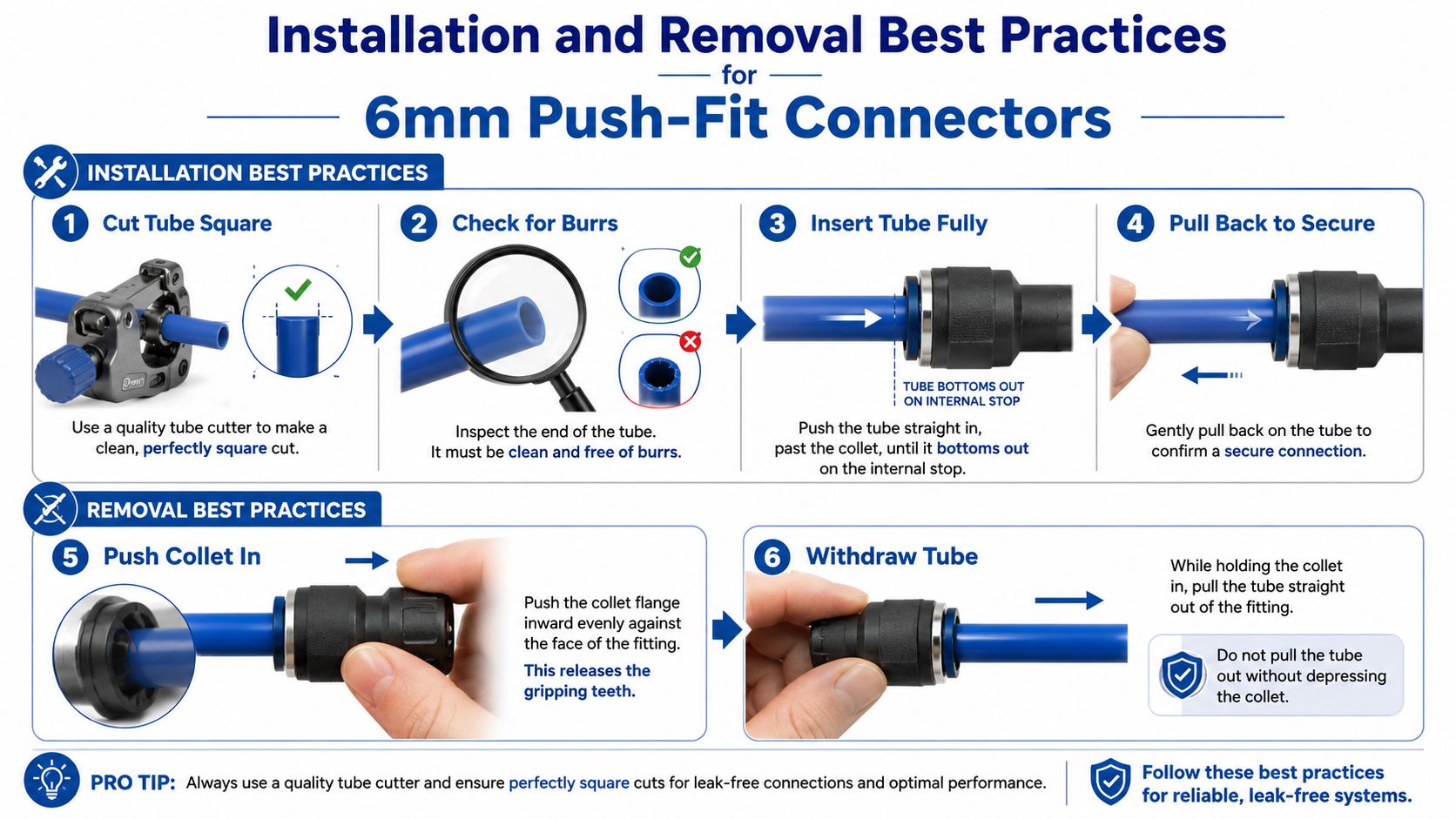
The cut needs to be square, clean, and dry. If the tube end is angled, crushed, or scored, the O-ring only seals on part of the circumference. That may hold on the bench, then start weeping once the machine sees pressure cycling, temperature change, or vibration.
Use a proper tube cutter. Avoid side cutters, knives, and any method that leaves burrs or an oval tube end.
Follow a simple quality sequence
-
Cut square
Make a clean, perpendicular cut across the tube. -
Inspect the end
Check for burrs, flattening, scratches, or dirt. -
Insert fully
Push the tube past the seal until it reaches the internal stop. -
Pull back lightly
A light tug confirms the collet has gripped correctly. -
Check the tube run
Make sure the line enters the fitting straight, without twist or side load.
For a broader field reference, keep these installation guidelines for hydraulic and pneumatic fittings close to the job sheet.
Common installation mistakes
The repeat offenders are easy to recognise:
- Angled cuts that leave part of the seal unloaded
- Dirty or wet tube ends that contaminate the sealing area
- Partial insertion where the tube has not reached the stop
- Unsupported tube runs that shake the fitting under vibration
- Using push-fit connectors as alignment points instead of routing the tube correctly
On mobile equipment, that last point causes a lot of grief. A 6mm connector will tolerate normal service movement. It is not there to absorb a badly routed line whipping around a panel or manifold.
Later in the process, this video shows the handling principles clearly:
Remove fittings without damaging them
Removal is simple if the sequence is right.
- Depressurise first. Never remove tube from a live circuit.
- Push the collet collar in evenly. Uneven pressure can cock the release ring and mark the tube.
- Withdraw the tube smoothly while holding the collet in.
- Inspect before reuse. If the tube shows scoring or flattening at the seal line, cut back to fresh material before refitting.
Do not pull the tube out against the collet. That drags the grab ring across the tube surface and often creates the leak that appears after reassembly.
If a line is difficult to release, stop and confirm there is no trapped pressure. On larger systems, teams already used to finding compressed air and steam leaks will know that residual energy and small leaks can mask what is really happening at the fitting.
Troubleshooting Common Problems and Maintenance Tips
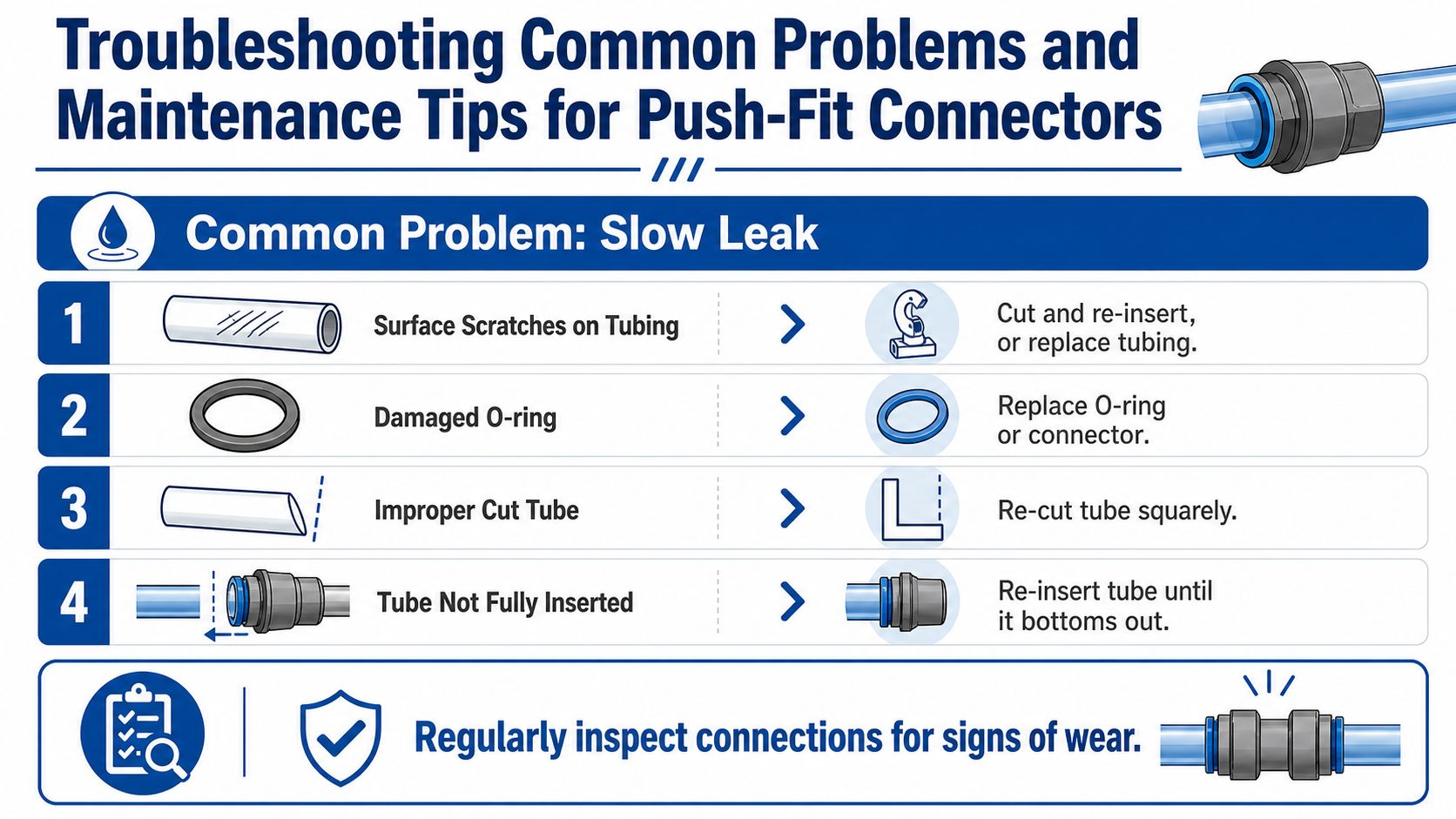
The most common complaint with push fit connectors 6mm isn't catastrophic failure. It's the irritating slow leak that leaves a line damp, drops system confidence and sends someone back to a fitting that looked fine when installed.
The fastest way to solve it is to work through the basics in order, rather than replacing random parts.
If the fitting is weeping
Start with the tube end. Remove it correctly, inspect the sealing area and look for scratches, scoring or flattening where the O-ring contacts the tube. If the tube has been in and out several times, trim back to a fresh section and remake the joint.
If the leak remains, the likely causes narrow quickly.
| Symptom | Likely cause | Practical fix |
|---|---|---|
| Slow leak at fitting mouth | Scratched or worn tube surface | Re-cut and reinsert using a fresh tube end |
| Leak after repeated reuse | Damaged or contaminated seal | Replace the connector |
| Tube won’t stay secure | Collet damage or incomplete insertion earlier | Refit correctly or replace fitting |
| Intermittent leak in service | Movement, vibration or line side-load | Improve support and routing |
If the tube pops out
That usually points to one of two things. The tube never fully bottomed out during installation, or the collet has been damaged by rough removal or previous misuse.
In mobile and vibrating environments, tube movement can also expose poor routing. If the line is under constant tension, the fitting is being asked to resist a problem the layout created.
A push-fit should retain the tube. It shouldn't act as the main structural support for a badly routed line.
Maintenance habits that actually help
- Inspect high-vibration locations regularly for looseness, rubbing and disturbed tube runs
- Keep fittings clean before disconnecting them so dirt doesn't enter the mechanism
- Replace suspect fittings early if the seal area has seen repeated disturbance
- Check line support so the connector isn't carrying unnecessary side load
For plant teams dealing with persistent air losses, methods used for finding compressed air and steam leaks can also help narrow down small leakage points that are difficult to locate by sight or sound alone.
A structured diagnostic process saves time. If you need one, this troubleshooting methodology gives a sensible sequence for isolating hydraulic and pneumatic faults without jumping straight to parts replacement.
Get Expert Advice on Your Connector Needs
A reliable 6mm push-fit connection comes down to two things. Correct selection and careful installation. Get either one wrong and even a decent fitting will underperform. Get both right and these connectors can give clean, compact, service-friendly results in the right low-pressure duties.
That matters whether you're maintaining mobile machinery, building industrial equipment or specifying ancillary lines around a bespoke hydraulic package. The fitting itself is only one part of the decision. Tube material, vibration exposure, routing and service conditions all matter just as much.
If you're unsure whether a 6mm push-fit is the right answer for your system, it's worth checking before the machine goes out the door or back into service. A short technical discussion at the selection stage usually prevents a much longer fault-finding exercise later.
For expert help with fittings, cross-references and application advice, contact MA Hydraulics Ltd. Phone 01724 279508 today, or send us a message for friendly, practical support.
