
You're usually looking at a Honda-powered hydraulic pack for one reason. The job has to happen away from a fixed electrical supply, and stopping to improvise power on site is a bad plan. That might be a service van attending plant in the field, a farm workshop working outside the yard, or a contractor running a tool where mains power isn't available.
That's where a Honda hydraulic power pack earns its keep. It gives you a self-contained hydraulic source you can move to the work, couple up quickly, and put straight into service. In UK conditions, that portability matters as much as the raw hydraulic output. The question isn't just whether the pack starts and makes pressure. The key question is whether it suits the duty cycle, the circuit, and the environment you're asking it to work in.
Procurement teams often get caught by the catalogue view of these units. A sheet shows engine brand, flow, pressure and tank size, and the purchase turns into a box-ticking exercise. In practice, that's where avoidable problems start. A pack that looks suitable on paper can still run hot, cycle too slowly, or spend its life on relief because the application was never properly defined.
Introduction Your Guide to Portable Hydraulic Power
A fitter is on a breakdown call at a remote site. The tool needs hydraulic power now, there is no usable mains supply, and hiring a generator just to run an electric pack adds time, noise and another failure point. In that situation, a Honda-powered hydraulic pack can be the right answer. It can also be the wrong one if the duty cycle, flow demand or working conditions have not been defined properly.
That is the part buyers often miss.
A portable pack is only useful if it delivers the right flow, pressure and oil control for the actual job. If it is undersized, the ram slows, the motor stalls or the oil temperature climbs too fast. If it is oversized, you pay for output you do not use, carry more weight than necessary, and can end up with poor control on light intermittent work.
Where Honda-powered units fit
Honda-powered packs are common because they suit mobile and temporary hydraulic duties well. The engines are widely recognised, parts support is generally straightforward, and service teams already know how to maintain them. For many UK users, that reduces downtime risk more than a small difference in headline specification.
The key selection question is not whether Honda is a good engine brand. It is whether a petrol-driven pack is the right power source for your duty cycle.
For short to medium-duration work away from fixed power, a Honda unit is often a sensible choice. For enclosed spaces, long continuous running, low-noise sites or applications with strict emissions controls, it may not be. That trade-off matters more than the brochure. A pack that starts easily and makes full pressure on a test bench can still be a poor fit once it is asked to run a heat-heavy circuit for hours, or supply a tool that needs stable flow rather than peak pressure.
Procurement decisions are better when the application comes first. Define how long the pack will run, how often the actuator cycles, what ambient conditions it will see, and how it will be transported and serviced. Once those points are clear, choosing a Honda-powered unit becomes a technical decision rather than a brand-led one.
What Is a Honda Hydraulic Power Pack
A Honda hydraulic power pack is a portable hydraulic supply unit that uses a Honda petrol engine to drive a pump. The engine provides the shaft power. The pump turns that into oil flow, and the hydraulic circuit then uses that flow and pressure to run a tool, cylinder or motor.
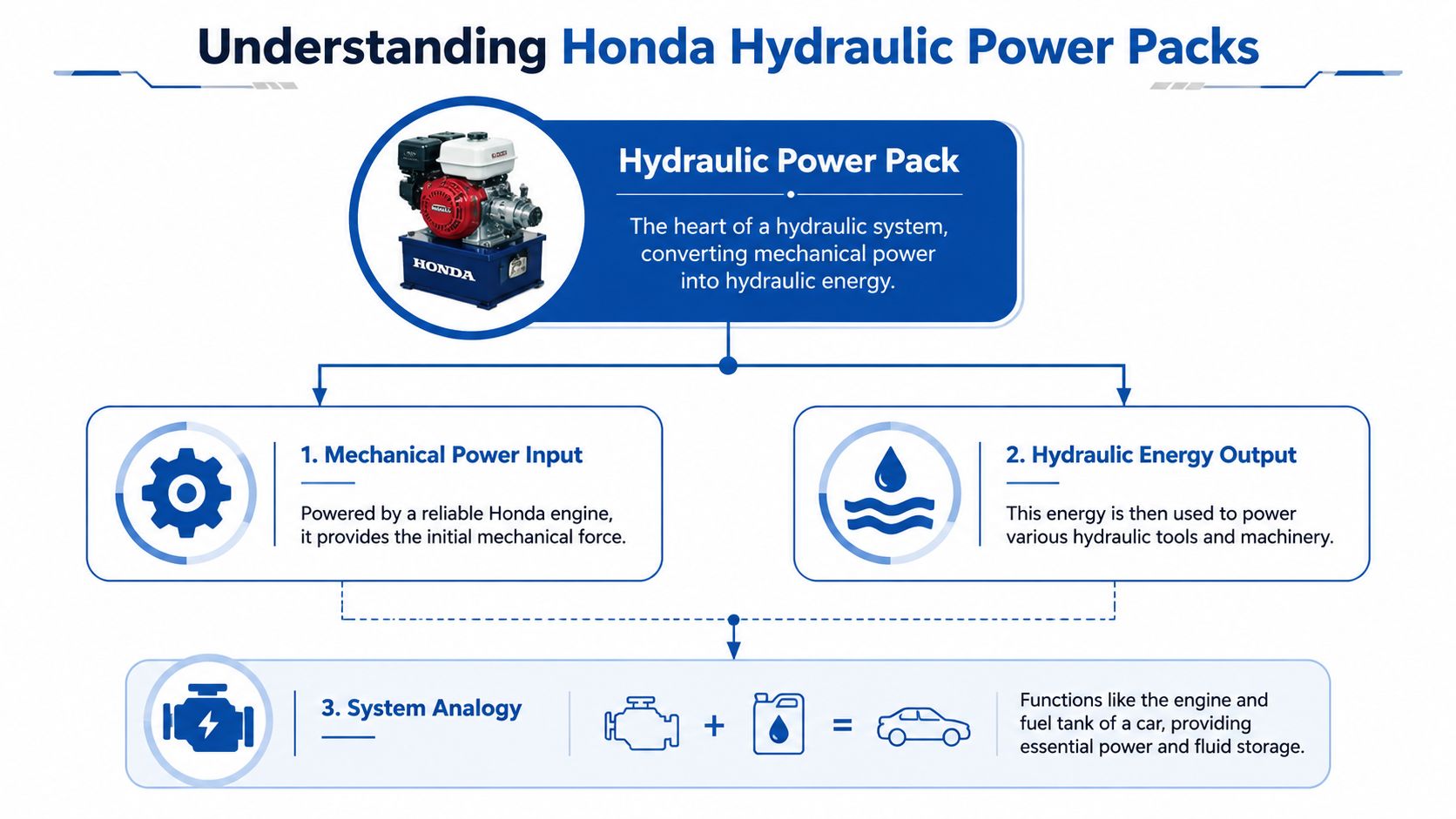
What matters in practice is that the pack is only one part of the job. It must suit the duty. A unit that works well on occasional breaker use may struggle if you ask it to hold pressure for long periods, run hot oil all day, or feed a circuit that is sensitive to flow variation.
A typical portable pack brings the main hydraulic elements together in one frame:
- Honda petrol engine to provide mechanical drive
- Hydraulic pump, commonly a gear pump, to generate flow
- Reservoir to store oil and allow some cooling and deaeration
- Relief valve to cap maximum system pressure
- Filtration to control contamination
- Control valve arrangement to send oil to the connected function
That sounds straightforward, and mechanically it usually is. The buying mistake is assuming all self-contained packs behave the same because the layout is familiar. Pump size, reservoir volume, valve setup and cooling capacity have a bigger effect on day-to-day performance than the engine badge on its own.
Honda engines are widely specified on portable packs because they are familiar to service teams and generally easy to support in the field. That makes sense on mobile and temporary work where starting reliability, parts access and straightforward maintenance all affect downtime. You can see the broader hydraulic power unit options from MA Hydraulics if you need to compare portable and fixed arrangements.
The definition, then, is not just "engine plus pump". A Honda hydraulic power pack is a petrol-driven hydraulic unit best suited to applications where independent, transportable power is needed and the duty cycle suits petrol operation. If the job involves enclosed areas, long continuous running, tight noise limits or sustained heat load, a different power source is often the better engineering choice.
Practical rule: Buy the pack for the duty cycle, not for the engine name. A well-known Honda engine on the wrong pump and tank setup will still give poor hydraulic results.
Understanding Key Specifications Pressure Flow and Power
The three figures that matter most are pressure, flow, and engine power. If you understand how those relate, you can assess a Honda hydraulic power pack properly instead of relying on broad product descriptions.
Pressure is what gives you force. Flow is what gives you speed. Engine power determines how much of each you can sustain at the same time.
Pressure and flow are a trade-off
A hosepipe analogy helps. Pressure is how hard the water can push. Flow is how much water is moving. In a hydraulic circuit, high pressure without enough flow gives force but not speed. High flow without enough pressure gives movement but not useful work against load.
For a Honda GX390-powered portable unit, a common envelope is roughly 5 to 10.5 GPM at up to 3,000 psi, with the engine around 11.8 hp, as shown in this GX390 hydraulic power pack specification. In metric terms, that is about 19 to 40 L/min and 207 bar.
That's why one GX390 pack can feel strong but slow on a cylinder job, while another feels quick but less forceful. The engine may be similar. The pump choice changes the behaviour.
A worked sizing example
Hydraulic selection should come back to cycle requirements. One worked example in a hydraulic design explanation shows a required flow of 38.15 L/min to achieve a 300 mm stroke in 12 seconds, using a 110 bar relief-pressure assumption, as discussed in this hydraulic power calculation example.
That matters because it shows how quickly a rough assumption can miss the mark. If your application needs about 38.15 L/min and you fit a pack delivering about 30.3 L/min, the machine won't meet the intended cycle time. It may still work, but it won't work as expected.
Typical Honda power pack configurations
| Honda engine model | Typical power (kW / hp) | Example flow rate (L/min) | Max pressure (bar) |
|---|---|---|---|
| Honda petrol engine example unit | Approx. 6.7 kW / 9 hp | Approx. 30.3 | Not stated in the cited listing |
| Honda GX390 | Approx. 8.8 kW / 11.8 hp | Approx. 19 to 40 | Up to 207 |
If you're comparing broader hydraulic power unit options, this is the level to compare at. Not just engine badge. Compare required flow, working pressure, pressure limit, and how long the unit is expected to stay loaded.
If the tool needs speed, buy for flow. If it needs force, buy for pressure. If it needs both, check the engine power first and stop guessing.
What goes wrong when buyers focus only on engine size
Two common mistakes show up repeatedly:
- Oversimplifying by horsepower alone. A larger engine doesn't automatically mean the pack suits the circuit. Pump displacement and pressure settings decide the hydraulic output.
- Ignoring relief setting and duty pattern. A pack that spends too much time near relief converts useful energy into heat. Operators then describe the unit as weak, when the problem is usually mismatch rather than failure.
For procurement managers, the safest approach is to start from the actuator or tool requirement and work backwards.
How to Size and Select the Right Unit
The biggest sizing error is assuming a Honda-powered pack is automatically suitable because the application is mobile. Mobility is only one requirement. The unit still has to match the work.
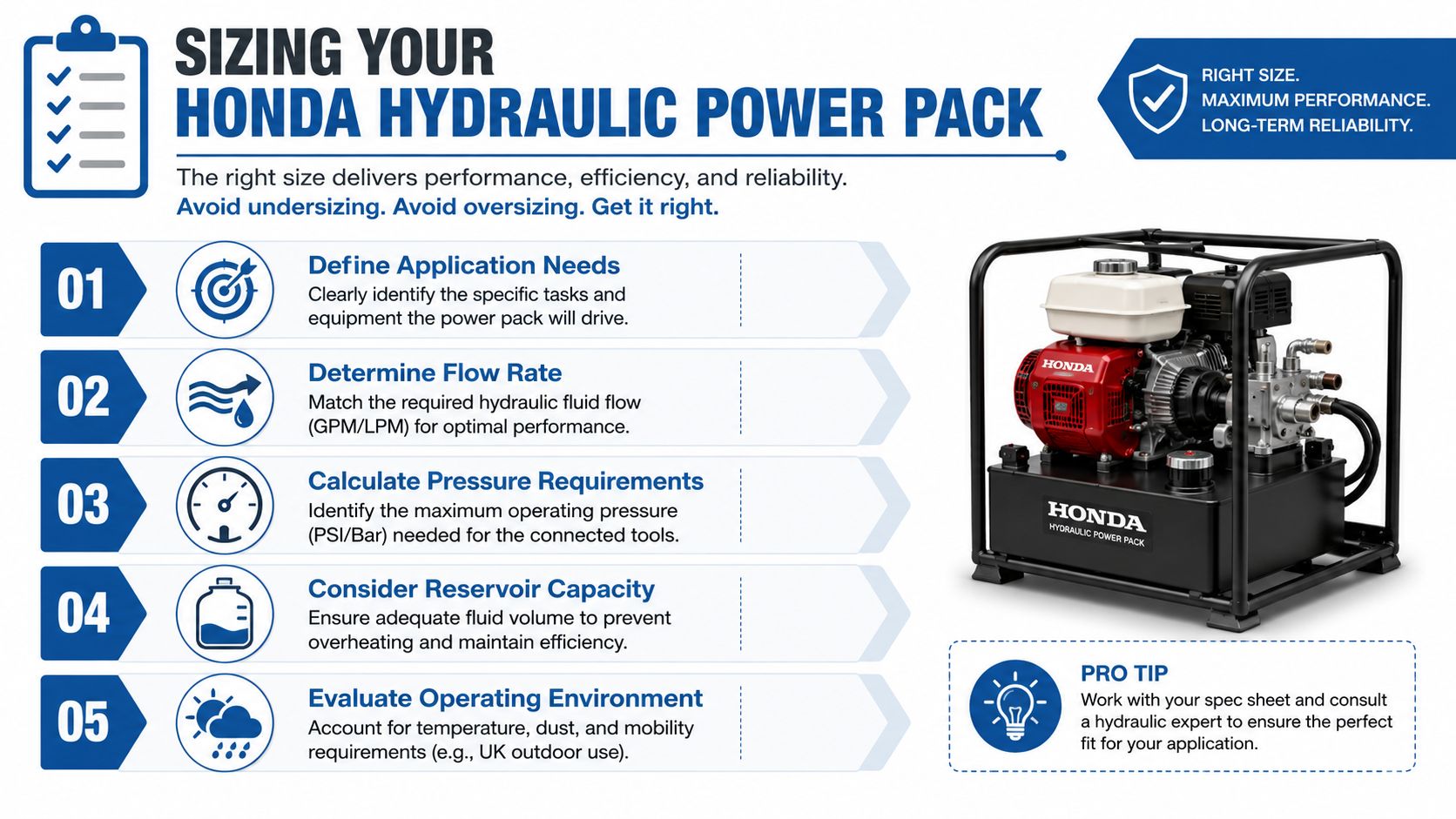
Start with the actuator or tool
Before choosing the pack, pin down what it is driving.
- Cylinder applications need the bore, stroke, required force, and target cycle time.
- Hydraulic motors need torque demand, running speed, and whether the load is steady or peaky.
- Intermittent tools like breakers or service tools can tolerate a different setup from equipment expected to run for long periods.
If the attached equipment specification is vague, the power pack selection will be vague too.
Duty cycle decides whether petrol is sensible
This is the question many buyers skip. Not every Honda engine pack should be treated like an all-day continuous-duty industrial power source.
A practical concern often missed in buying decisions is whether a Honda-engine pack is right for the required duty cycle. Questions such as whether it can run continuously all day without overheating, or what reservoir size is needed for summer work in the UK, are more important than the spec sheet alone, as highlighted in this discussion of common hydraulic power unit problems.
Ask these five questions before ordering
-
What exactly is the load?
Don't accept “general hydraulic use” as a brief. Identify the cylinder, motor, or tool. -
What flow is required at the actuator?
Required speed comes from flow, not engine brand. -
What pressure is needed in normal work?
Set the pack around the actual working load, not around the highest pressure somebody thinks sounds safe. -
How long will it stay loaded?
Short bursts, repeated cycles, and extended running all produce different heat patterns. -
Where will it operate?
Outdoor site work, farm use, and workshop use each bring different constraints around ventilation, dirt, weather, and portability.
A unit that survives occasional short runs may be the wrong choice for repeated heavy loading over a full working day.
What works and what doesn't
What works is a buying process that treats the pack as part of the hydraulic circuit.
What doesn't work is choosing the nearest standard model and hoping the relief valve will cover the difference. Relief valves are protective devices, not sizing tools.
For indoor work, fixed workshop use, or applications with long run periods, many buyers find the Honda-powered option stops making sense once heat, fumes and operating environment are considered. For remote jobs, roadside work or field servicing, petrol often remains the practical answer.
Common Applications in UK Industries
A crew arrives on a remote site with breakers, a post knocker, and no practical mains supply. The job still has to get done that day. That is the sort of work where a Honda-powered hydraulic pack earns its place.
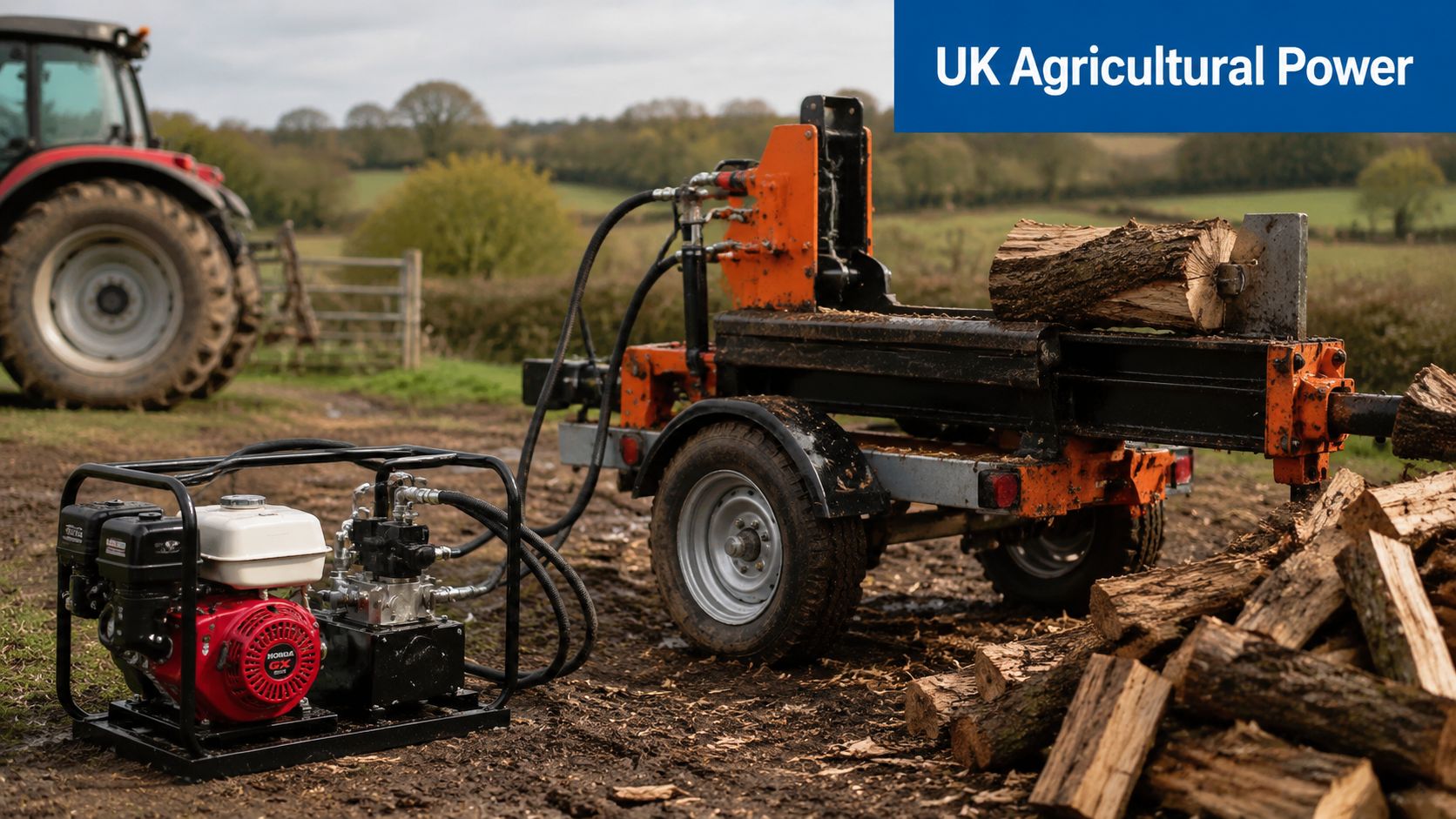
The common thread across UK applications is not the industry badge. It is the duty cycle. These packs suit mobile jobs, short to medium run periods, and work where portability matters more than quiet operation or all-day continuous use. That distinction matters in procurement, because the same unit that performs well on field service work can be a poor fit for a fixed indoor process line.
Where Honda-powered packs make sense
In agriculture, they are often used for log splitters, bale handling attachments, press functions, and general maintenance away from the yard supply. The pack travels to the machine, runs the function, then moves on.
On construction and civils sites, they commonly power handheld tools, small cylinders, and temporary hydraulic functions where dragging in electrical infrastructure costs more time than the task itself. Recovery and utility teams use them in much the same way. Access first, tidy installation second.
Plant servicing is another strong fit. A maintenance team can carry a self-contained pack in a van to stroke a cylinder, test a valve bank, or power an auxiliary function during fault-finding. For that kind of work, ease of starting after transport and simple hose connection points matter as much as catalogue performance.
The selection point buyers often miss
Application lists on their own are not enough. A Honda-powered pack is suitable for many of these jobs only if the working pattern matches what the unit can dissipate and deliver in real use.
A splitter used in short cycles on a farm is one thing. A hydraulic motor running for long periods on a utility rig is another. Both are "mobile applications", but their heat load, fuel use, and operator expectations are different. That is where poor buying decisions start. The engine may be reliable, yet the overall pack can still be wrong for the job if the reservoir, cooling, filtration, or valve set-up do not suit the cycle.
I usually advise buyers to separate jobs into three groups: occasional actuation, repeated intermittent cycling, and sustained running. Honda-powered packs are often a sound choice for the first two. The third group needs closer scrutiny, especially if the work is indoors, noise-sensitive, or likely to spend long periods under load.
What field use actually demands
In UK conditions, these packs are expected to tolerate wet weather, trailer transport, rough ground, and dirty couplings. That shifts the buying criteria away from headline engine branding alone.
Frame strength matters because packs get lifted in and out of vans. Tank access matters because oil condition is checked in poor light and bad weather. Hose routing matters because awkward outlet positions get hoses kinked or damaged. Good procurement decisions are usually the boring ones that reduce service calls six months later.
For packs that will be connected into larger temporary circuits or used during commissioning work, following proper hydraulic system commissioning procedures helps avoid chasing faults that are really caused by contaminated oil, trapped air, or incorrect hose connection.
A useful rule is simple. Buy a Honda-powered pack for the jobs that need portable hydraulic power at the point of work, then check whether the actual duty cycle supports that choice. If the pack will spend its life travelling, starting, stopping, and running in bursts, petrol often makes good sense. If it will sit in one place and run hard for hours, another power source is usually the better engineering decision.
Essential Installation and Maintenance Tips
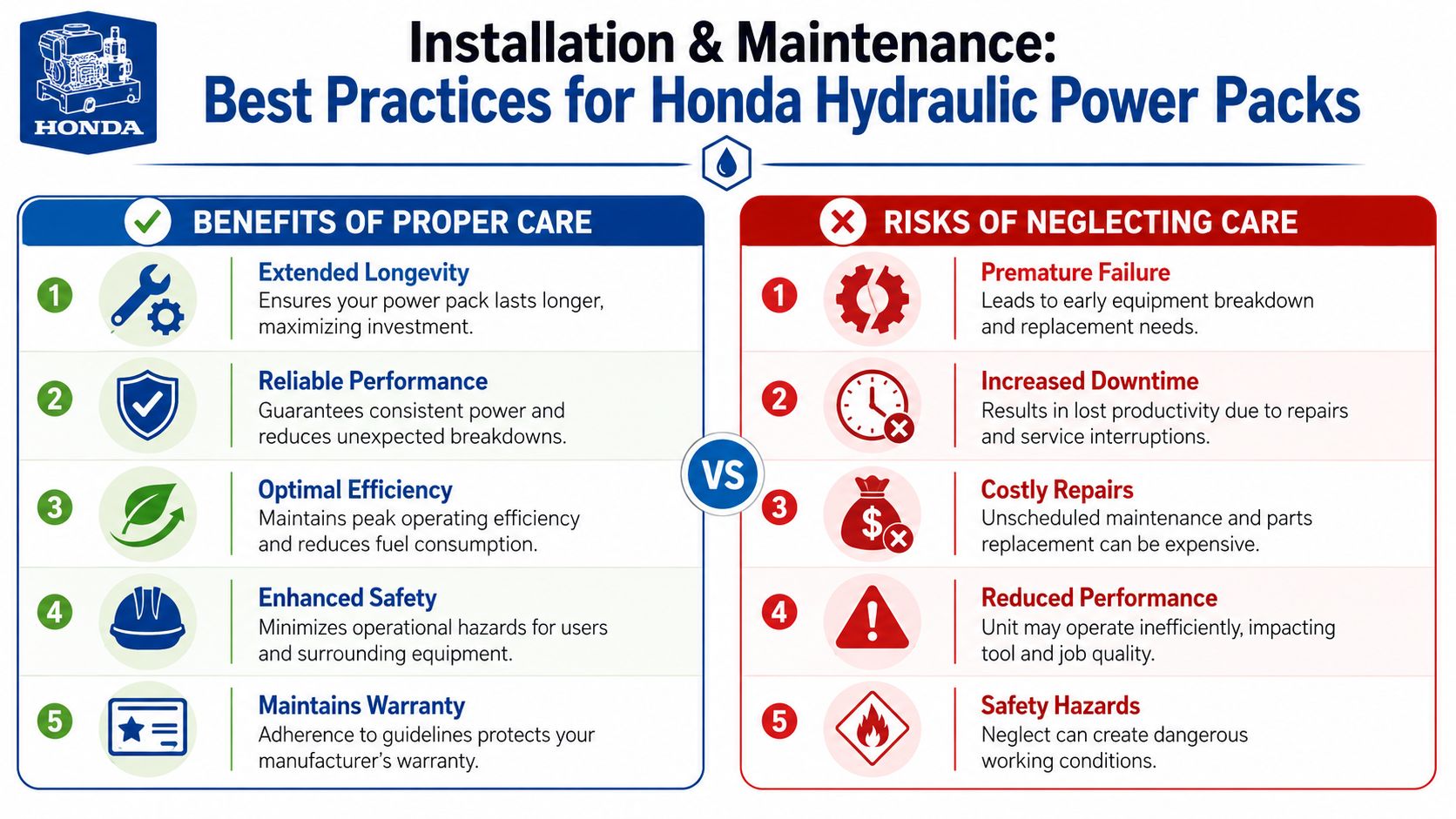
A Honda-powered pack can be mechanically sound and still give poor service if it's installed badly or maintained casually. Most field failures aren't mysterious. They come from contamination, bad hose practice, incorrect oil level, or heat.
What to check before first use
Start with the basics and do them properly.
- Level and position. Place the pack on stable, level ground. That helps both engine lubrication and oil pick-up.
- Oil condition. Check engine oil and hydraulic oil before running. Don't assume a delivered unit is ready to work.
- Clean couplings. Dirt enters quickly through open hoses and dirty quick-release couplings.
- Correct hose routing. Avoid tight bends, rubbing points, and unsupported hose weight at the ports.
For units that are installed as part of a larger system, following structured commissioning procedures for hydraulic systems helps reduce avoidable faults at first start.
Filtration is not optional
High-quality portable power packs are typically configured with an integrated gear pump, a reservoir around 5-gallon, or roughly 19-litre, on smaller units, plus 10-micron return filtration and an adjustable relief valve, as shown in this portable Honda-motor hydraulic unit specification.
That matters because poor filtration raises the risk of cavitation and accelerated wear. In field service, contamination is the failure mode I'd worry about first, not last.
Clean oil is cheaper than pumps, valves and downtime.
A practical maintenance routine
A sensible routine doesn't need to be elaborate:
- Daily visual check. Look for leaks, hose damage, loose fittings, and signs of foaming or overheating.
- Monitor starting and running behaviour. Hard starting, unstable speed, or unusual noise usually turns into a bigger issue if ignored.
- Watch oil appearance. Darkened, aerated or milky oil tells you something is wrong.
- Keep filters in the maintenance plan. A blocked or neglected filter undermines the whole unit.
- Inspect after transport. Portable packs often suffer from vibration-related loosening and impact damage.
What operators often miss
The pack may only run intermittently, but every start-up still matters. A unit that is bounced around in a vehicle, stored outside, and coupled up in muddy conditions needs stricter cleanliness discipline than a fixed indoor power unit.
That's why good maintenance on a Honda hydraulic power pack isn't just engine servicing. It's contamination control, hose care, relief setting awareness, and paying attention to heat.
Get the Right Honda Power Pack from MA Hydraulics
Choosing a Honda-powered hydraulic pack properly means defining the application before selecting the assembly. The wrong unit usually isn't dramatically wrong. It's just wrong enough to create slow cycles, excess heat, awkward servicing, and operator frustration.
For procurement managers, the best approach is to specify the work first. State the actuator or tool, target speed, expected pressure, run pattern, and operating environment. Then decide whether a portable petrol pack is the right answer, or whether another power source would suit the duty better.
Where a standard catalogue unit doesn't quite fit, bespoke assembly becomes the sensible route. MA Hydraulics supplies hydraulic components and builds power pack solutions for mobile and industrial applications, including bespoke industrial power packs up to 11 kW, with related support covered on its fluid power services page. That matters when you need the engine, pump, valve, reservoir and filtration package matched to the job rather than loosely approximated.
A properly matched Honda hydraulic power pack should do three things well. It should deliver the required flow and pressure, stay within sensible thermal limits for the duty, and remain serviceable in the actual environment where it will operate. If any one of those is weak, the purchase will cost more in use than it saved at order stage.
If you need help specifying the right Honda-powered hydraulic pack for your application, contact MA Hydraulics Ltd. Phone 01724 279508 today, or send us a message.
