
Choosing the right metal oil tank for your hydraulic system isn't just about finding a container that fits. It's a foundational decision that directly impacts the efficiency, reliability, and ultimately, the lifespan of your entire setup. Getting it right from the start saves a world of headaches down the line.
Why Your Hydraulic System Depends on the Right Metal Oil Tank
It’s tempting to see a hydraulic tank as just a box for holding oil, but that's a costly oversimplification. A better way to think of it is as the system’s combined lungs and kidneys—a hard-working component with a vital, active role. It's where the hydraulic fluid can cool down, where trapped air can escape, and where nasty contaminants like water and metal fragments have a chance to settle out before the oil is sent back to the pump.
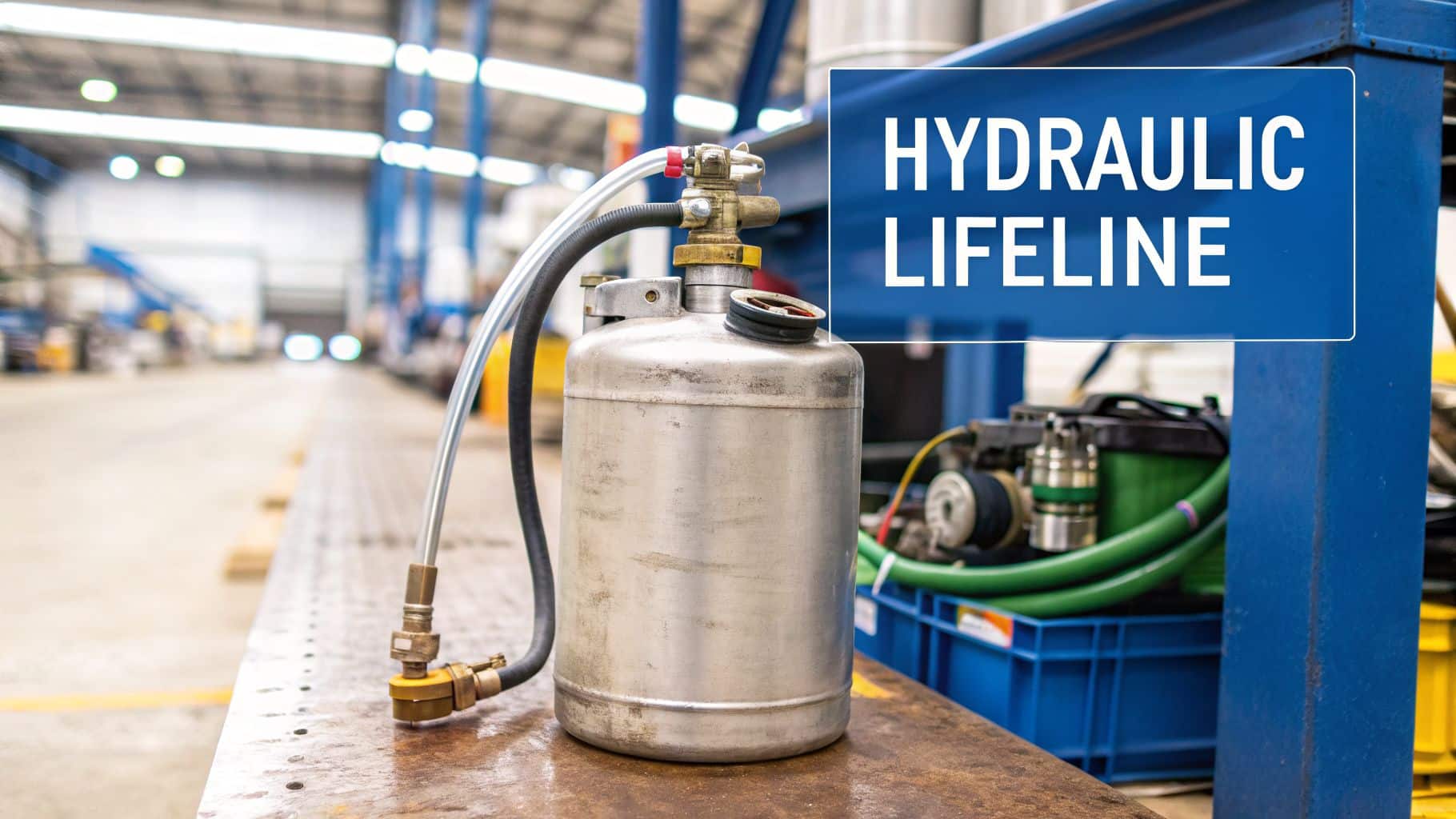
Skimping on the tank or specifying it incorrectly is a recipe for disaster. It can trigger a cascade of problems, leading to premature and catastrophic failure of your most expensive components—pumps, motors, and valves. Whether it's on a piece of mobile machinery or a large industrial power pack, a poor tank choice will always undermine the system's reliability.
The Tank's Critical Functions
A well-designed metal oil tank is constantly multitasking to protect the fluid, which is the lifeblood of your machinery. These aren't just 'nice-to-have' features; they are essential for a healthy hydraulic circuit.
- Heat Dissipation: Hydraulic systems generate a lot of heat. The large surface area of a metal tank acts like a radiator, allowing the oil to shed heat and preventing it from degrading or losing its vital properties.
- Contaminant Settling: The tank creates a calm reservoir. This gives heavier-than-oil contaminants, like water and tiny metal particles, the time to sink to the bottom instead of being recirculated through the pump.
- De-aeration: It allows entrained air bubbles—a major cause of pump cavitation and spongy, unresponsive actuators—to rise to the surface and escape from the fluid.
- Fluid Storage: Of course, it also holds a reserve of oil, ensuring the pump never runs dry and accommodating the volume changes that happen when cylinders extend and retract.
There's an old industry rule of thumb that holds true today: for every £1 you spend on preventing contamination, you'll save as much as £10 on future repairs and component replacement. Your tank is the first and most important line of defence in this battle.
Making an Informed Decision
Now that you realise just how critical the tank is, you're ready to dig into the details. This guide will walk you through everything you need to know, from selecting the right grade of steel and protective coatings to properly sizing a tank for your specific application. We’ll also cover crucial UK regulations and explore the advantages of commissioning a bespoke tank, giving you the confidence to make the right call.
Phone 01724 279508 today, or send us a message to discuss your requirements.
Choosing the Right Steel and Coatings for Your Tank
The metal your hydraulic tank is made from isn't just a line item on a spec sheet; it's the foundation of its entire service life. Get this choice right, and you’re set up for years of reliable performance. Get it wrong, and you could be facing premature failure, costly downtime, and a constant battle against corrosion.
Think of the steel as the tank's skeleton. No matter how perfectly designed the rest of the system is, an unsuitable material will eventually let you down. For hydraulic tanks, the choice almost always comes down to specific grades of mild steel or stainless steel, and each has its place.
Understanding Steel Grades for Hydraulic Tanks
For the vast majority of industrial and mobile hydraulic systems, mild steel is the go-to material. It hits the sweet spot, offering a great combination of strength, cost-effectiveness, and the flexibility to be formed into complex shapes.
But not just any mild steel will do. In UK manufacturing, a trusted and widely used grade is S275JR. The name itself tells an engineer everything they need to know: "S" means it’s structural steel, "275" is its minimum yield strength in megapascals (MPa), and "JR" confirms it has passed certain impact tests. For a hydraulic tank, this means it has the muscle to handle the pressures and stresses of everyday work without breaking a sweat.
There are times, however, when a tank is heading into a much tougher environment. In these situations, stainless steel is the only sensible choice.
- On the Farm: Agricultural machinery is in a constant fight against moisture, fertilisers, and other corrosive elements.
- At Sea or on the Coast: Salt spray and relentless humidity will eat through standard steel in no time.
- Food & Beverage Plants: When hygiene is critical and aggressive wash-down chemicals are used daily, stainless steel is usually a requirement.
For these jobs, we look to grades like 304L and 316L. The "L" stands for low carbon, which makes welding easier and reduces the risk of corrosion creeping in at the seams. Grade 316L is the real champion for harsh conditions, thanks to the addition of molybdenum. This gives it superb resistance to chlorides, making it the perfect fit for marine and coastal applications.
To help you decide, here’s a quick comparison of the common steel grades you’ll encounter.
Steel Grade Comparison for Hydraulic Oil Tanks
| Steel Grade | Key Properties | Best Suited For | Relative Cost |
|---|---|---|---|
| S275JR | Good strength, excellent formability, cost-effective. | Standard industrial and mobile hydraulic systems in controlled or indoor environments. | £ |
| 304L | Excellent corrosion resistance, good weldability, hygienic surface. | Food processing, chemical industries, and general outdoor use where rust is a concern. | £££ |
| 316L | Superior corrosion and chloride resistance (due to molybdenum), durable. | Marine, coastal, offshore, and highly corrosive chemical environments. | ££££ |
Choosing the right grade is about matching the material's strengths to the challenges it will face day in and day out.
The Critical Role of Protective Coatings
Even the best steel needs a good jacket. A protective coating is the tank's first line of defence against the outside world, and it also plays a key role in keeping the hydraulic fluid inside clean and uncontaminated. This finish is every bit as important as the steel underneath.
A high-quality industrial paint is a solid, basic finish. When applied correctly over a prepared and primed surface, it provides a reliable barrier against rust for tanks that live indoors or in sheltered spots.
But for more demanding jobs, you’ll need to step up the protection.
- Powder Coating: This isn't just paint. A dry powder is electrostatically applied and then baked onto the tank, creating a thick, incredibly tough finish. It’s far more resistant to chipping, scratches, and chemicals than standard paint, making it ideal for mobile equipment that gets knocked about.
- Galvanising: For the ultimate in corrosion protection, the entire tank is dipped into a bath of molten zinc. This process creates a metallurgical bond between the zinc and the steel that is second to none. Galvanised tanks are built for the long haul and are a smart investment for permanent outdoor installations.
Choosing the right combination of steel and coating is about future-proofing your investment. A slightly higher initial cost for a superior material or finish can save thousands of pounds in premature replacement, downtime, and potential environmental clean-up costs over the tank’s service life.
It's also vital to ensure any tank you specify meets recognised safety and construction benchmarks, like the standard for a UL 142 Tank. Understanding these standards helps you procure a tank that is not only fit for purpose but also safe and compliant.
If you need expert guidance on picking the perfect materials for your hydraulic application, our team is here to help. Give us a call on 01724 279508 or send us a message for a no-obligation technical chat.
How to Correctly Size Your Hydraulic Oil Tank
When it comes to sizing a hydraulic tank, it’s about much more than just finding something that will squeeze into the available space. Getting the volume right is a delicate balancing act, one that has a massive impact on the stability, health, and overall efficiency of your hydraulic system. Nail the sizing, and your system will run cool and smooth. Get it wrong, and you’re just asking for trouble—overheating, component damage, and the kind of costly downtime nobody wants.
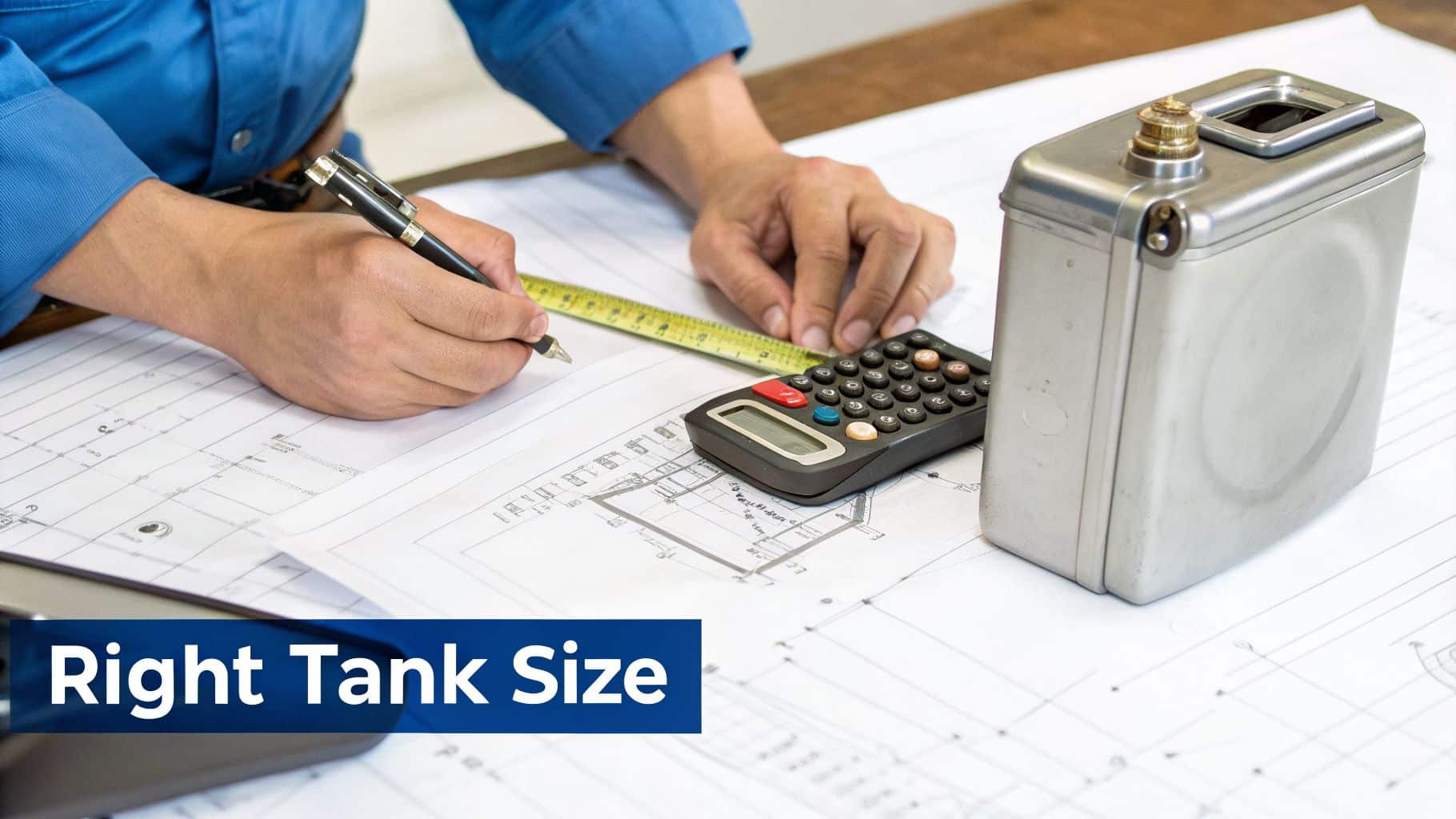
So, where do you even begin? Thankfully, there’s a tried-and-tested industry guideline that gives us a fantastic starting point for almost any standard hydraulic setup. It's often called the 'three-to-five times rule'.
The Three-to-Five Times Sizing Rule
The rule itself is beautifully simple: the nominal volume of your metal oil tank should be three to five times the flow rate of your hydraulic pump in litres per minute (L/min). For a pump that shifts 50 litres of oil every minute, you’d be looking for a tank somewhere between 150 and 250 litres.
This isn't just a random figure plucked from thin air. This calculation is all about ensuring the oil has enough dwell time—that’s the average amount of time a single drop of oil gets to rest in the tank before being pumped back into the circuit. Giving the oil this 'break' is essential for three critical reasons:
- Cooling: The tank's large surface area acts like a radiator for the oil. Sufficient dwell time lets the hot return fluid shed its heat before it gets sent back to work.
- De-aeration: It allows tiny, troublesome air bubbles to rise to the surface and escape. Without this, you risk cavitation (which can destroy a pump) and spongy, unresponsive system performance.
- Contamination Settling: It provides a calm environment where heavier nasties like metal shavings or water can sink to the bottom, well away from the pump’s suction line.
Think of a correctly sized tank not just as a container, but as a conditioner. It’s actively working to cool, clean, and de-aerate the fluid, which helps extend the life of every single component in your system.
A Practical Sizing Example
Let's put this into practice with a real-world scenario. Say you're putting together a mobile hydraulic system for a log splitter that uses a standard gear pump.
-
Find the Pump Flow Rate: You look up the pump's spec sheet and see it has a flow rate of 20 litres per minute.
-
Apply the Rule:
- Minimum Tank Size: 20 L/min x 3 = 60 Litres
- Maximum Tank Size: 20 L/min x 5 = 100 Litres
-
Choose Your Tank: With that range in mind, a standard 75-litre or 80-litre tank would be a perfect fit. It gives you plenty of dwell time without adding unnecessary weight or expense to the machine.
This straightforward calculation provides a safe and effective ballpark to work in. From there, you can pick a standard tank size that fits within those numbers, keeping any physical space or weight limits in mind. To see how the tank fits into the bigger picture, you might find our guide on building a hydraulic power unit useful.
The Dangers of Improper Sizing
Straying from this simple rule can open a real can of worms. The consequences of going too small or too big are serious, making an informed choice vital for the long-term reliability of your equipment.
An Undersized Tank Is a System Killer
If your tank is too small, the oil simply doesn’t get enough dwell time. It gets cycled through the system far too quickly, creating a vicious cycle of problems:
- Overheating: The oil never gets a chance to cool. As its temperature climbs, its viscosity drops, meaning it doesn't lubricate as well. This dramatically speeds up wear and tear on pumps and motors.
- Pump Cavitation: Air bubbles are whipped straight back into the pump before they can escape. These bubbles implode under pressure, causing tiny but incredibly violent shocks that physically eat away at internal components.
- Accelerated Contamination: Dirt and debris are kept in constant circulation instead of settling out. This means filters clog up faster and you risk scoring the precision-machined surfaces inside valves and cylinders.
An Oversized Tank Wastes Resources
While it’s certainly less damaging from a mechanical standpoint, a tank that’s far too big is just plain inefficient and uneconomical. It creates needless costs you could easily avoid.
- Higher Initial Cost: You're simply paying more for a larger tank than you need.
- Wasted Fluid: That extra capacity needs to be filled, meaning you have to buy and maintain a larger, more expensive volume of hydraulic oil.
- Increased Weight & Space: For mobile equipment, this is a huge deal. Every extra kilogram and every centimetre of space matters.
In the end, proper sizing is all about finding that "Goldilocks zone"—not too big, not too small, but just right to keep your hydraulic system running happily and efficiently for years to come.
For help selecting the perfect size for your application, Phone 01724 279508 today, or send us a message at https://www.mahydraulics.co.uk/contact-us/.
Understanding UK Oil Storage Regulations
When you're dealing with metal oil tanks, getting the hardware right is only half the battle. You also have to get your head around the UK’s laws on oil storage. This isn’t just red tape; it’s a legal framework designed to stop environmental pollution in its tracks and protect your business from the staggering fines and clean-up costs that follow a spill.
These regulations can feel a bit daunting at first, but they’re mostly rooted in practical common sense. If you run a commercial, industrial, or agricultural site anywhere in the UK, knowing your legal duties is fundamental. The main piece of legislation is The Control of Pollution (Oil Storage) (England) Regulations 2001, with very similar rules in place for Scotland, Wales, and Northern Ireland.
Secondary Containment and Bunding Explained
The single most important principle you'll encounter is secondary containment, which most people in the trade simply call ‘bunding’. The easiest way to think of a bund is as a protective basin or a "moat" built around your tank. It's an outer, sealed barrier whose only job is to catch every last drop if the main tank leaks or fails, stopping oil from contaminating the ground or reaching a waterway.
A bund is a legal must-have for most commercial and industrial sites—including for hydraulic power packs—if your tank holds more than 200 litres. This rule applies anywhere a spill could find its way into a drain, ditch, or surface water channel. Let's be honest, given the UK's geography and drainage, that means pretty much every commercial installation.
A single litre of oil has the potential to contaminate up to one million litres of drinking water. This statistic alone highlights why the Environment Agency takes oil storage so seriously and why bunding is non-negotiable for responsible operators.
The law is also very particular about how this bund needs to be built and looked after.
The 110% Capacity Rule
One of the most straightforward rules is about the bund's size. Your bund must be large enough to hold at least 110% of the main tank's maximum contents. That extra 10% isn't just a random number; it’s a crucial safety margin. It accounts for things like rainwater collecting in an open-topped bund or the powerful surge of oil during a catastrophic tank breach.
So, if you have a 1,000-litre metal oil tank, the bund surrounding it must have a minimum capacity of 1,100 litres. It’s a simple but vital calculation that an inspector will check immediately. This ensures that if the worst happens, the entire contents of the tank are safely contained.
But it's not just about size. A compliant bund must also:
- Be completely impermeable to oil and water, with no drains or outlets whatsoever.
- Contain all associated pipework and gauges within its walls.
- Be built from materials strong enough to withstand the force of a full spill.
For anyone working with hydraulic systems, having a firm grasp of your fluid’s properties is another piece of the safety puzzle. We cover this in more detail in our article explaining if hydraulic fluid is flammable.
Other Key Regulatory Requirements
Beyond bunding, the regulations look at the entire installation as a complete system. If you miss any of these points, you could face enforcement action, so it pays to get everything right from the start.
Essential Compliance Points:
- Tank and Bund Condition: You must keep both the tank and its bund in good shape. That means no corrosion, cracks, or damage that could affect their integrity. A quick visual check should be a regular part of your routine.
- Secure Taps and Valves: Any valve or tap on the tank has to be lockable. This is a simple measure to prevent accidental operation and to stop vandals or unauthorised staff from causing a spill.
- Overfill Alarms: If your tank is filled by a delivery driver using a remote hose, you will likely need an automatic overfill prevention device or a loud, audible alarm to stop spills during refuelling.
- Clear Labelling: The tank needs to be clearly marked with its contents and capacity. This is vital information for your team and for emergency services if they ever need to attend your site.
Following these rules isn’t just about ticking boxes to avoid a fine. It’s about being a responsible operator and protecting your business, your reputation, and the environment you work in.
For expert advice on ensuring your metal oil tanks and hydraulic systems meet all UK legal standards, Phone 01724 279508 today, or send us a message.
Essential Fittings and Accessories for Tank Performance
So, you’ve picked out your steel tank. Job done, right? Not quite. A bare metal oil tank is really just the starting point. To get it working as a proper, high-functioning reservoir that protects your hydraulic system, you need to outfit it with the right fittings and accessories.
Think of it this way: the tank is the house, but these accessories are the utilities—the plumbing, wiring, and security system. Each one has a critical job, safeguarding the expensive pumps and valves downstream from contamination and ensuring everything runs like clockwork. Skimp on these, and you’re setting your system up for a short, troubled life.
Keeping Your System Clean and Breathing
First things first, you have to control what gets in and out of the tank. The two non-negotiables here are the filler-breather and the filters. The filler-breather cap does a lot more than just seal the filling port. As your fluid level changes during a work cycle, the tank needs to 'breathe'. The cap allows air to move in and out, but its built-in filter is the crucial part, stopping airborne dust and moisture from being drawn into your oil. This is your first line of defence against contamination.
Next up are the filters in the fluid lines themselves. They're not optional.
- Suction Strainers: These sit just before the pump. They are the last-chance saloon for catching any larger debris that could cause immediate, catastrophic damage to your pump.
- Return Line Filters: As oil completes its journey through the circuit, it picks up tiny particles from wear and tear. The return filter cleans this oil before it gets dumped back into the reservoir, preventing contamination from spreading.
Getting the return line position right is just as important as the filter itself. It must always discharge below the minimum oil level. If you let it splash down from above, you'll whip air into the fluid. That leads to foaming and aeration, which are absolute killers for pump efficiency and longevity.
Monitoring and Managing the Fluid
Once your oil is in the tank, you need to keep an eye on it and help it settle. That’s where level gauges and internal baffles come into play. A good oil level gauge, often one that includes a thermometer, gives you an instant visual on both the fluid quantity and its temperature. It’s a simple but vital tool for daily checks, helping you spot leaks or overheating problems before they become serious.
Inside the tank, there's a feature you can't see but can't live without: the baffle plate. This is a simple sheet of steel welded down the tank's centreline, physically separating the pump's suction port from the return line. This forces the returning oil to take a long, slow route back to the pump. This extra "dwell time" is hugely important—it gives any trapped air a chance to rise to the surface and allows heavier contaminants to settle at the bottom, away from the pump intake.
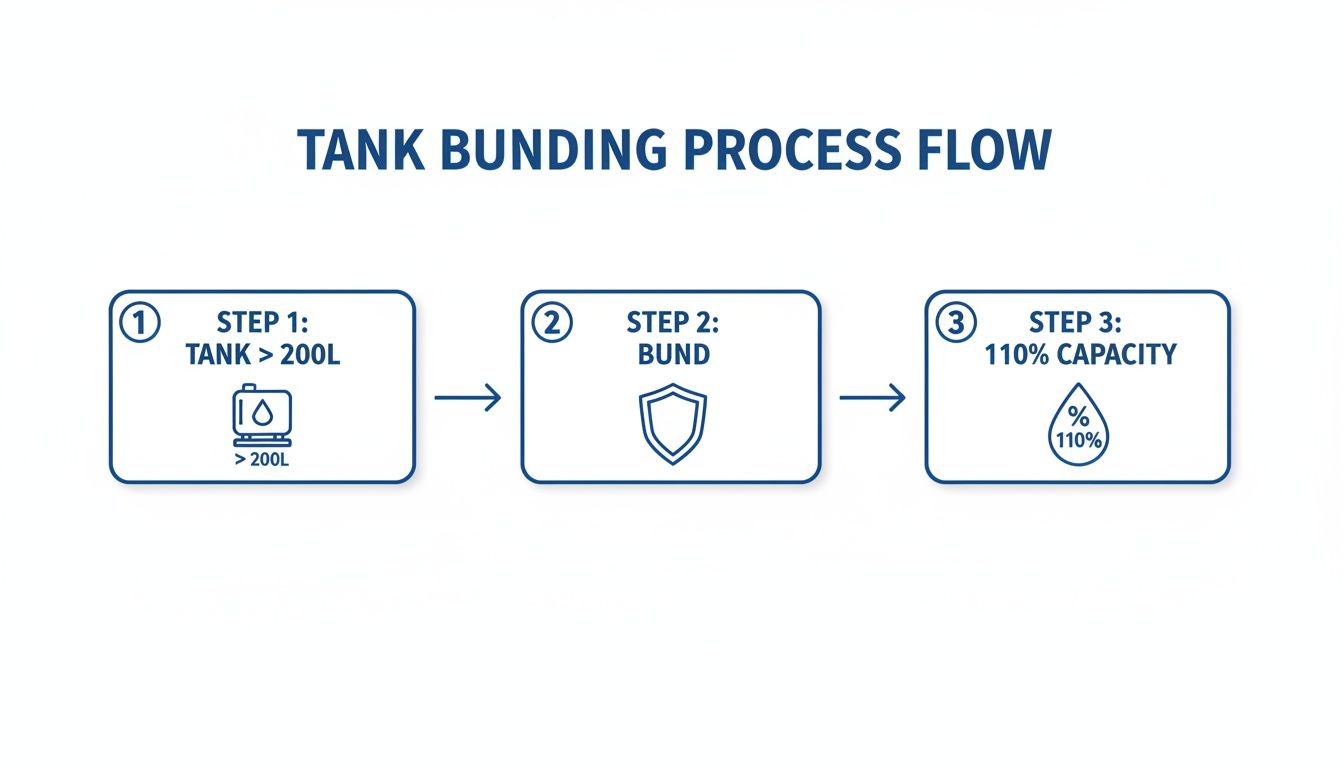
This kind of meticulous system design isn't just a recommendation; it's often part of meeting wider regulations, especially concerning environmental protection. For instance, the process for bunding (secondary containment) for larger tanks is a key compliance point in the UK, ensuring any potential leaks are safely contained.
Thankfully, sourcing these high-quality components is straightforward. The UK's own Tanks, Reservoir & Metal Container Manufacturing sector has seen healthy growth, expanding at a 5.2% compound annual rate from 2020-2025. With 212 businesses operating in this space as of 2024, there's a strong industrial backbone supplying the durable, reliable parts needed for robust hydraulic systems. You can find more detail on the UK tank manufacturing industry from IBISWorld.
For any engineer or maintenance professional, understanding how these accessories work together is the key to building a truly reliable hydraulic tank. To help you get it right, we stock a wide variety of essential components, including a complete range of OMT tank accessories to finish your setup perfectly.
If you need expert advice on choosing the right fittings for your metal oil tanks, give us a call on 01724 279508 today, or send us a message.
When to Choose a Bespoke Metal Oil Tank
Off-the-shelf metal oil tanks are great for many applications, but they’re not the answer to every problem. When you're designing modern machinery, every millimetre counts. Performance is everything. In these situations, trying to shoehorn a standard tank into a custom design is often a major compromise, and that’s when bespoke fabrication really proves its worth.
A custom-made tank isn't a luxury; it becomes a necessity when you hit a wall with standard products. This happens all the time in specialised mobile and industrial equipment, where a perfect fit is absolutely vital for the machine to run efficiently and reliably.
Scenarios Demanding a Custom Solution
Picture a compact mobile plant machine, like a mini-digger or a specialist harvester. The only available space for the hydraulic reservoir is often some awkward, irregular-shaped void tucked between the engine and the chassis. A standard rectangular tank simply won’t fit. If you somehow manage to squeeze a smaller one in, you risk sacrificing capacity, which can lead to the very overheating issues we discussed earlier.
It's a similar story with complex industrial power packs on a factory automation line. You might need a very specific layout of ports to feed multiple pumps, handle various return lines, and accommodate specialist sensors. Forcing a standard tank into this role creates a tangled mess of adaptors and pipework—a guaranteed recipe for leaks and a maintenance headache down the line.
In our experience, a bespoke tank is the only sensible choice in these common situations:
- Severe Space Constraints: The tank has to fit a unique, non-rectangular space on a vehicle or within a machine frame.
- Specific Port Configurations: You need multiple suction, return, or drain ports in precise locations to suit a complex hydraulic circuit.
- Integrated Components: The tank needs to do more than just hold oil. It might need built-in mounting brackets for filters, coolers, or entire valve blocks to create a compact, unified assembly.
- Unique Performance Needs: The system demands special internal baffles to prevent oil starvation on steep inclines or requires specific materials to handle aggressive fluids or extreme temperatures.
A bespoke tank is more than just a custom-sized box; it’s an engineered component designed from the ground up to solve a specific problem. By getting the tank design right, you improve the performance, reliability, and serviceability of the entire hydraulic system.
Our Collaborative Design and Fabrication Process
Opting for a bespoke solution is a partnership. We work closely with our OEM and engineering clients, translating their unique challenges into a finished, high-performance metal oil tank. It's a process built on a deep understanding of hydraulics and fabrication. This expertise has roots in a long national legacy; the UK's steel tank manufacturing heritage, which began in the late 19th century and was revolutionised by arc welding after WWII, gives today’s specialists the foundation to build reliable tanks for any modern system. You can see a brief history of the steel storage tank industry on Tuffa.co.uk to learn more about this.
Our fabrication journey follows a few clear, collaborative stages:
- Technical Consultation: It all starts with a conversation. We get to grips with your exact needs—from the physical space and capacity to flow rates and port locations.
- CAD Design: Our team then translates these requirements into detailed 3D models and technical drawings, which we send to you for review and sign-off.
- Fabrication & Quality Control: With your approval, our skilled fabricators build the tank to exacting standards, followed by rigorous testing and quality checks.
- Final Delivery: The finished tank arrives on-site, ready for a seamless fit into your machinery.
For a hydraulic solution engineered to fit your machine perfectly, Phone 01724 279508 today, or send us a message to get your bespoke tank project started.
Bringing It All Together with MA Hydraulics
As we've seen, a metal oil tank is far more than just a container. It's an active, hard-working part of your hydraulic circuit, responsible for cooling, cleaning, and de-aerating the fluid that keeps everything moving. Getting the materials, size, and connections right isn't just a detail—it's absolutely central to your system's health and lifespan.
Whether you're after a standard tank for a straightforward replacement or need a completely custom-built unit for a one-of-a-kind machine, our team has the real-world experience to get it right.
Think of a well-specified tank not as a cost, but as an insurance policy for your entire hydraulic system. It’s the solid foundation that protects your most expensive components from wear and tear, ensuring your operation runs smoothly for years to come.
That’s where we can help. With decades of hands-on experience, we can walk you through every step, from choosing the right grade of steel to selecting the final fittings. Our aim is simple: to provide a solution that works perfectly from day one and delivers genuine value over its entire service life.
Let us be your trusted partner for all things hydraulics.
For practical advice, help with component selection, or to talk through your next project with MA Hydraulics, give us a call on 01724 279508 today, or send us a message.
