

So, what exactly is a hydraulic accumulator and what does it do? The simplest way to think of it is as a rechargeable battery for your hydraulic system. It’s a pressure vessel that stores hydraulic fluid under pressure, typically using an inert gas like nitrogen to provide the force.
This stored energy can then be released on demand to give the system a powerful boost, absorb sudden shocks, or maintain consistent pressure.
What Do Hydraulic Accumulators Actually Do?
Imagine the flash on a camera. It quietly stores up energy, then releases it in a powerful, instantaneous burst of light—something the camera’s main battery couldn’t do on its own. A hydraulic accumulator works on a similar principle, storing hydraulic energy and discharging fluid far more rapidly than the system's pump could ever manage alone.
This ability is a game-changer for machines that need quick bursts of power or have to deal with sudden, jarring loads.
Without an accumulator, you'd need a much larger (and more expensive) pump to meet those peak demands, which would guzzle energy even during quiet periods. An accumulator lets you install a smaller, more efficient pump. It simply "charges up" with pressurised fluid during low-demand parts of the cycle and then unleashes that energy when it's needed most. This clever principle makes machinery across the UK more efficient, safer, and longer-lasting.
The Three Core Jobs of an Accumulator
At its core, an accumulator is hired to do three critical jobs within a hydraulic circuit. Understanding these roles makes it clear why they're such an essential component in everything from factory presses to mobile diggers.
-
Energy Storage: The accumulator's primary job is to store pressurised fluid and release it to supplement the pump's flow. This is perfect for applications needing a high-speed action for a short time, like a hydraulic press needing to complete a rapid stamping cycle.
-
Shock Absorption: It acts as a hydraulic cushion, soaking up the pressure spikes and shockwaves that happen when a valve slams shut or the machine hits an unexpected load. This protects vital components like hoses, seals, and even the pump itself from damaging pressure surges, massively extending their service life.
-
Leakage and Thermal Compensation: In closed-loop systems, an accumulator can compensate for tiny fluid losses from internal leakage, holding the pressure steady. It also makes room for the hydraulic fluid to expand and contract as operating temperatures change, preventing pressure fluctuations.
To really nail down these functions, here’s a quick-reference table that summarises the value an accumulator brings to any hydraulic circuit.
Hydraulic Accumulator Functions At A Glance
| Function | What It Does | Key Benefit For Your System |
|---|---|---|
| Energy Storage | Stores pressurised fluid and releases it on demand. | Allows for smaller, more efficient pumps and provides faster cycle times. |
| Shock Absorption | Cushions the system against pressure spikes and hydraulic shock. | Protects components from damage, reduces noise, and increases machine lifespan. |
| Leakage & Thermal Compensation | Makes up for small fluid losses and volume changes due to temperature. | Maintains consistent pressure, improving system accuracy and reliability. |
As you can see, these functions all work together to improve the overall health and performance of the equipment.
By mastering energy and pressure, accumulators help hydraulic systems run smoother, more efficiently, and with far greater reliability. They aren't just an add-on; they are a fundamental component for optimising performance and cutting down your operational costs.
How Accumulators Store and Release Hydraulic Energy
So, how does an accumulator actually work? The secret lies in a simple principle you probably learned in a science class: Boyle's Law. It states that if you compress a gas into a smaller space, its pressure increases. Give it room to expand, and the pressure drops. Accumulators are ingeniously designed to put this law to work, acting like a powerful, rechargeable spring for your hydraulic system.
Inside the accumulator’s robust steel shell, you’ll find a pre-charge of inert gas (almost always dry nitrogen) on one side and hydraulic fluid on the other. A flexible bladder, a sliding piston, or a diaphragm keeps them separated. This chamber of gas is the "spring," waiting to be compressed.
The Charge Cycle: Storing Potential Energy
The process kicks off when your hydraulic pump sends fluid into the system. As the pressure builds, it eventually overcomes the nitrogen pre-charge pressure inside the accumulator. At this point, hydraulic fluid starts to flow into the accumulator.
This incoming fluid pushes against the separator, squeezing the nitrogen into a smaller and smaller volume. As the gas is compressed, its pressure climbs dramatically. The energy used to do this is now stored, ready to be released. Think of it like drawing back a bowstring – the more you pull, the more potential energy you store.
This "charging" typically happens during lulls in the machine's work cycle, like when an actuator isn't moving. This is a huge advantage because it means you can often get away with a smaller, more efficient pump. The pump doesn't need to be sized for the single biggest power demand; it just needs to keep the accumulator topped up during quieter moments.
This simple process flow shows the core functions an accumulator performs in a hydraulic circuit.
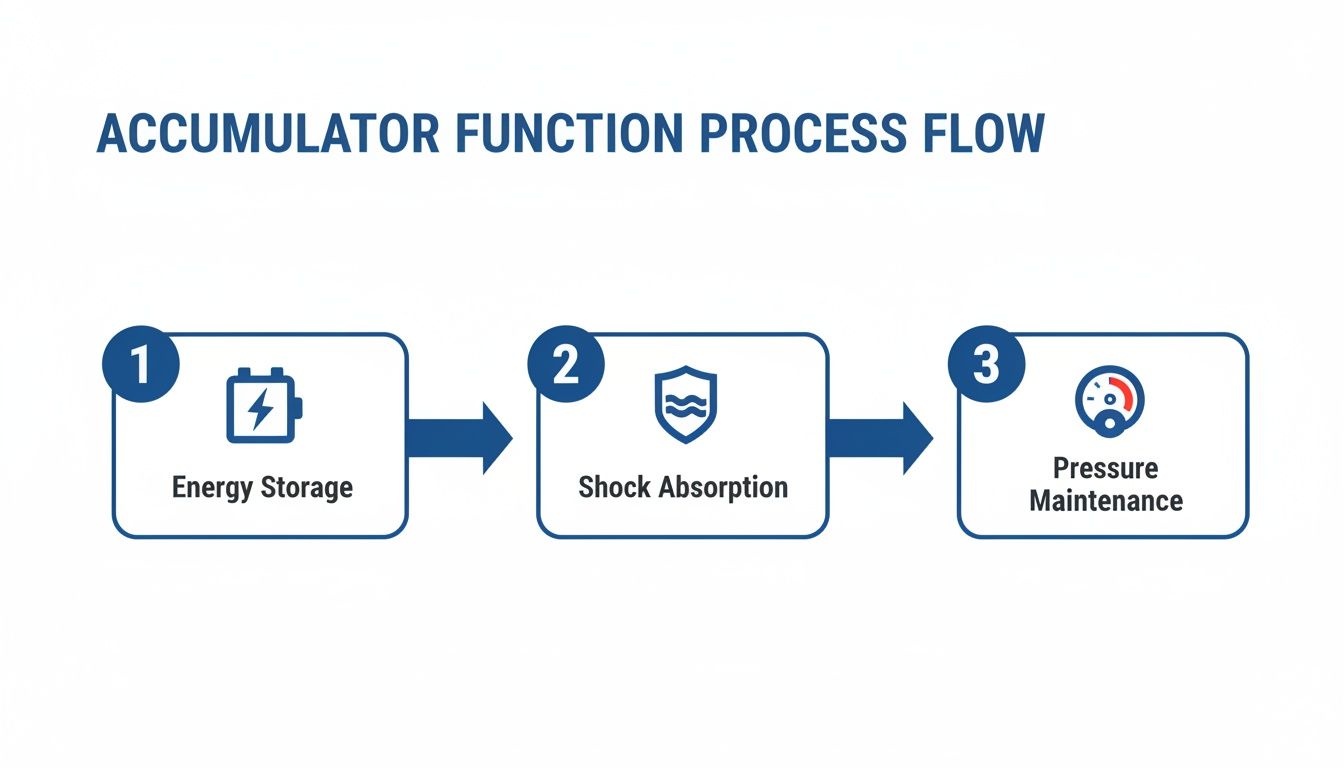
As you can see, the accumulator is more than just a power-booster; it’s a multi-talented component that protects and optimises the entire system.
The Discharge Cycle: Releasing Kinetic Energy
Now for the exciting part. Your system suddenly needs a massive burst of power—a hydraulic press needs to clamp down instantly, or a piece of mobile plant requires a fast, heavy lift. Often, the pump alone can't supply fluid fast enough to meet this peak demand.
This is the accumulator's moment to shine. As the actuator opens, the demand for fluid causes the system pressure to drop slightly below the pressure of the compressed gas in the accumulator. That pressure difference is the trigger.
The highly compressed nitrogen gas expands almost instantly, pushing the stored hydraulic fluid back out into the circuit with tremendous force and at a very high flow rate.
This rapid flood of fluid supplements the pump's output, delivering the instant power the job requires. Once that high-demand task is finished and the system pressure stabilises, the pump takes over again, and the charge cycle begins anew. It's this continuous charge-and-discharge rhythm that lets a hydraulic system deliver incredible performance with surprisingly economical components.
Choosing Between Bladder, Piston, And Diaphragm Accumulators
Alright, now that we've covered the basics of what an accumulator does, let’s get into the nitty-gritty of choosing the right one. You’ll mainly come across three designs in the field: bladder, piston, and diaphragm. Picking the correct type isn't just a detail—it's absolutely fundamental to your system's performance, safety, and long-term running costs.
Getting this choice wrong can cause all sorts of headaches, from sluggish performance to premature failure. Think of it this way: you wouldn't use a sports car's suspension on a heavy lorry. In the same vein, a nimble bladder accumulator that's perfect for soaking up shocks on a telehandler is completely out of its depth in a high-pressure industrial press, where a tough piston type is needed. It’s all about matching the tool to the job.
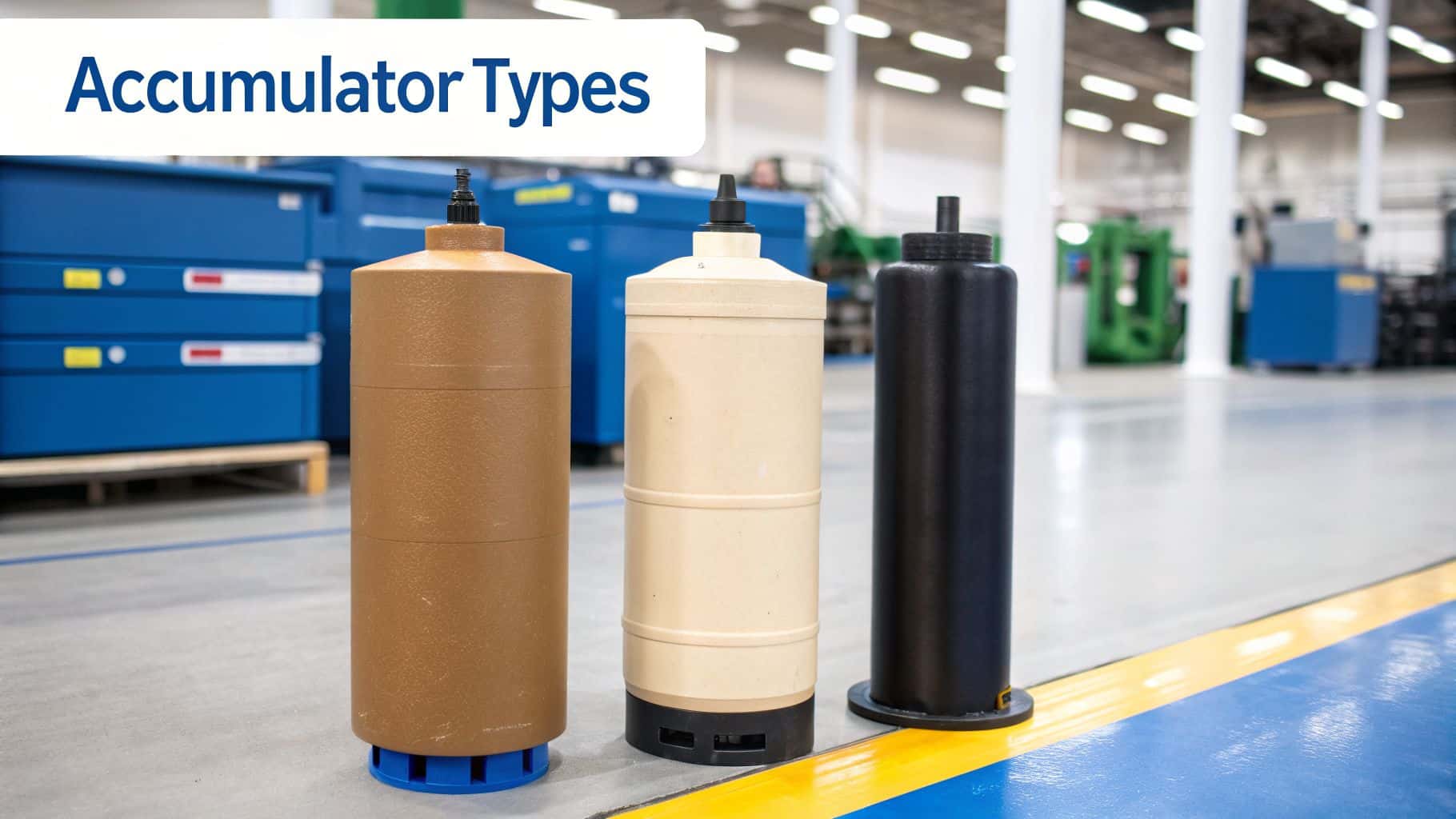
The Flexible And Fast: Bladder Accumulators
Bladder accumulators are the go-to choice for a huge range of applications here in the UK, and for good reason. Inside a high-strength steel shell, there's a flexible rubber bladder, much like a heavy-duty balloon. This bladder gets pre-charged with nitrogen gas. When hydraulic fluid enters the shell, it squeezes the bladder, compressing the gas and storing energy.
Their standout feature is an incredibly fast response time. Because the bladder itself is so lightweight, it reacts almost instantly to pressure spikes and drops. This makes them brilliant for:
- Shock Absorption: They are second to none at smoothing out the jarring hydraulic shock (or 'water hammer') that happens when a valve slams shut. This protects fittings, hoses, and components from damage.
- Pulsation Dampening: They smooth out the pressure ripples from pumps, leading to quieter, more stable machine operation.
While bladder accumulators are fantastic all-rounders for both mobile and industrial systems, keep in mind the bladder is a wearing part. It will eventually need to be replaced as part of a regular service schedule.
The Powerful And Robust: Piston Accumulators
When you're dealing with serious muscle—extremely high pressures or massive volumes of fluid—the piston accumulator is the undisputed champion. This design ditches the flexible bladder in favour of a free-floating piston moving inside a finely honed cylinder, creating a robust seal between the gas and the fluid.
Piston accumulators are built for brute force and endurance. They handle pressures and volumes that would destroy other types, making them the only real choice for heavy-duty machinery like forging presses, large injection moulding machines, and die-casting equipment.
Their solid construction allows them to handle very high compression ratios and gives them an incredibly long service life, with maintenance usually just involving a seal change every few years. The trade-off? The piston has more mass and inertia, so its response time is slower than a bladder type's, making it less ideal for absorbing very rapid shocks.
The Compact And Cost-Effective: Diaphragm Accumulators
Diaphragm accumulators are the smallest and most economical of the family. They feature a flexible diaphragm, made of either elastomer or metal, which is welded or bolted between two halves of a shell. Gas on one side, fluid on the other. Simple and effective.
Their compact, lightweight nature makes them a perfect fit where space is at a premium and the stored volume needed is small. You'll often find them used for:
- Leakage Compensation: Holding pressure steady in a closed system by making up for tiny, slow fluid losses over time.
- Thermal Expansion: Giving hydraulic fluid a place to expand into as it heats up during operation, preventing a dangerous pressure build-up.
They are incredibly reliable and usually maintenance-free. The downside is that they are limited to lower pressures and smaller volumes. A typical diaphragm unit might hold less than 4 litres and cost between £50 – £150, whereas a large industrial bladder or piston model can easily run into the thousands.
Comparing Accumulator Types: Bladder vs Piston vs Diaphragm
Deciding between these types really comes down to matching the accumulator’s strengths with your application's specific needs. To make that decision easier, we've put together a quick comparison.
This table gives you an at-a-glance look at the key differences, helping you pinpoint which design is the best fit for your pressure, volume, and response time requirements.
| Feature | Bladder Accumulator | Piston Accumulator | Diaphragm Accumulator |
|---|---|---|---|
| Primary Use | Shock absorption, pulsation dampening | High-pressure energy storage, large volume | Leakage/thermal compensation, small systems |
| Response Time | Very Fast | Slower | Fast |
| Pressure Rating | Medium to High | Very High | Low to Medium |
| Volume Capacity | Medium to Large | Very Large | Small |
| Maintenance | Bladder requires periodic replacement | Piston seals require periodic replacement | Often maintenance-free (welded) |
| Cost | Moderate | High | Low |
Ultimately, the right choice ensures your hydraulic system runs efficiently and reliably for years to come.
If you need an expert opinion on selecting the perfect accumulator for your machine, our team is always here to help. To talk through your requirements and get a quote, give us a call on 01724 279508 today or send a message via our contact page.
Real World UK Applications In Your Industry
It’s one thing to talk about the theory, but seeing where hydraulic accumulators make a real difference is what truly matters. Right across the UK, from busy factories to sprawling farms, these components are quietly making machinery more efficient, safer, and ultimately more profitable. They’re not just another part in a catalogue; they're a practical way to improve your bottom line.
Let's move past the diagrams and look at how accumulators deliver tangible results in key British industries. You'll see how a simple pressurised vessel can lead to lower fuel bills, less downtime, and a safer workplace for your team. This is where the engineering pays off in day-to-day operations.
Boosting Efficiency in UK Agriculture
In farming, every piece of kit has to be tough and efficient. Hydraulic accumulators are absolutely essential here, especially in modern tractors, telehandlers, and combine harvesters. Just picture a tractor crossing a bumpy field—those constant jolts aren't just uncomfortable for the driver; they put incredible strain on the machine's frame and hydraulics.
By fitting an accumulator into the suspension or boom circuit, it acts like a sophisticated shock absorber. It smooths out the ride, which means the operator is less fatigued and can often work faster. More importantly, it shields the entire hydraulic system from damaging pressure spikes, leading to fewer burst hoses and a much longer life for expensive pumps and valves.
This is an area we know inside and out at MA Hydraulics, often supplying robust components like Vivoil gear pumps or custom power packs built for tough agricultural work. The UK's agricultural sector relies on over 200,000 tractors and harvesters. For those using accumulators to absorb shocks, we see a reduction in mechanical wear by up to 30% and an improvement in fuel efficiency by as much as 15-20%. For a deeper dive, you can read the full research about the accumulator market.
Powering UK Manufacturing and Production
The world of manufacturing is all about speed, precision, and repeatability. Whether it's a huge hydraulic press stamping out metal parts or an injection moulding machine, accumulators are often the unsung heroes of the production line.
Many of these processes need a massive, instant burst of hydraulic flow—far more than the machine's pump could ever deliver on its own. Instead of fitting a huge, power-hungry pump, an accumulator quietly stores up energy during the quiet parts of the machine's cycle. Then, it discharges it all in one powerful surge to get the job done. This smart approach allows manufacturers to:
- Slash Cycle Times: The machine can work much faster, which directly increases output.
- Use Smaller Pumps: You can get away with a smaller, more energy-efficient pump, which makes a real dent in electricity bills. A compact Hydronit power pack from us, paired with the right accumulator, is a perfect example of this lean design.
- Hold Unwavering Pressure: In processes like moulding, an accumulator can hold a perfectly steady clamping force, which is absolutely vital for consistent product quality.
Enhancing Safety in Logistics and Materials Handling
Walk through any warehouse, distribution centre, or building site in Britain, and you’ll see that safety and control are everything. Forklifts, mobile cranes, and cherry pickers all become safer and more controllable with an accumulator in their hydraulic system. On a forklift, for example, it smooths out the lifting action, preventing jerky movements that could easily destabilise a heavy or fragile load.
But the most important job an accumulator has in this environment is providing emergency power.
If the engine cuts out or the main pump fails, the stored energy in the accumulator provides just enough pressure to safely lower a suspended load to the ground or apply the emergency brakes.
This backup function is not just a nice-to-have; it's a critical safety feature that protects people and property. It turns the accumulator from a performance booster into an essential piece of safety equipment, giving you peace of mind and helping you meet strict UK safety standards.
For expert advice on integrating an accumulator into your own machinery, give our team a call on 01724 279508 or send us a message through our contact page.
Correctly Sizing and Selecting Your Accumulator
Getting accumulator sizing wrong is one of the easiest ways to undermine your system's performance and even cause damage. It's a common mistake. An undersized unit will starve your system of fluid when it's needed most, while an oversized one is just a waste of space and money.
So, how do you get it right? It all comes down to a few key calculations based on what you need the accumulator to do. Are you storing energy for a power boost, damping shocks, or just making up for minor leaks? The answer will point you to the right formulas.
Key Parameters for Sizing Calculations
Before you even think about looking at a catalogue, you need to know your numbers. Without this critical data from your hydraulic system, any attempt at sizing is just a shot in the dark.
Here are the main variables you'll always need to have on hand:
- Required Fluid Volume (ΔV): Put simply, this is how much hydraulic fluid (in litres) the accumulator needs to push into the system during a single cycle.
- Minimum System Pressure (P1): This is the lowest pressure (in bar) your system operates at when the accumulator is doing its job.
- Maximum System Pressure (P2): The highest pressure (in bar) seen by the system when the accumulator is fully charged with fluid.
- Gas Pre-charge Pressure (P0): This is the nitrogen pressure inside the accumulator before any hydraulic fluid enters. It's a crucial setting. For energy storage, a good rule of thumb is to set it at around 90% of your minimum system pressure (P1).
Nailing these pressures is absolutely fundamental. If the pre-charge is off, you risk everything from erratic system performance to a completely failed bladder.
Correct sizing isn't just a recommendation; it's a requirement for a safe and efficient hydraulic system. The goal is to ensure the accumulator provides the right amount of fluid within the correct pressure window, every single time.
Beyond the Numbers: Other Vital Factors
While the maths forms the core of the selection process, a few other real-world factors can make or break your component's success. These details determine the accumulator's lifespan, safety, and basic compatibility with your equipment. For instance, the accumulator is a key part of the wider system, which often revolves around a bespoke hydraulic power unit.
Don’t overlook these critical checks:
- Fluid Compatibility: The material used for the accumulator’s seals and bladder must be able to handle your hydraulic fluid, whether it's standard mineral oil or something more specialised like water-glycol. The wrong material will swell, degrade, and fail—often very quickly.
- Operating Temperature: Heat affects gas pressure. You need to consider both the ambient temperature in the workshop and the running temperature of the fluid itself. Make sure the model you choose is rated for the full temperature range it will experience.
- Certifications: In the UK and Europe, pressure vessels like accumulators fall under the Pressure Equipment Directive (PED 2014/68/EU). Always check that the component has the proper CE marking and any other certifications required for your specific industry.
By choosing components from trusted brands like OMT and Luen, you can be confident you're meeting these essential quality and safety standards. Better yet, let our technical team at MA Hydraulics handle the complex calculations for you. We'll make sure you get a perfectly matched accumulator for optimal performance.
For expert help with sizing and selection, phone 01724 279508 today, or send us a message at https://www.mahydraulics.co.uk/contact-us/
Installation, Maintenance, And Safety Guidelines
When you're dealing with hydraulic accumulators, getting the installation and maintenance right isn't just a suggestion—it's essential. Think of them as pressurised energy storage units; they deserve a healthy dose of respect and a systematic approach to keep them safe and performing for the long haul. Any shortcuts here can lead to poor performance, early failure, or a dangerous, uncontrolled release of stored energy.
For service engineers and maintenance teams, a few best practices from day one make all the difference. It all starts with the physical installation.

Correct Installation Procedures
Getting the mounting right is your first port of call. For bladder and diaphragm accumulators, we strongly recommend vertical mounting with the gas valve pointing upwards. This simple step prevents gas from slowly permeating through the separator and lets any trapped air bleed out of the system easily.
Just as crucial is fitting a dedicated accumulator safety block. This is a non-negotiable piece of kit that combines isolation, pressure relief, and a fluid drain into one compact manifold. It gives engineers a safe way to isolate the accumulator from the main circuit and completely depressurise it before touching anything. To get a better handle on these components, you can learn more about the role of a hydraulic safety relief valve.
Finally, be meticulous with the pre-charging. Always, and we mean always, use dry nitrogen and a proper charging and gauging kit. Never substitute oxygen or compressed shop air—doing so creates a serious risk of explosion.
A Simple Maintenance Checklist
An accumulator that’s looked after is one you can depend on. Building a solid maintenance plan means weighing up the benefits of predictive maintenance vs preventive maintenance to find what works best for your equipment and budget.
Here’s a basic checklist to get you started on routine inspections:
- Check Pre-Charge Pressure: Check the nitrogen pre-charge every 6-12 months. An incorrect pre-charge is the number one cause of poor performance and bladder failure.
- Inspect for Leaks: Get your eyes on all connections and the accumulator shell. Look for any tell-tale signs of weeping hydraulic fluid or escaping gas.
- Listen for Unusual Noises: Any knocking or banging sounds when the system is running can be a red flag for a low pre-charge or a failed bladder.
- Check System Temperature: Overheating is bad news for seals and can mess with the pre-charge pressure. Make sure the system is operating within its designed temperature range.
Safety First: Depressurisation Protocols
If you take away only one thing, let it be this: always treat an accumulator as a live, pressurised component until you have proven it is safe. Before any spanners come out, the accumulator must be isolated and fully depressurised.
According to UK Health and Safety Executive (HSE) guidelines, all stored energy must be safely dissipated before work begins. Failure to do so can result in catastrophic failure and serious injury.
In UK industrial manufacturing and materials handling, accumulators are vital for stabilising pressure and keeping things running smoothly. For instance, in an automotive assembly line, a well-maintained accumulator can maintain consistent pressure, cutting cycle times by 12% and energy use by 18%. You can discover more insights about the accumulators market on researchandmarkets.com.
If you need expert guidance on accumulator safety or want to discuss your system's specific requirements, give our team a call on 01724 279508 today, or send us a message.
Your Partner for UK Hydraulic Solutions
As we've seen, a hydraulic accumulator is much more than just a pressure vessel; it’s a smart addition that can bring a whole new level of efficiency, safety, and power to your machinery. At MA Hydraulics, we’re engineers at heart, and we get a real sense of satisfaction from helping UK businesses get the absolute most from their hydraulic systems.
We believe in providing a complete solution. That might mean finding the exact part you need from our extensive stock of leading brands, or it could involve designing and building a bespoke power pack right here in our workshop. Our comprehensive fluid power services are designed to support your project from the initial idea all the way through to commissioning and long-term maintenance.
Think of us as an extension of your own technical team. When you partner with us, you get practical, expert advice, competitive pricing, and components that are ready to go when you need them. We’re here to make sure your hydraulic systems perform flawlessly.
If you’re planning a new project or need some expert advice on your current setup, phone 01724 279508 today, or send us a message.
