

At the heart of every hydraulic system, from a simple log splitter to a massive industrial press, lies one beautifully simple principle. It’s all about how Force is applied over a specific Area.
Understanding this relationship is the key to unlocking the immense power of hydraulics.
Understanding The Core Pressure Calculation
The fundamental formula is something every technician should know by heart: Pressure = Force ÷ Area (P = F/A). This single equation is the foundation for calculating everything from system performance to component safety ratings.

Think of it this way. If you press your thumb as hard as you can against a piece of wood, you might leave a slight mark. Now, take that exact same amount of force and apply it through the tiny point of a nail. The nail sinks straight in.
Your force didn't change, but by concentrating it onto the much smaller area of the nail's tip, you generated immense pressure. That’s the magic of hydraulics in a nutshell. It’s not just about how hard you push; it’s about where and how that push is focused.
The Components of Pressure
In a professional hydraulic setting, each part of this formula has a specific name and unit. Getting these right is crucial for design, maintenance, and safe operation. To make it clear, let's break down the components.
This table outlines the three core elements you'll be working with.
| Component | Symbol | SI Unit (UK Standard) | Definition in Hydraulics |
|---|---|---|---|
| Force | F | Newton (N) | The “push” generated by an actuator, like a hydraulic cylinder ram extending. |
| Area | A | Square Metres (m²) | The surface the force acts on, most often the face of the piston inside a cylinder. |
| Pressure | P | Pascal (Pa) / bar | The concentration of force. While the Pascal is the official unit, bar is the go-to standard in UK industry. |
Understanding these terms is the first step towards properly diagnosing and specifying any hydraulic circuit.
The real power of this principle is in its flexibility. A small force acting on a small piston can generate the same high pressure as a huge force acting on a large piston.
This is exactly how a relatively compact hydraulic pump on a mobile crane can create enough pressure to lift several tonnes. The system manipulates the force-to-area ratio to its advantage.
This isn't just theory for an exam; it's a practical, everyday tool. It allows engineers to ensure a pump, hose, or valve is correctly rated for a job. It helps technicians troubleshoot why a machine is underperforming. Ultimately, mastering this simple calculation is fundamental to building and maintaining safe, powerful, and efficient hydraulic systems.
Applying The Core Pressure Formula P = F/A
Right, let's get practical. That formula, P = F/A, isn't just something you see in a textbook. On the workshop floor, it's the fundamental rule we live by. It’s how we design safe, powerful hydraulic systems and figure out what’s gone wrong when they fail. This is where the theory truly meets the metal.
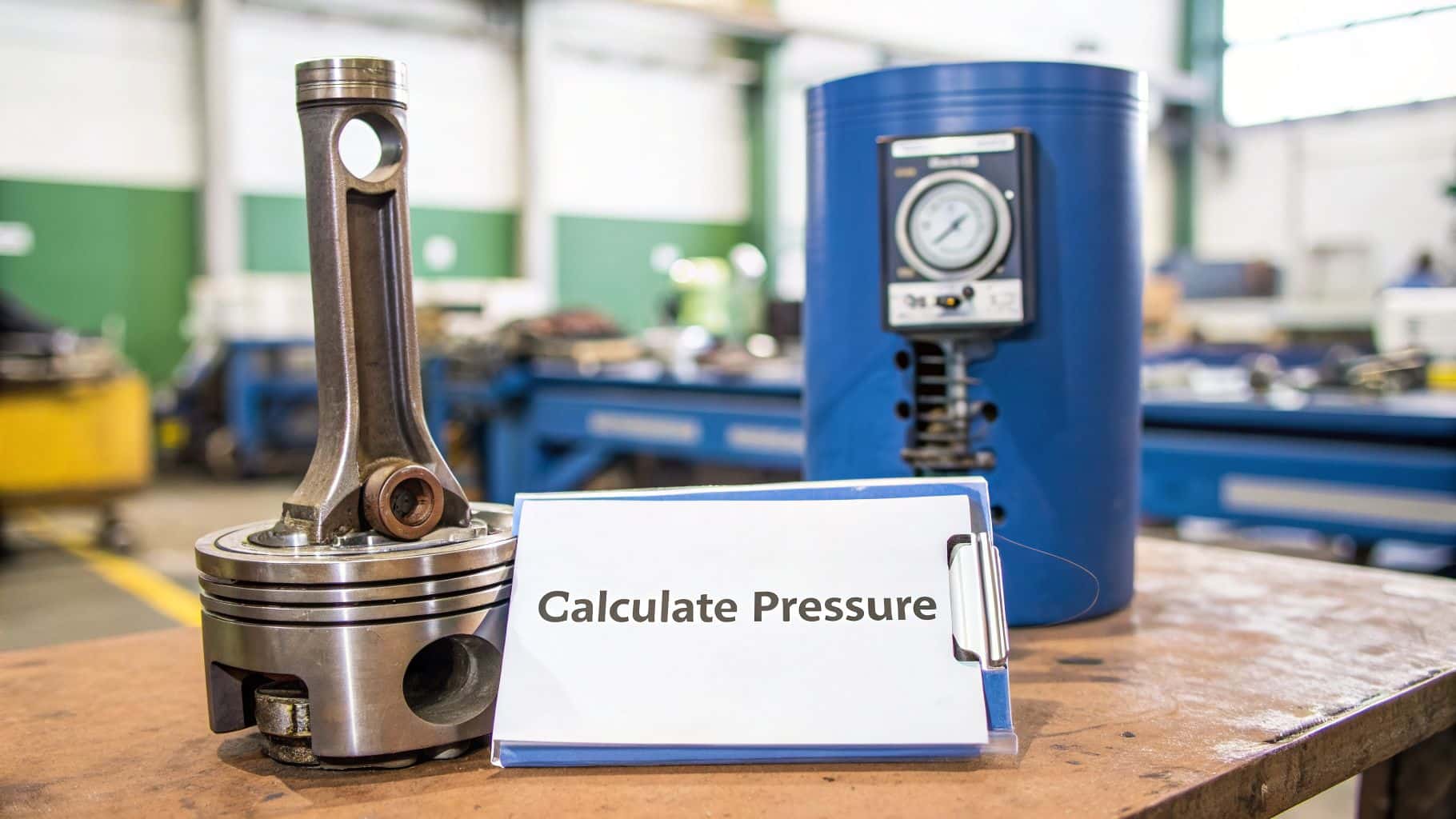
So, how does this play out in real life? Here's a classic scenario. You have a hydraulic ram that needs to generate 20,000 Newtons (N) of force to do its job. You look at the cylinder specs and see it’s fitted with a 50mm diameter piston. The big question is: what pressure do you need to feed it?
First things first, we need the area of the piston face. To make our sums work, we must convert everything to standard metric units – force in Newtons and area in square metres.
Calculating The Piston Area
We need the area of a circle, which uses the formula: Area = π × radius².
-
Convert Diameter to Radius in Metres:
- Diameter = 50mm, which is 0.05 metres.
- Radius is half the diameter, so that’s 0.025 metres.
-
Calculate the Area:
- Area = π × (0.025m)²
- Area ≈ 0.00196 square metres (m²)
Now we have our two key ingredients: the force (F) and the area (A). With these, we can work out the pressure. If you're new to these sorts of figures, looking at some real-world examples of forces can give you a much better feel for what 20,000N actually means.
This calculation is more than just maths; it's a safety check. It confirms if a component, like a gear pump, can operate within its specified limits or if a different part is needed to handle the load.
Plugging our numbers into the main formula:
- Pressure = 20,000 N ÷ 0.00196 m²
- Pressure ≈ 10,204,081 Pascals (Pa)
That's a huge number and not very practical for workshop gauges. We convert it to bar, knowing that 1 bar is 100,000 Pa. This gives us 10,204,081 ÷ 100,000 = approximately 102 bar.
This single number tells you everything. If the pump in your system is only rated for 100 bar, it’s not up to the job. It’s that simple. A solid grasp of the relationship between force and the area of a hydraulic cylinder piston is absolutely essential.
The Economic Impact Of Accurate Calculations
Getting these numbers right has massive implications. The British Fluid Power Association (BFPA) highlighted that the UK hydraulics and pneumatics market, built on these core principles, had sales of £1.6 billion in 2026. More directly, for the maintenance, repair, and overhaul teams keeping plant machinery running, precise pressure calculations have been shown to slash downtime by up to 40%, a huge boost to any company's bottom line.
This simple formula also provides a perfect, practical demonstration of Pascal's Law. The 102 bar we calculated isn't just sitting in the cylinder; it's transmitted equally through every drop of fluid in the system, ready to do work anywhere in the circuit.
For expert advice on your specific hydraulic calculations and component needs, phone 01724 279508 today, or send us a message.
Essential Pressure Units And Conversions For UK Engineers
When you’re working with hydraulics, speaking the right language of pressure is more than just good practice—it's absolutely critical for safety and system compatibility.
Academically, the official SI unit for pressure is the Pascal (Pa). But in the real world of high-power hydraulics, a single Pascal is an incredibly tiny amount of force. Using it would be like measuring the distance from London to Manchester in millimetres. That’s why, on almost every gauge, pump, and datasheet across the UK and Europe, you’ll see the term bar.
It’s a far more practical unit for our industry, with a simple relationship: 1 bar is equal to 100,000 Pascals. For engineers and technicians on the ground, using bar keeps the numbers sensible and easy to manage.
Of course, the world of hydraulics is a global one. You'll regularly come across components, particularly from the US or on older machinery, rated in Pounds per Square Inch (psi). You’ll see units like psi on a common water pressure gauge, for example. Being able to translate between these units isn't just a handy trick; it’s a non-negotiable skill for any serious technician.
Core Conversion Factors
The single most important conversion to burn into your memory is the one between bar and psi. Getting this right prevents dangerous and costly mismatches between components.
- 1 bar ≈ 14.5 psi
- 1 psi ≈ 0.069 bar
Knowing this lets you confidently spec a European-made Vivoil pump (rated in bar) for a system using an American valve (rated in psi), ensuring they work together safely. A solid understanding of what a hydraulic pressure gauge is telling you is the foundation of good engineering.
A word of warning from the field: it’s tempting to round up and use 15 psi for 1 bar to do some 'quick maths' in your head. Don't. That small 3.4% error can become a big problem in high-pressure circuits, leading to incorrectly adjusted relief valves and gradual, long-term damage to expensive components. Always stick to the 14.5 factor for your calculations.
To help you get these conversions right every time, here's a quick-reference table for the most common units you're likely to encounter in the UK.
Common Hydraulic Pressure Unit Conversions
| Unit | Equivalent in Bar | Equivalent in PSI | Equivalent in Pascals (Pa) |
|---|---|---|---|
| 1 Bar | 1 | 14.5038 | 100,000 |
| 1 PSI | 0.0689 | 1 | 6,894.76 |
| 1 Pascal (Pa) | 0.00001 | 0.000145 | 1 |
Getting comfortable with these units and how they relate is a true hallmark of a skilled hydraulics professional. It’s this fluency that ensures every part of a system, no matter where it was made, performs together reliably and safely. This ability to 'translate' pressure is a core skill that underpins all good hydraulic design and maintenance.
For expert advice on your specific hydraulic calculations and component needs, phone 01724 279508 today, or send us a message.
Calculating Pressure From Fluid Weight
So far, we've talked about the pressure created by active forces, like a pump pushing oil through a system. But that's only half the story. Pressure can also be entirely passive, generated simply by the weight of a fluid sitting in a tank or a pipe. This is called hydrostatic pressure, and it's a force you can't afford to ignore in hydraulic design.
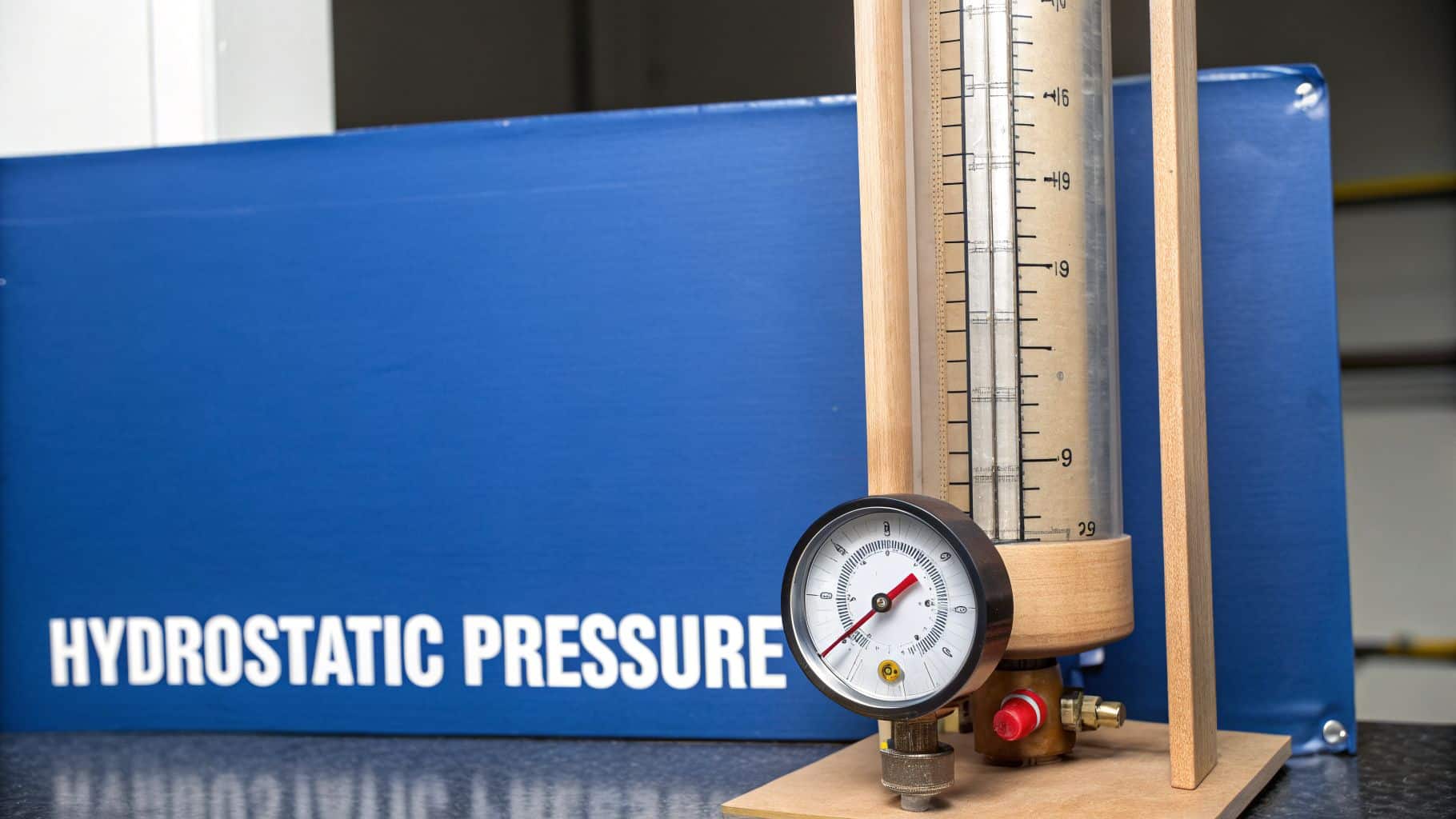
The formula for this is beautifully simple: P = ρgh. Each part of that equation tells us something vital, helping us predict how a system will behave before a single component is even installed.
Deconstructing The Hydrostatic Formula
Let's quickly unpack what's going on inside that formula.
- ‘ρ’ (Rho): This is the density of your fluid. For a typical hydraulic oil, we're looking at around 870 kg/m³.
- ‘g’: This is the acceleration due to gravity, a constant we know as 9.81 m/s².
- ‘h’: This is the vertical height of the fluid column, measured in metres.
This isn't just a niche hydraulic calculation; it’s a fundamental principle of physics. In fact, it's used on a massive scale. GOV.UK’s hydraulic modelling for UK rivers uses these exact calculations to predict flood risks, helping to prevent an estimated £500 million in damages. You can dive deeper into their methodology by reading the government's technical standards on hydraulic modelling best practice.
Think about a tall, 2-metre hydraulic reservoir filled with oil. All that oil has weight, and it's all pushing down on the fluid at the very bottom. That downward push creates pressure, and we can calculate exactly how much.
Let’s run the numbers using our formula: P = 870 kg/m³ × 9.81 m/s² × 2 m. The result is 17,069 Pascals, or about 0.17 bar.
Now, 0.17 bar might sound insignificant when your system is designed to run at hundreds of bar. But it’s incredibly important. This small amount of hydrostatic pressure is what helps "feed" the main pump, ensuring there's a positive charge of oil right at the inlet.
If the oil level in the tank drops too low, this helpful "head" of pressure vanishes. This can starve the pump, leading to a destructive phenomenon called cavitation. Vapour bubbles form in the low-pressure fluid and then violently collapse, eating away at expensive pump and motor components. It’s a fast track to premature failure.
This is precisely why engineers spend so much time considering reservoir placement and pipework height. It’s a perfect reminder that in hydraulics, even the smallest, most passive forces have a huge impact on the health, efficiency, and reliability of the entire system.
For expert advice on your specific hydraulic calculations and component needs, phone 01724 279508 today, or send us a message.
Connecting Calculations To Real-World Hydraulic Applications
Those pressure formulas aren't just for textbooks; they’re the invisible force driving British industry every single day. Getting your head around how pressure is calculated is what ensures the powerful machinery we all rely on is safe, efficient, and dependable.
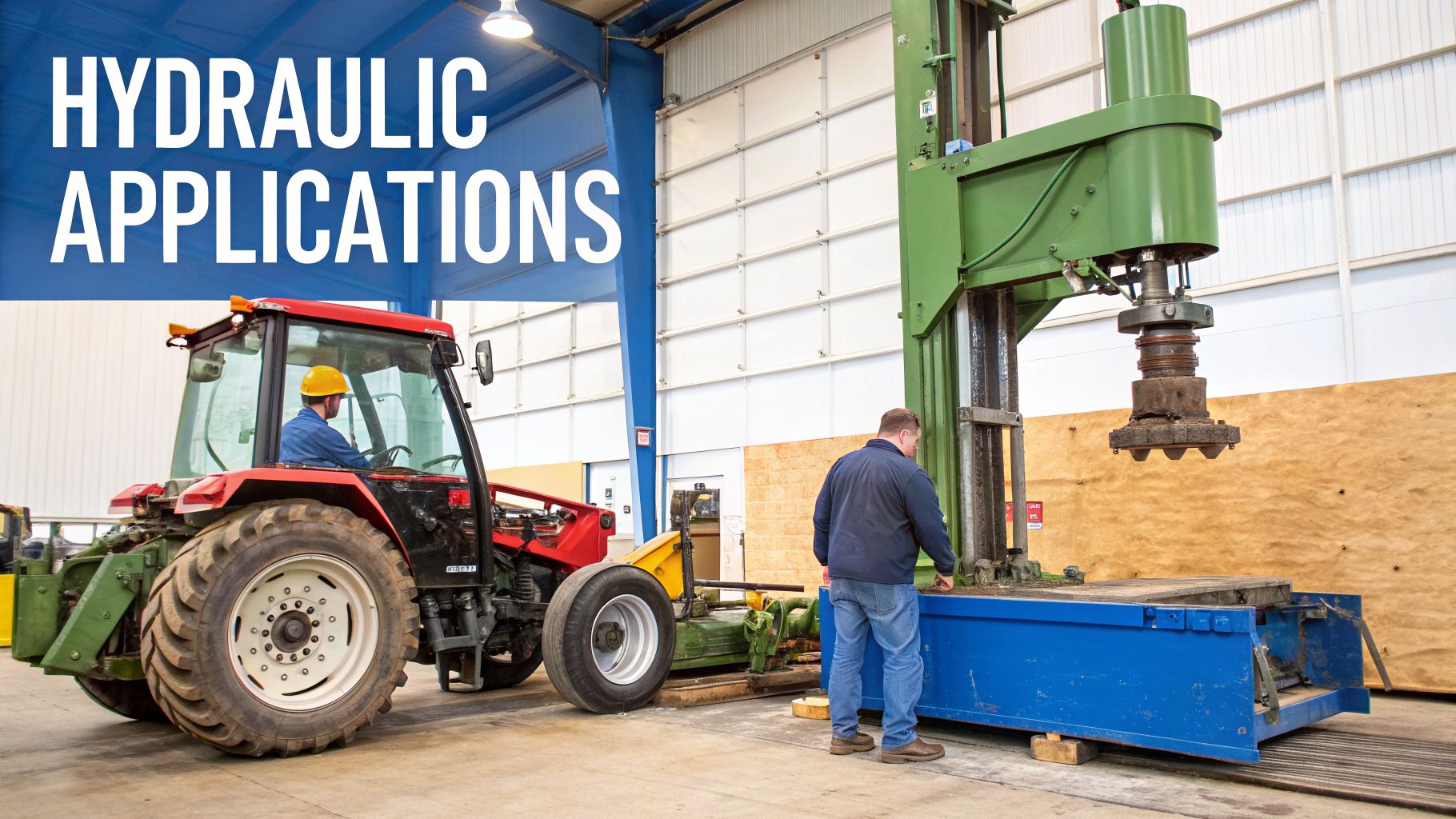
It doesn't matter if you're looking at a compact Hydronit mini power pack on a tipper trailer or a colossal press stamping steel in a Sheffield factory. The same fundamental principle, P = F/A, is always at play. It’s the practical knowledge that connects a rich history of British engineering to the reliable components we supply here at MA Hydraulics.
From Victorian London To Modern Machinery
This reliance on hydraulics has incredibly deep roots in the UK. Think back to Victorian London. In 1882, the London Hydraulic Power Company used these very same calculations to engineer something revolutionary: a city-wide power network.
They pumped water at a steady 700 pounds per square inch (psi)—about 48.3 bar—through 150 miles of underground mains. This network powered everything from dockyard cranes to hotel lifts, all based on a solid understanding of force and pressure.
That same logic applies directly to today’s equipment. When a farmer lifts a heavy cultivator with their tractor, the hydraulic system's success hinges on a correct pressure calculation. Get it wrong, and you could end up with a system that’s underpowered, sluggish, or even dangerously overloaded.
This shows that knowing how pressure is calculated isn't just a 'nice to have'—it's a core competency. It’s the bridge between a component’s data sheet and its actual performance on a construction site or factory floor.
For instance, when designing a new hydraulic circuit, an engineer must first calculate the maximum pressure needed to shift the heaviest load. This single number determines the required specification for every part in that system, from the pump right down to the hoses and fittings.
Most importantly, that calculation dictates the setting for the machine's primary safety device. Our guide on hydraulic pressure relief valves details how these crucial components are set to that maximum pressure, acting as a guardian against destructive pressure spikes. It's the ultimate practical application of a theoretical calculation, preventing catastrophic failures and protecting operators.
For expert advice on applying these principles to your specific hydraulic needs, phone 01724 279508 today, or send us a message.
Get Expert Help With Your Hydraulic Calculations
The formulas for calculating pressure might look simple on paper, but turning those numbers into a reliable, real-world hydraulic system is a completely different challenge. It's one thing to know the theory; it's another to confidently select the right pumps, motors, and valves that will perform under pressure, day in and day out.
This is where the true performance and longevity of your machinery are decided. It's also where our hands-on experience can make all the difference.
At MA Hydraulics, we live and breathe these principles. Every day, we're helping clients across the UK choose the right components, designing bespoke hydraulic power packs from the ground up, and troubleshooting complex system faults. Our entire focus is on making sure the parts you get from us are a perfect match for your machine's pressure and flow demands.
Getting the specifications right means you're building a system that runs at peak efficiency, wastes less energy, and enjoys a much longer service life. We can help you bridge the gap between theory and a practical, high-performing hydraulic solution. Don't leave the performance and safety of your system to guesswork.
For expert advice on hydraulic calculations and selecting components that fit your exact needs, give us a call today on 01724 279508, or send us a message through our contact form.
Answering Your Key Questions on Pressure Calculation
Let's dive into some of the questions we hear all the time from technicians, engineers, and even procurement managers. Getting these fundamentals right is the key to understanding any hydraulic system.
What’s the Real Difference Between Pressure and Force?
This is probably the most crucial distinction to grasp. It's easy to mix them up, but they are fundamentally different things.
Force is the total push or pull being applied. Think of it as the total might of a hydraulic cylinder trying to move something. We measure this in Newtons (N).
Pressure, on the other hand, is how concentrated that force is. It’s the force divided by the area it's pushing on, giving you an intensity measured in bar or Pascals.
Here’s a simple way to think about it: imagine being pushed by someone’s flat, open palm. Now, imagine being pushed with the exact same amount of effort, but through the point of a needle. The force is identical, but the tiny area of the needle tip creates immense, piercing pressure. That’s the difference.
Why Do We Use Bar Instead of PSI in the UK?
You'll see 'bar' used almost exclusively in modern hydraulics across the UK and Europe, and for good reason. Bar is the go-to metric unit for pressure here.
It fits perfectly into the SI unit system, with 1 bar being a clean 100,000 Pascals (Pa). This standardisation makes life much easier for engineers, ensuring specifications for components are consistent and clear.
While you’ll definitely still stumble across PSI (Pounds per Square Inch) on American-made components or older equipment, 'bar' is the language of today's European industry. It simplifies everything from choosing the right part to performing critical safety checks.
A quick but vital side note: pressure and flow are not the same. It's a common point of confusion. Pressure is the force that allows work to be done, while flow rate (in litres per minute) is the speed at which that work happens. A high-pressure, low-flow system moves slowly but with tremendous strength.
How Do I Figure Out Force if I Know the Pressure and Area?
This is a calculation you'll use constantly in the real world. It's just a simple rearrangement of the main formula we’ve already covered.
If you remember that Pressure = Force / Area, then a little bit of basic algebra gives you the answer. To find the force, you just multiply the pressure by the area:
- Force = Pressure × Area
This is incredibly useful for working out the true capability of a hydraulic ram or motor. If you know its operating pressure and the piston dimensions, you can calculate precisely how much work your machine can actually perform.
If you need an expert hand to apply these calculations to your own machinery, get in touch with MA Hydraulics. Phone 01724 279508 today, or send us a message.
