
You're often asked to size a system around the headline number. Motor power, pump flow, inverter rating, battery kW, pressure rating. On paper, it all looks adequate. Then the machine has to hold, clamp, lift, steer, or ride through a supply interruption for longer than the stored energy can support, and the design falls short in service.
That mistake turns up in both electrical and hydraulic work. An engineer specifies enough power, but not enough energy storage capacity. The system can respond sharply for a moment, yet it can't sustain the duty. In hydraulics, that usually shows up as pressure sag, poor repeatability, overworked pumps, or an accumulator that looks correct by nominal volume but delivers far less usable oil than expected once pre-charge and pressure band are accounted for.
The useful way to think about storage is simple. Ask two separate questions. First, how fast must the system deliver energy? Second, how long must it keep delivering it? If those aren't answered together, component selection becomes guesswork.
Why Storage Capacity Is More Than Just a Number
A storage asset only helps if it can discharge at the right rate and for the required duration. That sounds obvious, but a lot of specifications still fixate on the top-line power figure and treat capacity as a secondary detail.
At grid level, that's a live issue in the UK. The harder question isn't only how much storage is installed, but how much usable storage remains after duration limits, losses, and difficult operating conditions. The debate is increasingly about capacity adequacy rather than simple installed MW, because storage only supports shortages if it can discharge long enough and at the right time, as discussed in this capacity adequacy perspective from NREL.
That same engineering problem appears in hydraulic systems every day.
Installed capacity and usable capacity aren't the same
A battery nameplate tells you one thing. The duty cycle tells you another. The same applies to an accumulator. A nominal shell volume doesn't equal the oil volume you can genuinely use within the machine's operating pressure window.
Three practical losses usually sit between the brochure and the machine:
- Pressure window limits. In hydraulics, you can't normally drain an accumulator from maximum system pressure down to zero. The circuit stops being useful well before that point.
- Conversion losses. Electrical systems lose energy through power electronics and charge-discharge inefficiencies. Hydraulic systems lose it through compression behaviour, heat, throttling and leakage.
- Operating condition penalties. Winter peaks on the grid and cold-start conditions on mobile machinery both expose the difference between theoretical and usable storage.
More storage on paper doesn't automatically mean more resilience in service.
Why new engineers get caught out
The trap is usually set by a specification sheet that mixes power and energy in a way that looks complete. A pump might supply the required flow. A motor might meet the torque demand. A battery may have enough kW. An accumulator may have enough vessel volume. But the machine duty often depends on what happens over time.
Use these questions before you lock any design:
- What is the actual discharge period? Seconds, minutes, or hours.
- What operating band is acceptable? Minimum voltage, minimum pressure, minimum actuator speed.
- What remains usable under worst conditions? Not ideal workshop conditions, but real operating duty.
- What happens at end of life? Capacity fade matters long before a component has physically failed.
A system that meets the first second of demand but misses the next thirty is undersized, however impressive the headline rating looks.
Defining Energy Storage Capacity
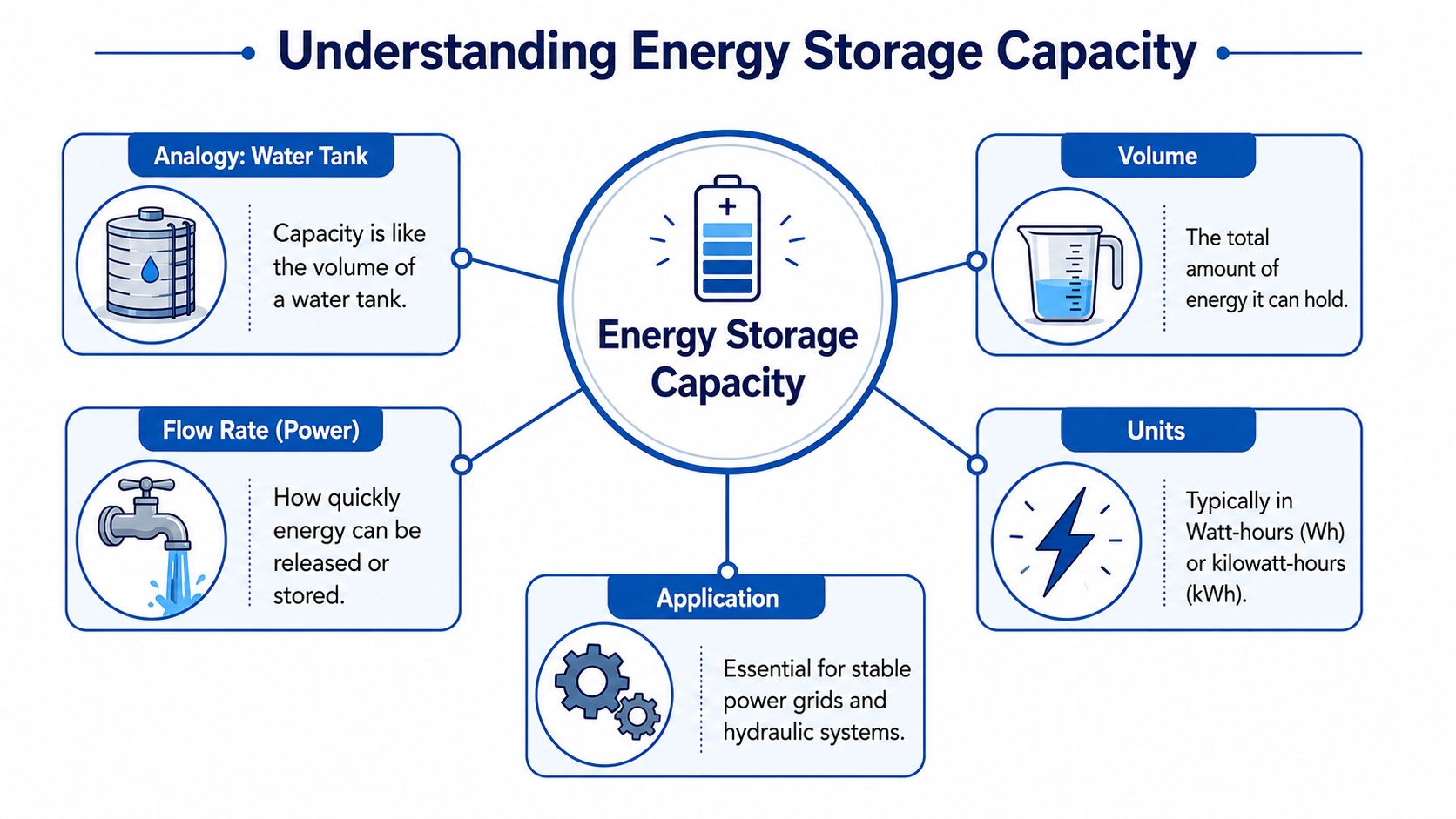
The cleanest analogy is a water tank. Capacity is the amount of water the tank can hold. Power is how quickly you can let that water out through a pipe. A large tank with a small outlet holds plenty but can't respond quickly. A small tank with a huge outlet responds hard, but empties fast.
Electrical storage works the same way. In battery energy storage systems, energy capacity is typically expressed in kWh or MWh, while power rating is stated in kW or MW. A practical industry benchmark treats a battery as reaching end of life when usable capacity has degraded to 80% of original nominal capacity, which matters directly to lifecycle economics and design margins, as set out in this BESS technical specifications guide.
The units engineers actually use
You'll see several units across datasheets and design notes:
| Term | What it means | Typical use |
|---|---|---|
| Wh | Watt-hour, a unit of stored energy | Small batteries, electronics |
| kWh | Kilowatt-hour | Backup systems, site storage |
| MWh | Megawatt-hour | Utility-scale projects |
| kW / MW | Rate of delivery, not stored amount | Inverters, discharge capability |
For a new design engineer, the key distinction is this: power tells you how hard the system can push, capacity tells you how long it can keep pushing.
Nominal capacity isn't the same as working capacity
In practice, nobody designs around the most flattering number on the datasheet. You design around what remains available through the intended operating life.
That matters because storage degrades, and because controls usually limit the usable window for reliability and safety. A battery may still function after its useful life threshold, but if it has dropped to the recognised 80% of original nominal capacity, the operating margin has changed. Your reserve time changes with it.
Practical rule: Treat nominal capacity as the starting point for calculations, not the final answer for component selection.
The same mindset carries straight into fluid power. A hydraulic engineer who ignores usable volume makes the same mistake as an electrical engineer who ignores usable kWh.
How to Calculate Storage Capacity
Most first-pass sizing starts with two numbers. The load, and the time that load must be supported. If those are unclear, no formula will save the design.
For electrical storage, the basic relationship is straightforward:
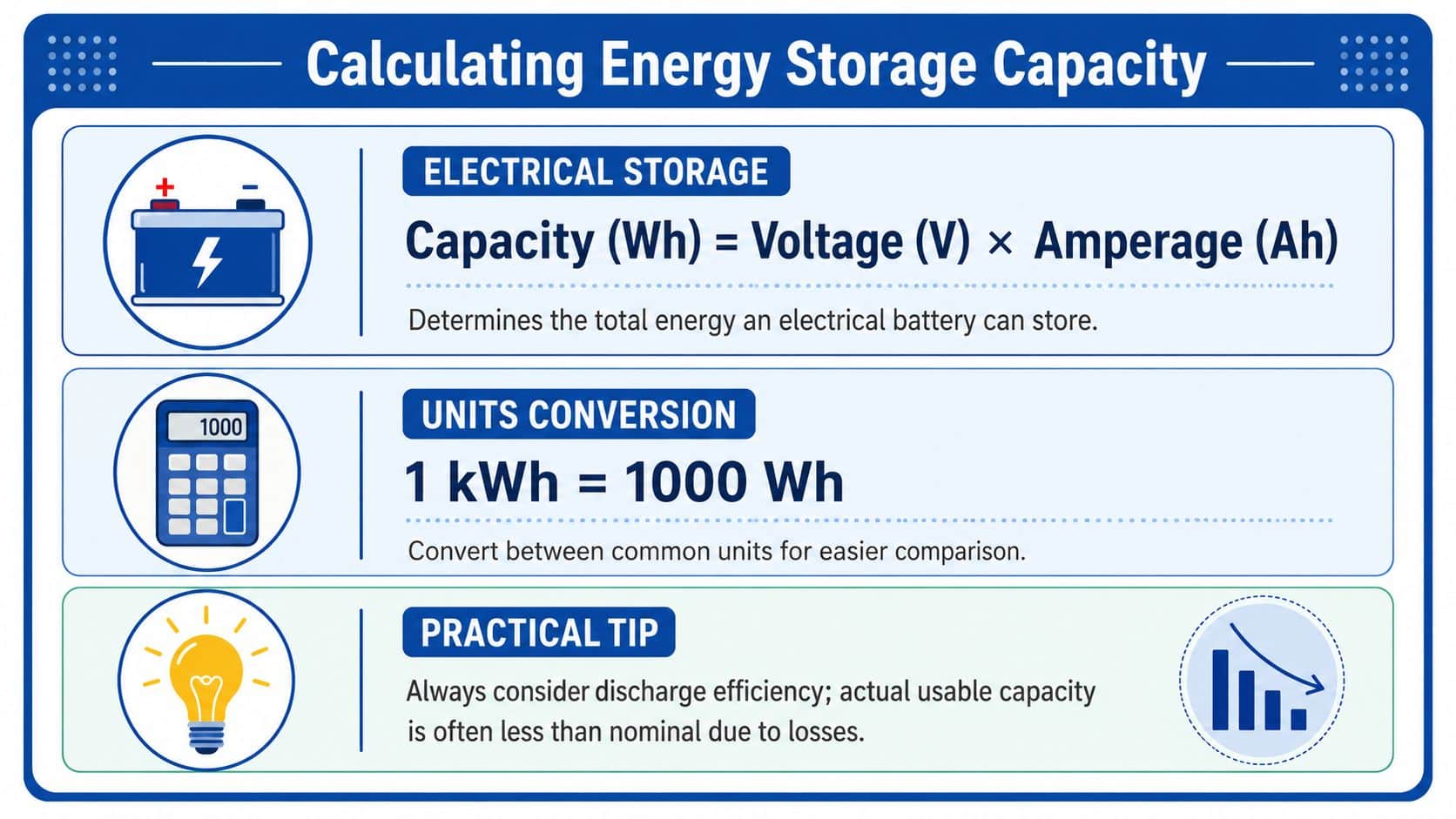
- Capacity (Wh) = Voltage (V) × Amperage (Ah)
- Energy required (Wh) = Load power (W) × Time (h)
- 1 kWh = 1000 Wh
A simple worked method
Suppose you need backup for a small monitoring device and control circuit. Start with the running load in watts, then multiply by the required support time in hours. That gives the ideal energy figure in Wh.
Then check three things before selecting a battery:
- Usable window. The full nominal figure may not be available in service.
- Discharge rate. A battery that stores enough energy may still be unable to deliver the required instantaneous power.
- Design margin. Leave room for ageing, temperature effects and non-ideal duty.
If you then want amp-hours, divide the required Wh by system voltage.
The same discipline applies in hydraulics
Hydraulic engineers often perform the equivalent calculation in terms of pressure, flow and time. If an actuator needs a certain flow for a certain duration, the stored oil volume has to cover that duty within the allowed pressure drop.
That's why pressure calculations matter so much during early sizing. If you need a refresher on the core relationship, MA Hydraulics has a useful note on how hydraulic pressure is calculated.
A practical workflow looks like this:
- Define the duty. Holding, emergency lowering, clamp support, shock absorption, peak flow support.
- Quantify the demand. Electrical load in W and hours, or hydraulic flow in litres per minute and seconds.
- Convert to stored energy or stored fluid requirement.
- Apply real-world correction. Usable capacity, pressure band, losses, ageing.
- Select the component around duty, not brochure maximums.
If the backup requirement is vague, the storage calculation will be vague as well. Tight specifications start with a clear duty profile.
Applying Capacity Concepts to Hydraulic Systems
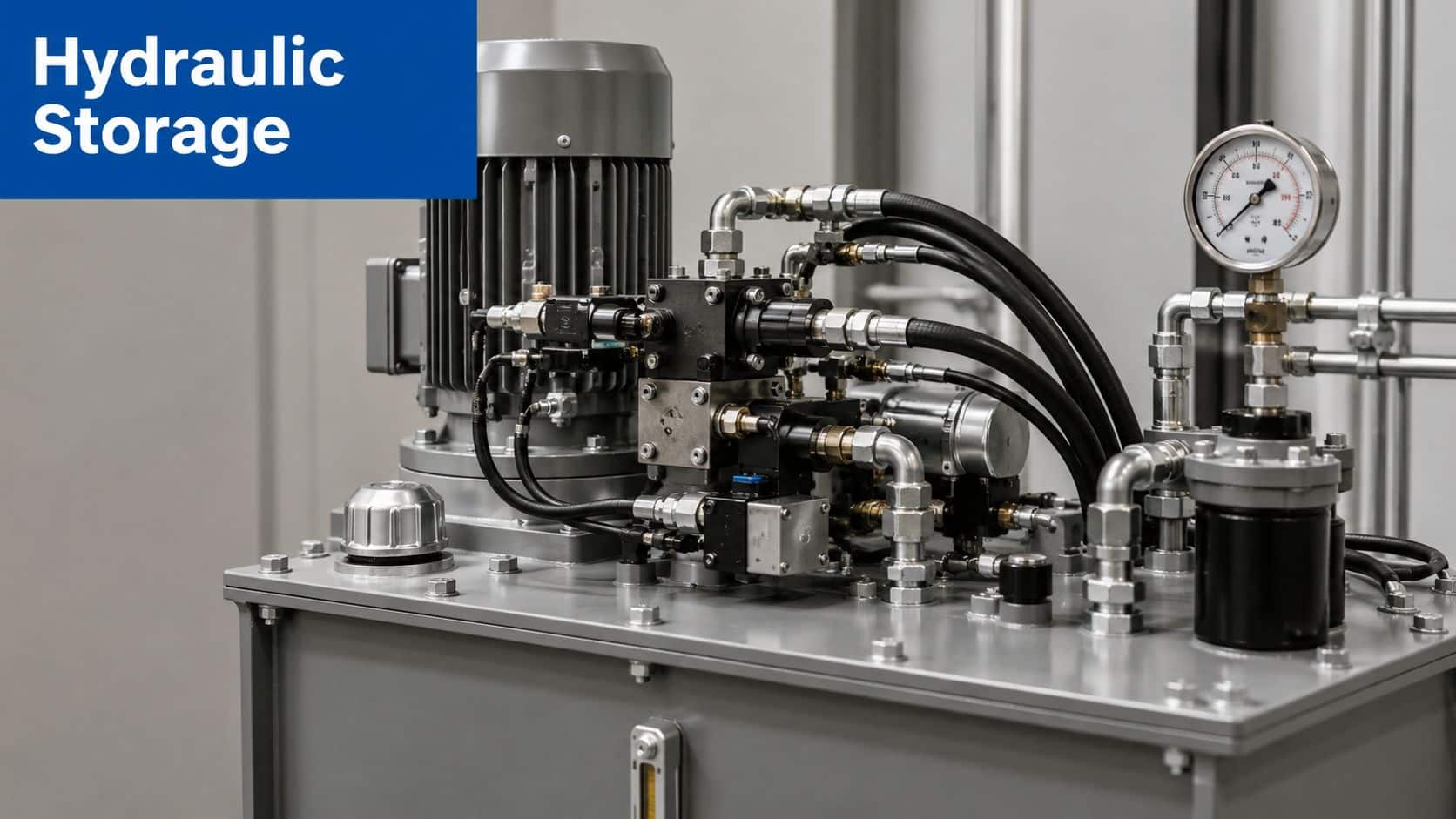
A hydraulic accumulator is an energy storage device. It just stores energy differently from a battery. Instead of chemical potential, it stores energy in compressed gas and returns that energy by pushing hydraulic fluid back into the circuit.
That distinction matters because many engineers new to fluid power focus on pump flow and system pressure, then treat the accumulator as an accessory. It isn't. In the right circuit, it is the storage element that makes the machine behave properly during transient demand.
What capacity means in an accumulator
With batteries, you usually think in Wh or kWh. With accumulators, you think in gas volume, fluid volume, pressure range and discharge behaviour.
The basic gas law relationship commonly used for first principles is:
- P1V1 = P2V2
That is Boyle's Law. For accumulator work, it gives you a way to understand how changing pressure changes gas volume, and therefore how much hydraulic fluid can be accepted or delivered across a pressure band.
The important practical point is this. The accumulator's shell size is not the same as the usable oil delivery. Usable delivery depends on:
- Pre-charge pressure
- Maximum system pressure
- Minimum acceptable working pressure
- The discharge event itself
Where engineers usually oversimplify
A common error is selecting accumulator size by nominal vessel volume alone. That's a poor shortcut because two accumulators with the same shell volume can deliver very different usable oil volumes once pre-charge and working pressures are set.
For example, an emergency function may need enough stored oil to complete a valve shift or lower a load after power loss. A damping function may need very rapid exchange of a relatively small oil volume. A pump-assist function may need repeated short bursts. Those aren't the same job, so they shouldn't be sized the same way.
If you're working through those parameters in detail, this hydraulic accumulator sizing guide is the right technical reference point.
Translate electrical thinking into hydraulic thinking
The easiest bridge for a new engineer is to map the concepts directly:
| Electrical storage concept | Hydraulic equivalent |
|---|---|
| Voltage | Pressure |
| Current | Flow |
| Energy capacity | Usable stored fluid energy across a pressure band |
| Power rating | How quickly the circuit can deliver flow at pressure |
| End-of-life margin | Pressure and delivery margin over service life |
That mapping is why power packs and accumulators must be specified together in many applications. A pump and motor provide ongoing power. The accumulator provides stored energy for sudden demand, temporary hold, emergency movement, or smoothing a duty that would otherwise force oversizing of the prime mover.
A bespoke hydraulic power pack from a supplier such as MA Hydraulics Ltd can therefore be sized around the duty cycle rather than only the peak event, with the accumulator handling short transients and reserve functions.
Here's a useful visual overview of accumulator basics and operation before finalising a design:
In hydraulics, stored energy is only valuable if the circuit can release it within the pressure band where the machine still does useful work.
Comparing Energy Storage Technologies
Different storage technologies solve different problems. Engineers run into trouble when they compare them as if one metric decides everything.
In the UK, pumped storage hydro remains the largest source of grid-scale storage capacity. A clear historical benchmark is the Dinorwig power station in Wales, commissioned in 1984 with an installed generating capacity of about 1,728 MW, as summarised in this energy storage overview. By contrast, the modern UK storage mix increasingly includes batteries, with roughly 5.3 GW of grid-scale battery storage capacity operating in 2024, according to this clean energy storage fact summary.
Those figures tell you something important. Storage isn't one technology race. It's a set of tools with different strengths.
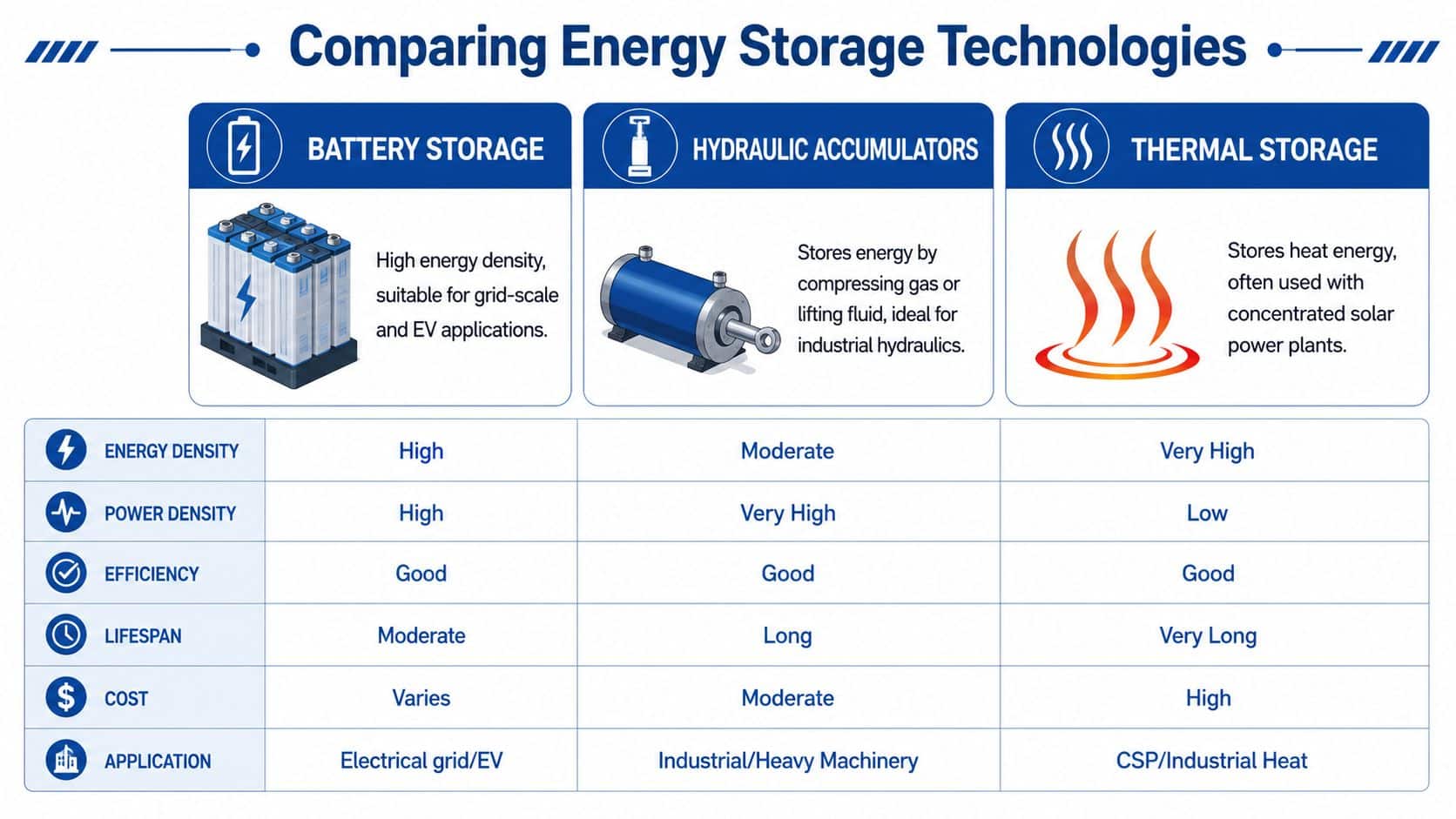
Side-by-side engineering comparison
| Technology | Best at | Typical strength | Main limitation |
|---|---|---|---|
| Battery storage | Fast electrical balancing and short-duration support | Flexible, quick deployment, strong control response | Duration must be checked carefully against duty |
| Pumped storage hydro | Bulk grid storage and system balancing | Large-scale storage with established grid role | Large civil infrastructure requirement |
| Hydraulic accumulators | Machine-level burst power and reserve hydraulic energy | Very fast response inside hydraulic circuits | Limited by pressure band and usable fluid volume |
What works well and what doesn't
Battery storage works well when the system needs fast response, repeated cycling and compact installation. It doesn't work well when engineers assume all MW are equally valuable regardless of duration.
Pumped hydro works well where the system needs very large-scale stored energy and rapid grid support from established infrastructure. It doesn't suit machine-scale industrial applications because the physical works are the whole point of the technology.
Hydraulic accumulators work well when a machine needs instantaneous hydraulic support. Think pulsation damping, emergency operation, leakage compensation, or short bursts of flow that would otherwise force a larger pump and motor. They don't work well when someone expects them to replace continuous hydraulic power over long periods.
If your work spans distributed energy systems as well as machinery, this external perspective on Connect VPP insights on solar batteries is useful because it frames battery selection around real operating roles rather than marketing labels.
Matching the technology to the duty
A good selection process starts with the problem, not the technology:
- Grid balancing over large system events often points towards bulk storage or coordinated battery fleets.
- Industrial backup and electrical ride-through often points towards batteries.
- Presses, mobile plant, clamping, shock loads and emergency hydraulic movements often point towards accumulators.
The right storage choice isn't the one with the best headline specification. It's the one whose delivery profile matches the duty.
Specification and Safety Considerations for Engineers
Good sizing isn't finished when the arithmetic works. Real specification lives in the details that affect usable capacity, service life, and failure behaviour.
At electricity-system level, future demand makes that especially clear. National Grid ESO's Future Energy Scenarios have projected a 24 GW to 29 GW requirement for battery storage by 2035 to support flexibility, and the engineering implication is explicit: specifying storage by MW alone is incomplete, because duration in MWh must be sized against dispatch need, as explained in this utility-scale storage discussion referencing National Grid ESO projections.
That same logic belongs in machine design.
The specification points that change outcomes
When reviewing any storage component, check these before issuing a purchase decision:
- Depth of usable discharge. Don't assume the whole nominal store is available in normal operation.
- Discharge rate. Storage may hold enough energy but still fail to deliver it quickly enough.
- Temperature behaviour. Cold starts, outdoor installations and enclosed plant rooms all change performance.
- Ageing allowance. If the component degrades in service, your reserve margin shrinks.
- Control strategy. Poor sequencing can make a correctly sized storage device behave like an undersized one.
Safety isn't a paperwork exercise
High-energy systems fail hard. Batteries bring thermal and electrical hazards. Accumulators store compressed energy even when the machine appears shut down. That means the specification must include isolation, pressure relief, discharge procedures, guarding, and maintenance access from the beginning.
For hydraulic assemblies, compliance checks should be built into the design review rather than added later. MA Hydraulics outlines that broader process in its guidance on compliance verification for hydraulic systems.
A safe storage system is one that remains predictable during fault conditions, not just during normal duty.
Future-proofing without overspending
Engineers often overcorrect after one bad project and oversize everything. That isn't good practice either. Better work comes from understanding load profile, reserve requirement, and acceptable degradation, then selecting the smallest system that still performs reliably under worst-case duty.
It's also worth keeping an eye on alternatives outside the usual battery-versus-hydraulics conversation. For broader context on long-duration concepts, these cryogenic market insights are worth reading because they show how other storage approaches are being positioned around duration and system flexibility.
Making the Right Capacity Choice for Your System
The right answer nearly always comes from pairing power and capacity properly. If you only specify flow, pressure, kW or MW, you're only solving half the problem. The other half is duration, usable reserve, and what remains available when the system is no longer new.
For practical design work, keep the sequence tight. Define the duty. Identify the minimum acceptable performance point. Calculate the stored energy or stored fluid volume needed across that window. Then apply margins for losses, ageing, controls and safety.
That approach works whether you're choosing a battery for backup power, an accumulator for emergency movement, or a power pack for cyclic industrial duty. If you want another example of how battery sizing is framed around real-world use cases, this HighFlow guide for QLD battery sizing is a helpful external comparison.
When the storage element is matched to the actual duty, the whole system gets easier to control, easier to protect, and more reliable in service.
For expert advice from MA Hydraulics Ltd on specifying hydraulic accumulators, power packs, and related components for your application, phone 01724 279508 today, or send us a message.
